Shia and Sunni Iraqi clerics were in Mecca last night to sign a document (or decree or treaty or whatever its name is!).
In my opinion choosing Mecca was not only for religious or spiritual reasons, actually I tend to believe that Saudi Arabia offered to host the meeting with such enthusiasm only to improve its image and change the general impression about it so that it's viewed as a country that supports peace and tolerance instead of a country that breeds extremism.
What the clerics agreed upon in that paper was no more than the fundamental fact and the first (or second) commandment in all religions; that is "murder is wrong".
How absurd and demeaning is that! As if they had to go to Holy Mecca to realize that murder is a crime. And as if they were admitting that until last night each sect's clerics didn't consider it a crime to murder someone from a different sect. Frankly I suspect there was never a time when they considered it a crime and I don't think signing that paper changed a thing.
With very rare exceptions, clerics are hypocrites who wear different faces for different times, situations and places, so all in all, I'm not expecting anything from that paper. Like Saudi Arabia, I think they went there and signed that paper also merely to improve their image and to pretend that they were/are not the ones to blame for the daily bloodshed in Iraq.
They want to satisfy their dead conscience and convince themselves that they had done their part of the job by signing that paper and that it's up to the people now to stop killing each other! As if it wasn't the militias they run and tensions they create that are causing the sectarian violence.
There's one other important point about the meeting that makes it rather impossible to expect it to make a difference on the ground; the two most vicious murderous factions that are responsible for most of the sectarian violence, i.e. al-Qaeda and Sadr's militia will not drop their weapons or stop their crimes just because some clerics signed a decree.
However, the document can possibly be of practical value only if it gets used in the right way; that is since the document alienates anyone who violates the points stated within, the MNF and the reluctant PM Maliki can take advantage of it and do what they have to do with people like Sadr who had long enjoyed unwritten immunity.
I mean if Sadr or certain Sunni groups refuse to abide by the articles of the decree and continue doing their daily dirty job then clerics and religious parties that signed the decree will have the pretext to stop the government or the MNF from taking action against them.
Still, this is just in theory.

New points of view about the future of Iraq and the Middle East.
Saturday, October 21, 2006

Thursday, October 19, 2006
Censorship and freedom of speech in Iraq: The Azzaman case.
Perhaps one of the hottest debates in the media community and its surroundings in Iraq these days is the one that was sparked by a controversial call from the speaker(s) of the parliament to the government to shut down al-Sharqiya channel.
The fury among the parliamentarians behind this call was apparently a reaction to the way the channel and its sister newspaper Azzaman covered and handled the story of the federalism law that was instated by the parliament last week.
Actually there was a particular report on Azzaman that went way far from objectivity and where the editor(s) obviously let the anger speak for them that they portrayed the MP's who turned the tide in that session as traitors who sold the country, blah blah blah.
I frankly do not like Al-Sharqiya channel nor I put much trust in Azzaman, or let's say I do not like its inclinations rather than its programs and reports, or at least some of them.
The channel and newspaper (both run by the same man Saad al-Bazzaz, once was the press advisor of Saddam) have a Baathist tone that is clear to the keen spectator/reader and it's one of those channels that are long time criticizers of America and the four Iraqi administrations that ruled the country since the fall of Saddam.
However, the channel has its admirable qualities as well. It now stands among the most popular Iraqi TV channels and it's the only secular one so to speak. It also gives entertainment a fair share of the broadcast time in contrast with most other channels that sound like a funeral house.
Anyway, I would not, by any means, support a campaign or a decision to silence this channel or its sister paper.
The diversity in voices and approaches is what makes today's Iraq different from what it used to be under a totalitarian regime and among the important forms of this diversity is that of media.
I was for the decision to put a ban on al-Jazeera a couple years ago because the damage al-Jazeera caused and poisons and provocations it spewed were so outrageous that made the ban sound very fair to me, but I was then against punishing al-Arabiya when the government ordered it to close its offices for a month.
Although al-Arabia is far from being perfectly objective, it hadn't done something that deserves a ban as a punishment.
Actually my greatest fear in this regard now is that this practice of arbitrary bans becomes systematic within the government and spreads to abolish the margin of freedom of speech we began to enjoy only three years ago.
Al-Sharqiya and Azzaman do spend most of their words and time on blaming America and the government or everything that went wrong in Iraq yet for a very long time they seemed to be rarely, if ever, willing to put some of the blame on the various factions of insurgents, and terrorists. Only recently they began to focus more on the atrocities committed by militias, especially Shia religious ones.
Al-Sharqiya and Azzaman do not support violence and this is something I admire in them, yet what I don't admire is that they tend to ignore the original sources of the violence that is sweeping large portions of our country.
Professor Cole wrote briefly about this and he wonders why the Communist Part and the Sadrists would defend Azzaman and al-Sharqiya (it's not al-Iraqiya Professor!).
I don't agree with Cole it's about posturing because I think the motives of the Sadrists are clear, first the ban was requested by the Sunni Islamist speaker of parliament Mashhadani, the National Iraqi List and the rival Shi SCIRI who both supported the vote and second because al-Sharqiya and Azzaman, like the Sadrists are both anti-American and anti-federalism.
On the other hand, it seems Mr. Cole didn't see clearly what the position of the Communist Party is regarding this issue. If you can read Arabic you will see, from the same Azzaman article that Cole referred to, that the Communist Part is clearly mad at al-Sharqiya and Azzaman but favors relatively more civilized measures in dealing with them. If I'm not mistaken, I read somewhere that the Communists want to sue Azzaman for what they published about the secretary general of the party, this can also be inferred from the same above link.
Perhaps what the editorial board of another Iraqi paper, al-Mada, wrote this morning presents the best understanding of the reasons why such conflicts between the government and the media keep happening.
Al-Mada reminded us and drew our attention to the fact that the press here does not have a functioning code of work ethics and that in general our press does not have clear lines to separate between reports and columns and opinion pieces.
In the same time, the executive and legislative authorities are yet to have the clear fair policy or the appropriate legislations that govern the way in which these authorities can deal with the press when they feel the press did something wrong.
I can say that both parties think and believe they were right in what they did and that their freedom grants them the right to do that but apparently they don’t realize that freedom without laws will be a mess.
Maybe it's time for both sides to start developing better standards of work and clear guidelines on how to coexist and do the service they are expected to do, and I hope this case motivates them to do so.
Wednesday, October 18, 2006
Me in the new Islamic State!
Nothing changed in my life as a Baghdadi since my city was announced a part of the Islamic State of al-Qaeda.
Of course I did not expect an improvement in electricity, security or other services but I was at least expecting a change in life style under the leadership of the new caliph Abu Omar al-Baghdadi (Abu who??).
I didn't see the women being forced to wear the chador nor did I see men switching to wear the official outfit of terror (the short dishdasha and the bushy dirty beard)!
And I did not see Mutawwa-like men carrying heavy sticks to beat people who break the laws of Sharia like we see in Saudi Arabia.
There's no ban on TV, sculptures, arts or wearing jeans!
I can notice even an increased presence of the government's security forces and I wonder how they could stay in Baghdad despite the declaration of the Islamic state!
Not only that, we did not see the policemen and soldiers executed in public as traitors and they were not even dismissed from service. On the contrary, their chief in the interior ministry is talking about reforms in the structure and force of the ministry and said he dismissed over 3,000 employees who were found not professional enough or not loyal enough to the county.
And the parliament still meets to agree or disagree and the PM still gives his statement through national TV and asks Bush whether he would be allowed to remain in office for another two months and Bush reassures him that he's an elected leader and will remain in office as long as the Iraqi people approve of his performance.
The Islamic State did not abolish the controversial federalism law that was instated after long debates and arguments, in fact it seems like it endorsed the law by announcing its own autonomous region in provinces that are supposed to be sympathetic r loyal to al-Qaeda despite the "lies" in the polls that say only 2% of Iraqis approve of al-Qaeda.
Offices and institutions did not change their regulations or functions and school curriculums are still the same and children go to schools by the millions against the will of the terrorists and n contrary to the press that claim no one can live here or practice any activity outside walls of their homes.
Yes of course living here is so tough beyond the imagination of many of outside spectators but this did not deter civil servants or students in their bulk from going on with their lives.
So what has changed then since the declaration?
Really, what was the cost or the effect on the ground other than the ink they used to print their announcement or the pennies they paid al-Jazeera to spread the news?!
To me it looks like the position of al-Qaeda has gotten so bad after the heavy blows it received at the hands of our liberators in the MNF and our brave brothers in our army and the patriots who rejected al-Qaeda and its agenda.
I think this was what forced those losers to make this meaningless announcement of a fake state. It reflects the undeniable desperation and the abandoning of their original ambitions, from a victory that drives away the Americans and the Iraqis who believed in the change to a pathetic maneuver such as this one.
But we are still here, at least the majority of us are,
Our liberators and allies are still here,
The voters are still here and the elected are still here.
The al-Qaeda is left with nothing but to fantasize about creating a caliph state as long as they still have a foothold in the country and hope that some locals would change their mind and side with them.
Ok fine, let them make their announcement but the indisputable fact remains that their state does not anywhere except for in their own sick minds.
Only two incidents can be counted among the amplifications of this move, the first was their failed assault against the offices of the local government in Mosul which left dozens of the assailants dead or arrested and the second was the attack in Salah Addin province that resulted in nothing but calls from the locals for further support from the government to assist them in abolishing the terror groups and in more reconciliation meetings between tribal leaders to forge unity against the takfiris.
There's no going back thirty years to the days of Saddam an there's no going back a thousand yeas to the days of the Caliphs.
It's over…
We have accepted the rough road and the outcome will not be in the benefit of the criminals. The war is tough, painful and hard but I have no doubt of the outcome that will mean the end for the supporters of tyranny and extremism.
Surrendering is much closer to them than it is to us and history will remember with pride those who sacrificed for the freedom of Iraq…
Maybe I will not live long to see that day but my children will certainly see it.
Sorry whiners, losers and pessimists. I only know to accept a challenge when I face one and I recognize only victory as an end.
Related comments from other Iraqi bloggers:
1-Al-Qaeda declares government, Islamic state in Iraq.
2-The Islamic state in Iraq!
Sunday, October 15, 2006
There are heroes, and there are criminals. The two never equate as victims.
There is one video I wish I can find on the web. It's a short video that was shown on al-Iraqiya last Friday evening and was replayed several times that night.
Until I can find a way to get a copy of the video and put it up I will try to share with you a description of what I saw…
It's about a police station somewhere in Iraq, the place was about to be hit by a suicide bomber riding a vehicle laden with explosives.
The driver approaches the entrance to the station which is surrounded by concrete walls. Several police officers open fire from their ak-47's on the incoming suicide bomber but he keeps closing in.
As the vehicle passes through the gate and past the last barricade all of the officers run away seeking shelter…except for one extraordinary man.
One police officer held his position and was still standing in the way of the terrorist and kept on firing his rifle at the windshield until the vehicle was just meters from the officer, then…BOOM.
End of video….
I watched the video over and over again and my amazement grew with every time I watched it…this is incredible…this is heroic…this is happening.
2 dead, (n) injured in a car bomb. That's what we would read in the news next day and then someone would come to make a body count and make a study about the human cost of the war and list the two men from the two extremes of this conflict, both as victims of the war!
So the policeman is a victim and the bomber too is a victim?…it sounds so cruel and unfair. A man who died to save his colleagues and a beast who killed himself to kill others cannot and must not be both counted as victims.
One is an anti-life criminal while the other is a hero, but on paper, some idiots describe them both as victims of the war.
Who knows?! Maybe there are some other idiots who count the 4,000 foreign terrorists whom al-Qaeda confessed were killed in Iraq as victims too!
Thursday, October 12, 2006
Responding to the Lancet lies...
Pajamas invited us to respond to a study full of lies made by Burnham, of the Johns Hopkins Bloomberg School of Public Health that claimed 665,000 Iraqis were killed since 2003. The disgraceful study is expected to be published on the website of The Lancet, a medical journal today.
The response was published last night on Pajamas, and here it is now in case you missed it.
******
Among the things I cannot accept is exploiting the suffering of people to make gains that are not the least related to easing the suffering of those people. I’m talking here about those researchers who used the transparency and open doors of the new Iraq to come and count the drops of blood we shed.
Human flesh is abundant and all they have to do is call this hospital or that office to get the count of casualties, even more they can knock on doors and ask us one by one and we would answer because we’ve got nothing to be ashamed of.
We believe in what we’re struggling for and we are proud of our sacrifices.
I wonder if that research team was willing to go to North Korea or Libya and I think they wouldn’t have the guts to dare ask Saddam to let them in and investigate deaths under his regime.
No, they would’ve shit their pants the moment they set foot in Iraq and they would find themselves surrounded by the Mukhabarat men counting their breaths. However, maybe they would have the chance to receive a gift from the tyrant in exchange for painting a rosy picture about his rule.
They shamelessly made an auction of our blood, and it didn’t make a difference if the blood was shed by a bomb or a bullet or a heart attack because the bigger the count the more useful it becomes to attack this or that policy in a political race and the more useful it becomes in cheerleading for murderous tyrannical regimes.
When the statistics announced by hospitals and military here, or even by the UN, did not satisfy their lust for more deaths, they resorted to mathematics to get a fake number that satisfies their sadistic urges.
When I read the report I can only feel apathy and inhumanity from those who did the count towards the victims and towards our suffering as a whole. I can tell they were so pleased when the equations their twisted minds designed led to those numbers and nothing can convince me that they did their so called research out of compassion or care.
To me their motives are clear, all they want is to prove that our struggle for freedom was the wrong thing to do. And they shamelessly use lies to do this…when they did not find the death they wanted to see on the ground, they faked it on paper! They disgust me…
This fake research is an insult to every man, woman and child who lost their lives.
Behind every drop of blood is a noble story of sacrifice for a just cause that is struggling for living safe in freedom and prosperity.
Let those fools know that nothing will stop us from walking this road and nothing will stop our friends and allies from helping us reach safe shores. There’s simply no going back even if it cost us more and their fake statistics will not frighten us…our sacrifices, like I said, make us proud because our bloods are not digits in those ugly papers. Our sacrifices are paving the way for future generations to live the better life we couldn’t live.
Tuesday, October 10, 2006
Massive explosions rock Baghdad!
Over the past 90 minutes or so, massive explosions could be heard in Baghdad and actually I'm hearing more of them while I'm typing.
When the first few bangs happened I thought they were just the usual dose of mortars for the night but more and more explosion kept happening!
I went up to the roof to see if anything could be seen from there and I was able to see several flashes coming from the south, south-west side of the city.
Using the simple method of measuring the lag between seeing the flash and hearing the sound I figured out the explosions are taking place somewhere in the area between Karrada and Dora, yet the explosions are very loud that they can be heard in the northern parts of Baghdad!
I'm searching the news for a clue about what's going on but I found nothing so far.
Update (12:35 am):
First news report on the situation is just in.
Reuters says the explosions were caused by a fire that broke out at "an ammunition dump at a U.S. base in southern Baghdad" apparently in the Dora district of Baghdad.
And yes, explosions can still be heard as of now.
Update (1:00 am):
It's been two hours since the first explosions were heard but I still hear more of them.
Right now I can hear several explosions a minute but they got milder than they were in the beginning, i.e. they are fairly loud but they no longer make doors and window shields shake in a 10 mile radius!
I can only imagine what it's been like over there and I can only pray that it did not cause casualties among US military or Iraqi civilians living nearby.
Update (2:20 am):
Less and less explosions can be heard now, I can say the frequency now is at about one every 5-10 minutes instead of 5-10 seconds, so I assume soon there will be no more explosions to hear.
I hope I'm right about my assumption because I really need to have a few hours of uninterrupted sleep...
Monday, October 09, 2006
On this and that...
This blog was not updated since Thursday and I personally did not write anything since last Monday and this really sucks.
I start to get this weird itchy feeling when I don’t write for some time, so here I am now in my pajamas trying to write mostly for the sake of writing, so unless you are as bored as I am and have 5 minutes to waste I do not recommend you go on and read more of this post. I'm sure you can find something more interesting than this.
Call it the week in review, call it a rambling…to me it's just my fix of blogging.
There were no big news from Iraq in the past few days…well, maybe there were some but they aren't considered big news for us anymore. You know, when today's headlines are almost the same as yesterday's and those of the day before you begin to lose interest in them and you just read them apathetically to stay in the loop.
Anyway, let’s take a look at some of the recent bigger stories. First there were the clashes in Diwaniya which can be seen as relatively good news since the operations led to the arrest of a vicious criminal who ordered the slaughter of a dozen Iraqi soldiers who ran out of ammunition during previous clashes back in August.
The funny thing is that Sadrists say it was not them who clashed with the raiding force and insist it was the residents of Diwaniya who did! Yeah sure, civilian residents organized 10 RPG teams out of the blue to attack that Abrams tank and defend the militia lieutenant! Ironically even the rival Badr leader Hadi al-Amiri insists it wasn't the Mehdi militia.
The IA and US army say it was Sadr's militia, the international media says so too and people in Iraq and especially in Diwanaiya know that too…Do they want us to buy their claims that such organized and heavily armed groups can find a place and act independently against the government and the MNF in provinces where the Sadrists and other politico-religious factions virtually control everything?
So who are they trying to fool? I have no idea!
Before that were the news about the national police brigade that was dismantled or sent for retraining after ties were discovered between the brigade's ranks and death squad activities. Some think this was a good first step but many still think many more similar decisions (and more radical ones) are needed because the defect seems to be systematic.
Today the brother of vice president Tariq al-Hashimi was assassinated (al-Hashimi lost another brother and a sister earlier this year in similar attacks) and I saw news reports indicating that gunmen in uniforms came in 10 official-looking vehicles and assassinated the man in a neighborhood that is supposed to be the jurisdictions of the IA, not the national police.
This raises concerns about the efficiency of the IA in this part of the capital which was the scene of heavy clashes last week, and of course suggests other national police units are likely still carrying out illegal operations.
Then there's the talk about the Iraq study group's possible recommendation to turn Iraq into three autonomous regions.
We talked about this some time ago and said that this would be very unlikely because supporters of federalism make up hardly a half of Iraq's parliament, so they have a rather poor chance at passing a legislation that gives too much power to the regional authorities at the expense of the central government.
I think also tough Sunni opposition for putting federalism into action and the strong rivalries among Shia parties, who are divided over this issue, will slow down if not kill the project.
However, a change in the political map in Iraq can change the equation in a way that allows federalism to be implemented, but that change would have to be dramatic, i.e. federalism in the form of three highly autonomous regions can only see the light under a parliament other than the one we have now.
This leads me to the other ambiguous headline I read yesterday about the American administration setting a deadline for Maliki's government to fix up things in Iraq, particularly in Baghdad.
I must say that I feel there IS some kind of deadline because this is not the first time we hear of this sort of things.
If I'm not mistaken, a few weeks back in September Lee Hamilton from the Iraqi study group did say that Maliki's government has got three months to improve security and restore basic services in Baghdad and now, almost a month after that, ambassador Khalilzad says that the time is down to two months, and this makes me think the clock is already ticking.
But it remains very difficult at this point to predict what the administration in D.C had planned for when the deadline is due; is it just a warning shot for Maliki to motivate him to work harder and make the tough decisions the US wants him to make regarding issues like disbanding militias?
Or if there are plans for "critical action" as Khalilzad said, what kind of action would that be, military or political, or both? And how "critical" would that action be?
We can only speculate at this point, some people here suspect America will start to disengage from Iraq if things remain as bad as they are by the end of the year while others believe the exact opposite is going to happen and think America will push forward with even more power and launch a wide and relentless military campaign that might even target political factions that are part of the current government.
Meanwhile and far away from Baghdad, our old friend from the axis of evil tested his first nuke.
I read on the news that the power of the explosion was little more than half a kiloton which sounds like a very small device compared to the multi-megaton devices owned by the US or Russia but I'm very interested to know the dimensions and mass of the device and I hope experts and intelligence can reveal some information about that because the smaller the device the easier it becomes to transport and deploy it.
I can't believe the world leaders let this happen! Now the world is under the mercy of a crazy man and his oppressive communist regime who wanted the bomb so badly that they let their people starve in this crazy pursuit for power.
What's going to be next? Will the world move to disarm North Korea? Will there be measures to stop it from sharing the bomb with terrorists?
I don't even want to think of it because looking at how our world works today I can see headlines coming two or three years from now telling us that Iran tested a bomb…well I think we'll be lucky if we got to read the news instead of being part of it.
Thursday, October 05, 2006
America's sin...Hesitation.
In the last post we talked about the biggest mistakes of Iraqi leaders and politicians and today I'm going to talk about America's mistakes. I chose this order for my thoughts because Iraqis with their mistakes contributed more to the current problems in Iraq than America did.
America too had her share of mistakes that made things go in the wrong direction instead of helping out. Perhaps America's biggest mistake was the hesitation in keeping up the strategy of preemptive war.
Yes, America used that strategy in Iraq but failed to go on, and instead of chasing terrorists, America stopped at Iraq and sat waiting for terrorists to come in.
Keeping a large number of troops in Iraq and hoping they could root out terrorists can only be described as a bad plan. It really wouldn't matter much if we had 50 thousand in stead of 150 thousand troops in Iraq and in fact what really matters is the distribution of these troops.
If we look back at the record of the war since April 2003 we'll see that adding more troops on the ground resulted only in making the enemy call for more reinforcements and the war kept getting more violent.
In other words, how much troops we have is not the question, where we put the troops is.
The huge mass of military power looks dull here and there's no meaningful objective for its presence but to protect the political structure of post-Saddam Iraq and this can be done with much less troops than there is now in Iraq.
It is unfair to leave this highly-trained, heavily-equipped mighty forces to fight a guerilla war against gangs and faceless insurgents and militias armed with old rifles and rusty mortars.
All the sophisticated warplanes, tanks and big organized units will have not have a chance to make the desired impact on the ground or meet the goals such units are built to achieve, which means smaller, more agile units backed by strong intelligence-gathering capabilities can replace the bigger units when the latter can move on to engage bigger targets elsewhere.
The insurgents, terrorists and militias operating in Iraq depend on foreign support for money, training, technology and in some cases men. Moreover the influence of foreign interference is clear even in the political arena in Iraq through the numerous political crises the country had faced.
Thus, this war will not see an end unless America revives the preemptive war strategy and start chasing the enemies and striking their bases in the region, especially in Syria and Iran.
We all saw how Saddam's regime collapsed in two weeks and we learned then how fragile and weak that regime and similar regimes are. And we discovered how ridiculous and futile the rage and warnings of the "Arab and Muslim street" were.
The same thing can happen to Syria or Iran; there's every reason to believe that regimes and armies will fall apart and surrender in the same manner that we saw in Iraq, and few will volunteer to stop Asad or Ahmedinejad from falling.
When this happens it will recharge the war on terror with great momentum and then Syria and Iran will no longer serve as training camps and recreation resorts for terrorists. The entire region from Afghanistan to the Mediterranean will be a dangerous place for terrorists just like Iraq and Afghanistan are and terrorists will have to keep running and hiding and will not be capable of launching organized campaigns from secure bases.
By expanding the war on terror to engulf these major terror hideouts, the huge military force will once again resume playing its logical role as a hunter not as a target trying to defend itself against incoming enemies.
Like what happened with OIF, the price of the operation itself would be much lower than the price of waiting and when the troops finish their primary objectives the peoples of the liberated countries and the troops will have the advantage over the remaining terrorists who will have their finance and support network disrupted.
Terrorists will then be forced southwards to Somalia, Yemen and Sudan which are countries already having problems with the international community and incapable of providing generous support for fleeing terror groups.
America's worst mistakes were hesitation, failing to invest the initial victory in Iraq and Afghanistan and not using her power and influence to achieve more. America simply did not act like a winner but instead stood idly like a weary giant doing nothing but complain about mosquito bites.
Some might ask…Do we have to do all of this? Go through all these battles and change those regimes?
My answer is Yes. For one reason; terrorists and terror-supporting regimes have chosen war and America, and the values it stands for, is the target and they will not stop shooting at America until they are dead or arrested.
It is a war that was imposed on the free world by murderous maniacs who would do anything to destroy the human civilization and they would not hesitate to use any means to destroy those who are different. Fighting those criminals now will cost less blood and resources than fighting them later.
Tuesday, October 03, 2006
The four sins...
Optimism about the future of Iraq has obviously decreased whether among Iraqis or their allies and conditions are seemingly taking a steep slope down to the worse.
There's a growing feeling here in Iraq and especially in Baghdad that things were much better say a year after the liberation than they are now.
How did this deterioration happen? For example when it comes to security…violence is increasing although the Iraqi police and army are steadily growing!
Moreover, chances for major reconstruction and economic development look poor amidst all the corruption and violence.
The people, in spite of their courage in challenging the extraordinary rough conditions and their amazing patience cannot afford now to pay attention for much beyond their personal safety and the people's concerns about their survival are increasingly replacing hopes and ambitions.
I want after this introduction to illustrate the reasons behind this grim reality.
Those reasons are numerous; local, regional and international, so in this post I will begin to identify the local Iraqi reasons and I will list them according to electoral weight of powers in question and their share of responsibility.
I will be talking only about leaderships, not the people because the latter expressed their choices in a civilized way but the leaderships led us to this unpleasant situation through a number of mistakes that I'm going to list one by one…
First is Sunni stupidity: The Sunni leaderships fell in the gravest mistakes the day they adopted the pan-Arab Baathist ideology of the past regime and stuck to the Saddamist ways without any consideration for the changes in the world in general and in Iraq in particular.
Sunni leaders dragged the Sunni body into a confrontation with a superpower and with other components of the Iraqi people, and happened despite the fact that Sunni communities hardly fired a bullet at the allied forces back during OIF and made an unconditional surrender.
The leaderships did not use the position to make something good out of it but instead used the collapsed organizations of the past regime to swim against the current in a suicidal stupid move blessed by Arab regimes awed by the fall of the idol.
Second is the treason of Shia leaderships; those are the ones who encouraged America to make the change and made all kinds of promises that they would contribute to leading the new Iraq in a way that plants the seeds of democracy and pluralism in the entire Middle East. In fact they were hiding their true intentions.
Those leaders pretended to be America's allies in the beginning but the Taqiyya soon faded away when those leaders seized offices and powers.
They went back to the laps of their primary sponsor replaced America's friendship with Iran's and abandoned the idea of a modern state for a stupid dream of building an Iran-style theocracy in Iraq.
Kurdish opportunism comes third. The closest friends and allies of America in Iraq let her down the day they put their plans for a separate Kurdish state above everything else and took advantage of the weaknesses of the center to make more gains for their project of an ethnic state.
So instead of having the Kurds and their pioneer experience as an element of stability for the rest of the country they became yet another element of instability and weakness. They presented the first chapter of ingratitude for America who was hoping the Kurdish experiment could become an example that can be reproduced and spread southwards.
Fourth and last of local reasons is the weakness, incompetence and confusion surrounding the liberal leaderships:
Those liberal leaders in spite of what they achieved in the beginning, allowed themselves to be infected with a very dangerous type of narcissistic selfishness.
They closed their ears, eyes and mouths to the then approaching theocratic threat.
Their selfishness and ego were the reason for many conflicts among liberal parties the thing that led to their collective lousy results in the elections.
Instead of joining their forces to stop the theocratic tide, liberal politicians like Allawi, Chalabi and the like were busy fighting each other at a so critical point in time.
Watching that happen, many secular politicians found themselves choosing to go under the umbrella of religious or ethnic blocs in order not to miss the chance to have a seat in the parliament.
Even worse, after two rounds of elections and winning a humble number of seats, they did not act like mature opposition and they did not take advantage of the poor performance of religious parties to improve their positions.
All they did was mostly to sit dumb and dull, adding nothing good to their record if not losing some points.
In my opinion these were the reasons from the Iraqi side of the equation. Next time I will talk about the American side.
Monday, October 02, 2006
About those poll numbers...
I've been trying to write about this poll and its results-which many consider depressing while I consider interesting-and I had received many emails asking and looking for answers but I was distracted by the rising tension in Baghdad and the unexpected curfew.
I'm not going to apologize, praise or give excuses for what was shown about my people's attitude in that poll but I will try to find some objective answers and identify relevant factors of influence that led to these results.
Now that I spent enough time mulling this over, I can say that having 40% of Iraqis who disapprove of attacks on US troops is actually a surprising figure (in a good way) and it's not that bad at all. I mean the numbers indicate that war has more support in Iraq than it has in the UK itself or in countries in the Middle East where America is not waging a war! But again, if we want to comment on these numbers we need to keep a few points in our minds…
The magnitude of pressure and misinformation the people here are subject to from the media is a factor that cannot be ignored. Since April 2003 and till now virtually all the media kept describing the US presence as a force of occupation even when the legal status of the forces ceased to be so long time ago.
For over three years, the media kept focusing on the mistakes and shortcomings of the US military and US administration in what I can only describe as force-feeding hatred to the Iraqi people.
It's not only the media, there are also our politicians. A good deal of the political class here is guilty of treason; some betrayed the US after posing as allies and friends while some betrayed the people by dragging them to an absolutely unnecessary confrontation with the US military.
Both types have been trying to convince the people that America is responsible for instability and chaos in Iraq.
The behavior of Iraq's neighbors, Arab league, UN and the anti-war crowds in America and Europe has had a no better influence than the media or our irrational politicians and clerics.
What do you expect the attitude of the common Iraqi to be when he watches, hears or reads about the fairly wide anti-war movement in the west?
When there are Americans who say America is wrong or say the war isn't for a just cause and when Americans say the US presence in Iraq is bad, and when that is the only side of the image the media focuses on, it becomes an invitation for Iraqis to resist this presence and there's no doubt many will answer the invitation whether with words or violent action since they will get the impression that they're legitimately resisting something bad.
We have little in our culture about compromise or working-out-our-differences-peacefully. Radical solutions often seem more tempting to the ordinary, less educated people.
When everyone, and I mean everyone, keeps telling them America is their enemy, the common reaction would certainly involve violent means of expression…yes, that's our common way in showing our disagreement with others in this part of the world.
It sucks, it's backward and it's savage but it's the fact and it will not change overnight, such changes happen slowly.
We should not expect pleasing answers from confused people, living in extremely difficult conditions, subjected to extreme emotional, physical and psychological stress and being misguided and misinformed by biased media and corrupt leaders.
After all this pressure and suffering, 40% of Iraqis still view America as their friend…now really, you can't find that in many countries that America did not fire a single bullet at especially in the Middle East.
There are 40% of Iraqis who view American soldiers (not only American people) as friends and in my opinion this should be considered a good foundation for building a much better relationship.
Some improvement in performance combined with removing some of the sources of negative influence can make the numbers change drastically.
I said in the beginning I would not apologize for or praise my people's attitude but I've changed my mind. I can't ignore the part of the poll that says 94% of Iraqis disapprove of al-Qaeda! I'm sure we can't get such a result anywhere else in the Arab or Muslim world…well, maybe not even in the west…who knows!
Saturday, September 30, 2006
Baghdad under curfew.
The situation in Baghdad calmed down soon after we made the previous post.
Saturday has been so quiet so far, never a single explosion happened as far as I know and there was hardly any sound of gunfire in or around our district in Baghdad.
What can be noticed about this particular curfew is that it's being strictly enforced by Iraqi and US forces in Baghdad.
During most previous days of curfew, vehicles and pedestrians were occasionally seen on the streets but this is not the case today. At least that's what I heard from people who tried to move around for shopping or other business. All, whether driving or on foot, were ordered to go home.
The reasons that made the government declare a curfew remain unclear. AFP reports that:
However, there's a rumor in Baghdad that al-Qaeda was planning to launch a major offensive in Baghdad and takeover wide sectors of the city. The rumor that was heard for the first time several days ago speaks of 3,000 al-Qeada fighters who have entered the city for that reason.
From what I heard it seems that most of yesterday's clashes took place in al-Dora and al-Hurriya districts south and north-west of Baghdad respectively and in al-Shaab and Sleikh north-east of Baghdad.
A cousin of mine who lives in al-Shaab told me this morning that the area is witnessing heavy presence of Iraqi army and police backed by US troops, and added that Sunni residents in Sleikh exchanged fire for hours with members of the Mehdi Army when the latter tried to invade the district.
Actually I've heard the exact opposite from Shia residents in that part of the city, they think that Sunni insurgents and Takfiris were leading the offensive…everyone tells the story in a different way based on his background.
It's still difficult to determine which story is closer to the truth at this moment.
More updates will follow when available.
Saturday has been so quiet so far, never a single explosion happened as far as I know and there was hardly any sound of gunfire in or around our district in Baghdad.
What can be noticed about this particular curfew is that it's being strictly enforced by Iraqi and US forces in Baghdad.
During most previous days of curfew, vehicles and pedestrians were occasionally seen on the streets but this is not the case today. At least that's what I heard from people who tried to move around for shopping or other business. All, whether driving or on foot, were ordered to go home.
The reasons that made the government declare a curfew remain unclear. AFP reports that:
"The curfew was implemented on the advice of multinational forces to the prime minister because they felt violence would increase today," interior ministry spokesman Brigadier General Abdel Karim Khalaf told AFP Saturday.
A US military spokesman would not say why it had recommended a curfew but only that "intermittent curfews have been an effective means of reducing violence in the past".
However, there's a rumor in Baghdad that al-Qaeda was planning to launch a major offensive in Baghdad and takeover wide sectors of the city. The rumor that was heard for the first time several days ago speaks of 3,000 al-Qeada fighters who have entered the city for that reason.
From what I heard it seems that most of yesterday's clashes took place in al-Dora and al-Hurriya districts south and north-west of Baghdad respectively and in al-Shaab and Sleikh north-east of Baghdad.
A cousin of mine who lives in al-Shaab told me this morning that the area is witnessing heavy presence of Iraqi army and police backed by US troops, and added that Sunni residents in Sleikh exchanged fire for hours with members of the Mehdi Army when the latter tried to invade the district.
Actually I've heard the exact opposite from Shia residents in that part of the city, they think that Sunni insurgents and Takfiris were leading the offensive…everyone tells the story in a different way based on his background.
It's still difficult to determine which story is closer to the truth at this moment.
More updates will follow when available.
Friday, September 29, 2006
Fierce clashes in Baghdad; government imposes curfew.
About an hour ago local TV stations reported that the office of PM Maliki announced that a total curfew will be imposed in Baghdad from now until Sunday morning.
The curfew apparently came in response to an acute deterioration in the capital that was noticed from the early hours of Friday morning especially in districts in the east and north east of Baghdad.
During the day several gun battles took place in several districts of Baghdad and sporadic explosions and gunfire can be heard until this moment.
I've heard from friends I talked to over the phone that unknown armed men have taken to the streets in more than a few districts on both sides of the Tigris river.
Whether the armed men belong to Sunni insurgent groups or Shia militias could not be confirmed. In fact it's quiet possible that it could be both.
Earlier on Friday, al-Sharqiya and al-Hurra TV networks reported that the home of a senior lawmaker from a "large political bloc" was raided by a joint Iraqi-American force. The identity of the lawmaker was kept secret "due to the sensitivity of the case" the report said.
The news also indicated the politician was arrested after a bomb factory and at least one VBIED were discovered during the raid. So some people are speculating that the current escalation is a reaction to the arrest.
Others believe the situation is connected to the threat a senior aide to Sadr made during the Friday prayers.
Hazim al-Aaraji, one of the closest aides to Muqtada al-Sadr warned the government on Friday that the Sadr movement would "start a revolution to topple the government if anyone dared arrest or harm Sayyed Muqtada…"
Right now Mohammed and I are sitting in the garden, smoking and sipping tea and trying to analyze the sounds of the explosions and gunfire to figure out the
dimensions and rough coordinates of the battlefield. And every like 5 minutes the phone rings and there would be a friend or a relative telling us to "stay alert" or "be careful" or making sure that we heard of the curfew.
I can see and hear all kinds of military aircrafts in the skies but I can tell that none was engaged in any of the clashes so far, at least that's the case in my part of Baghdad.
The sounds of war continue while I'm typing these words…the night is obviously going to be a long one but tomorrow should bring the truth about what's happening.
More important, tomorrow will be a big challenge for the Iraqi security forces in Baghdad.
We'll try to keep you updated when we can.
Reconciliation in Iraq; the present and a different approach.
First of all we must keep in mind that there is no such thing as reconciliation in the way it's being portrayed by PM Maliki or President Talabani and I think 'settlement ' or 'compromise' would be better words to describe the kind of effort that would've been appropriate considering the status quo in Iraq.
The core point here is that no reconciliation is needed between the different factions of the Iraqi populace which means the initiative so far is not addressing the people and groups that are behind the violence.
I think it has been made clear that there are certain factions that have no interest in building peace in Iraq and are doing all they can to destabilize the country and ruin the democratic project in Iraq. It has been made clear by those particular factions whom were now used to see respond with escalation whenever a call for calm is made.
Of course such factions are funded and directed by powers in other countries that have their own agendas for Iraq that have nothing to do with Iraq's national goals.
So in this case a solution for Iraq's security problems which arise from the criminal activities of foreign-sponsored armed groups must take the form of a political deal with these regional sponsors who should be persuaded or threatened to accept such a deal, so the government can probably try to figure out what these powers and countries want from Iraq and bargain to convince these powers to end their support for the local troublemakers in return for some of what they want from Iraq or better, in return for Iraq not interfering with their business.
The outcome depends here on how well a deal our negotiators can cut. That means there are no guarantees but it's better to give that a shot that to keep looking for something in a place where that thing never existed.
Perhaps President Talabani's latest warning to Iraq's neighbors falls in this category of bargaining and is a good first step in this direction but words need to be reinforced with action in order to provide leverage, so Talabani and Maliki are expected now to keep the momentum of this warning charged.
Maliki and Talabani should concentrate their efforts in this direction especially that what had been done and achieved with Maliki's original plan of reconciliation does not rise to the level of expectations and does not match the noise made in the local media about it.
There's no clear work plan or guidelines. The entire thing looks arbitrary and many of the people who took part in the latest big conferences where PM Maliki spoke to civil society organizations and community leaders have had the same impression.
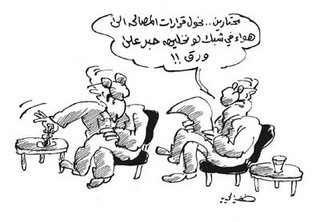
We're confused, should we turn the reconciliation decisions into 'winds in nets' or keep them as ink on paper?
(Courtesy of Iraqi cartoonist Khudair al-Himyari/New Sabah)
The search for a solution should start from the back corridors of the parliament and should go side by side with efforts to put pressure on, and negotiate compromise with, the countries that are meddling with Iraq's affairs.
This is of course going to take extraordinary efforts from the leaders who care about Iraq and who put Iraq's welfare on top of their priority lists and will require great assistance from the US especially when it comes to dealing and negotiating with leaders of Iraq's neighboring countries.
In my opinion, political and sectarian violence does not reflect internal problems as much as it reflects symptoms of the problem which is the interference of regional powers in Iraq's affairs and their desires to gain a foothold in Iraq and stop democracy from spreading further in the region.
This means reaching deals with the pawns of these powers is not enough a measure to solve the problem because pawns are replaceable and pacifying one local violent faction will only mean that those who were pulling its strings will look for a new pawn to continue the mission.
Sometimes history, even that of dark eras where evil men ruled, can provide some examples that we probably can learn from…
In one of the previous sessions of the Anfal trial Saddam spoke about how the Kurdish rebellion surrendered immediately after he signed a treaty with the Shah of Iran back in 1975…"120 thousand weapons were turned in, in a matter of days…"
With all the fundamental differences between the two cases and the moral differences between the savage insurgency in Iraq these days and the legitimate Kurdish revolt against the Baath regime, this story tells us how an armed struggle that lasted for half a century collapsed when its main supporter backed out.
For long years before 1975, it was considered next to impossible for the Iraqi military to crush the rebellion, and no political resolution could have been reached between the rebels and the central government but a paper signed by two men was enough to put an end, for some time at least, to that confrontation.
The core point here is that no reconciliation is needed between the different factions of the Iraqi populace which means the initiative so far is not addressing the people and groups that are behind the violence.
I think it has been made clear that there are certain factions that have no interest in building peace in Iraq and are doing all they can to destabilize the country and ruin the democratic project in Iraq. It has been made clear by those particular factions whom were now used to see respond with escalation whenever a call for calm is made.
Of course such factions are funded and directed by powers in other countries that have their own agendas for Iraq that have nothing to do with Iraq's national goals.
So in this case a solution for Iraq's security problems which arise from the criminal activities of foreign-sponsored armed groups must take the form of a political deal with these regional sponsors who should be persuaded or threatened to accept such a deal, so the government can probably try to figure out what these powers and countries want from Iraq and bargain to convince these powers to end their support for the local troublemakers in return for some of what they want from Iraq or better, in return for Iraq not interfering with their business.
The outcome depends here on how well a deal our negotiators can cut. That means there are no guarantees but it's better to give that a shot that to keep looking for something in a place where that thing never existed.
Perhaps President Talabani's latest warning to Iraq's neighbors falls in this category of bargaining and is a good first step in this direction but words need to be reinforced with action in order to provide leverage, so Talabani and Maliki are expected now to keep the momentum of this warning charged.
Maliki and Talabani should concentrate their efforts in this direction especially that what had been done and achieved with Maliki's original plan of reconciliation does not rise to the level of expectations and does not match the noise made in the local media about it.
There's no clear work plan or guidelines. The entire thing looks arbitrary and many of the people who took part in the latest big conferences where PM Maliki spoke to civil society organizations and community leaders have had the same impression.

We're confused, should we turn the reconciliation decisions into 'winds in nets' or keep them as ink on paper?
(Courtesy of Iraqi cartoonist Khudair al-Himyari/New Sabah)
The search for a solution should start from the back corridors of the parliament and should go side by side with efforts to put pressure on, and negotiate compromise with, the countries that are meddling with Iraq's affairs.
This is of course going to take extraordinary efforts from the leaders who care about Iraq and who put Iraq's welfare on top of their priority lists and will require great assistance from the US especially when it comes to dealing and negotiating with leaders of Iraq's neighboring countries.
In my opinion, political and sectarian violence does not reflect internal problems as much as it reflects symptoms of the problem which is the interference of regional powers in Iraq's affairs and their desires to gain a foothold in Iraq and stop democracy from spreading further in the region.
This means reaching deals with the pawns of these powers is not enough a measure to solve the problem because pawns are replaceable and pacifying one local violent faction will only mean that those who were pulling its strings will look for a new pawn to continue the mission.
Sometimes history, even that of dark eras where evil men ruled, can provide some examples that we probably can learn from…
In one of the previous sessions of the Anfal trial Saddam spoke about how the Kurdish rebellion surrendered immediately after he signed a treaty with the Shah of Iran back in 1975…"120 thousand weapons were turned in, in a matter of days…"
With all the fundamental differences between the two cases and the moral differences between the savage insurgency in Iraq these days and the legitimate Kurdish revolt against the Baath regime, this story tells us how an armed struggle that lasted for half a century collapsed when its main supporter backed out.
For long years before 1975, it was considered next to impossible for the Iraqi military to crush the rebellion, and no political resolution could have been reached between the rebels and the central government but a paper signed by two men was enough to put an end, for some time at least, to that confrontation.
Tuesday, September 26, 2006
One reason why I love winter...
Finally, summer in Baghdad is coming to an end.
Although we still get temperatures slightly above 40c every other day, the overall averages are well below what we used to have back in July and August and temperatures at nights are going below 20c again for the first time since June.
These lower temperatures mean I'm going to be relieved from one of the most tedious and exhausting duties I had to bear for the past 3-4 months. That would be maintaining the power generators.

I have two of these things at home, pieces of utter junk, yet it's junk that you have no other choice but to rely on under the scorching heat of summer time in Baghdad.
These tow generators, each produce ~2.5 kw of power which is enough to cover the basic power needs of a household; fans, lights, TV, fridge, water pump and a computer. But this comes at a high expense; especially time-wise…keeping these two generators functioning cost an average of up to 2 hours of my time every day in the past 3-4 months.
I can't remember a day when both machines were functioning! At any given day there would be one of them yelling for some sort of maintenance. Aside from the daily oil-check and refueling and an oil change 2-3 times a week for each engine, there's a lot of maintenance to be done…
There's an almost biweekly change of carburetors, monthly change of engine valves. Every other while a retractable starting-cord would wear out and need replacement.
And at least once a month, each generator would need one major repair, for example, this season alone, I had to replace an engine and two generator coils.
Not to mention spark-plugs and silencers and exhaust tubes that rupture occasionally!
The problem that forces you to choose these pieces of junk is the limited range of options in the market. There are either those fuel-economic $200 things or multi-thousand dollar generators that are fuel-hungry. Even though fuel is available and cheaper now that the shortage is over, fuel prices and availability remain a concern because you can't take anything for sure in this place, and purchasing the wrong generator would have meant having to spend ~$600/ month for fuel alone at times when gas prices rocketed to $4/gallon!

The picture should give you an idea of how the various power sources are organized in a common mains-box in the ordinary home in Baghdad. As you can see there are 2 'knife switches' which we call here 'change-over(s)' which we use to switch between two different power sources, so two of these switches mean 4 different sources, each has a small red indicator-LED that tells us which is on and which is off.
But that's not it, the number of power sources can further increase. In our home for instance we have 6 of them; 4 you saw above and 2 in two other locations but are sort of temporary/portable connections.
Each one of these 2 is basically a double long extension cord running between one home and a neighbor's, through which people can get electricity from their neighbors when one house has it and the other doesn't. These are often considered 'emergency' lines since neighbors usually have little extra power to share, so these extension cords are used to power the very basic needs of a household in the summer…a fan, a light and a TV set.
Anyway, I don't why I'm writing this but it's just that I feel so much relief the worst days of summer are gone, now I don't have to worry much about gas or cheap spare parts, and above all it means I can once again enjoy my treasured afternoon naps…
Monday, September 25, 2006
War on peace…
Yesterday around noon, the 'Virgin Mary Old Eastern Church' in Baghdad was attacked with a series of bombings that involved the use of at least three explosive devices.
The sequence in which the bombs were set off indicates the terrorists were trying to inflict as many casualties as possible among the worshippers who were preparing to leave the church after the Sunday ceremony.
What really makes me sad and angry is that churches are the most peaceful places in the country.
Churches did not turn into bomb factories or hideouts for criminals. They remained beacons for peace and love unlike our mosques and Husseiniyat that drifted far away from their original purpose and sadly became sources of fear and death and changed to become homes to torturers and kidnappers.
It's not the first time churches come under attacks from criminal extremists but if this attack was an act of revenge for what the pope said, then it shows how ignorant those criminals are and how much blind hate they have in their hearts because that church is an orthodox church, not a catholic!
But No, this is not about the pope's "offensive" remarks and I cannot find any motives behind such attacks but hate; hate for everything that represents peace.
Regardless of the motives of the attack, the government and its security apparatus are to blame for not providing sufficient protection for Christian worship places after the terrorists declared their intentions to launch a wave of attacks against these sites.
Ironically, instead, the interior ministry announces a plan to provide more protection for mosques and Husseiniyat.
Thursday, September 21, 2006
Begging for more anger!
Iraq's speaker of parliament opened Tuesday's session (Arabic) by complaining about "the pope's excuses are not enough, he must make a clear apology…."
The Islamist speaker, Mahmoud al-Mashhadani said it without shame or hesitation, just like all other leaders who owe us a thousand apologies a day for their ignorance and incompetence.
What can I say? We got used to this kind of behavior. When someone is full of mistakes he finds no shelter except in accusing others of being wrong.
I don't know what good can this do for Iraq or its people! What difference does it make to the average Iraqi whether the pope apologized or not? Did Mr. Speaker ask himself these questions?
My guess is that he was in a state of euphoria after watching the 150 teenagers-demonstration in Basra which is another proof of the ignorance of its managers.
I saw angry young men burning the flags of America and Israel, and I still can't figure out the connection they saw between Israel or Jews and the pope!!
In fact the continuous pathetic attempts to blame the west and Israel for everything shows clearly that the motives of such demonstrations are political not religious.
Anyway, it looks like the reaction of Muslims were not as violent or as bloody as the leaders wished them to be and that's why they're now provoking and yelling at the "sleeping" masses and pushing them to show more fury.
They want to add another big scene to the countless previous ones—angry mobs burning flags and pledging to destroy the "infidels".
Actually their latest calls for MORE ANGER are becoming pretty much like begging.
Iran thinks the Muslim people fell short of doing their duty and Qaradawi calls Muslims to have a "day of fury".
All these are theatrical acts directed by governments and corrupt clerics seeking controlled anger among the mobs to use in intimidating the west and discouraging it from applying more pressure on, or calling for changing, these tyrannical regimes.
Such calls are taking the headlines in the governments-controlled media in the Arab countries, and the governments, whether religious or secular, are promoting this provocation of anger.
Meanwhile, voices of reason are being pushed to the rear to appear in a short subtitle or in a tiny corner in the 10th page, or even not mentioned at all.
What the rulers want is the anger that the masses, in the eyes of the rulers, did not express enough of.
What has to be done now from the governments' perspective is to lash those lazy masses with the whips of the media and religion to do more angry protests and show more fist-shaking on TV.
For a while let the people forget about poverty, hunger, terrorism, illiteracy and other problems of the region… And let's redirect the world's attention from "insignificant" issues like Darfur, nuclear reactors, Hizbollah's defiance or Syrian and Iranian meddling with Iraq's or Lebanon's affairs.
What matters now is anger and only anger.
Right Mashhadani? Right Ahmedinejad? Right Asad? Right Mubarak?
Tuesday, September 19, 2006
When will we be ready to accept criticism?
Are those who demand an apology from the pope ready to apologize for some of their own mistakes? Or have they never made any mistakes?
Regardless of what the pope said, the Arab and Muslim world, through the tense and offensive reactions, showed once again how incapable its leaders are to respond to criticism in a civilized way.
Here we always insist that the greatest miracle of the prophet is the words he was sent with, the same words that tell Muslims to use logic and kindness in their attempts to invite others to the Islamic faith, the same words that discourage them from using a rude or repulsive tone in their conversations.
The sad thing is that in spite of all these advices, most of the common people and the elites choose offensive, rude if not violent reactions as a first measure to counter criticism.
One friend reminded me of the assassination attempt that targeted the former pope two decades ago wondering what the reaction of the pope was…as we all know he eventually visited the assailant and pardoned him.
No mosques were blown up and no speech of a clash of civilizations was made.
So why don't we admit that the "other" is better than us at responding rationally when criticized? Why don't we learn from others?
When we closed our ears to anything that doesn't match our beliefs and refused all criticism wasn’t that enough reason for the deterioration of our civilization?
Ok, let’s suppose the pope criticized the Muslims' way in spreading their belief, can anyone prove that wrong??
This question pushed me to review some recommended books of Islamic history, books that are held high and considered cornerstones in the documentation of Arab-Islamic history. I started to review these books looking for facts as to whether Islam was spread peacefully.
Yes, many entered in Islam voluntarily over history but I want to shed light on a certain part of history when the sword was used. That's the stage that must be studied and revisited. And there must be no shame felt in criticizing or renouncing it if that's necessary and it should not be treated as a divine story that cannot be questioned.
Let's take a look at the campaigns led by the first set of Caliphs who ruled the Islamic state after the death of the prophet and see in which of these campaigns the faith was spread peacefully and in which ones other means were implemented and which of the peoples of the region entered in Islam voluntarily….
Iraq? Persia? Spain? Egypt?
Which of those nations embraced the Islamic call voluntarily?
I will start from Iraq to state my thoughts about the Islamic invasion of Iraq and I will try to find which statement is closer to the truth; with sword, or through a peaceful invitation?
Anyone with the slightest knowledge about the ancient Middle East knows the enormous difference in riches between green Mesopotamia and the deserts of Arabia. This difference makes it natural to expect that early Muslims who lived in the desert looked ambitiously to the rich lands of their neighbors in Mesopotamia.
I will provide historical texts from some of the most respected books in Islamic history such as al-Tabari, Seerat Ibn Hisham and Tafseer Ibn Katheer. These books show that the questionable motives behind invading Iraq were not secret but were rather mentioned boastfully every time our historians celebrate the achievement of adding Iraq to the young Islamic state.
The story began when the first Caliph Abu Bakr sent two of his toughest generals to Iraq (both are notorious for crimes they had supposedly committed).
Abu Bakr sent Khalid Bin al-Waleed to the south parts of Iraq and sent Iyadh Bin Ghanam to the west (upper Euphrates valley). To motivate the two generals he told them that the first to reach al-Heera would become the Emir and have superiority on the other.
Khalid understood the message and according to al-Tabari he made a speech to his army in which he said "Don't you see soldiers that food piles in that land are as big as mountains!? I swear to God that even if it wasn't for Jihad and even if it was only for the treasures then it's worth fighting for to make these riches our own and leave behind the days of hunger and poverty".
The first village the army met on the road was inhabited by Christian Arabs who were taken by surprise at the size of the invading army. They wondered what Khalid wanted from them and tried to negotiate for peace.
The negotiator of the village and its chief Bin Slooba managed to save his village only after he agreed to pay 90 thousand Dirhams in tribute.
Next was another village that paid as much as 190 thousand Dirhams.
The story continued until the army arrived at the first village that refused to pay the tribute and refused to obey the orders of the army, and so was the battle of "Alees" that town was also inhabited by Christian Arabs.
Khalid Bin al-Waleed vowed to make "a river flow out of their blood".
Khalid's men killed 70 thousands of the town's people in one day and one night according to al-Tabari's story.
But the spilled blood did not form a river which upset Khalid but al-Qa'qa (one of Khalid's lieutenants) advised him to direct water from the river to the spot of the slaughter through a canal.
That way a river of blood was formed and Khalid kept his vow.
The invasion went on in this manner and the men from the desert for the first time knew the word million, which at that time they referred to as "one thousand thousand".
The treasures that fell in the hands of the army were enormous, for example in one battle, Khalid won the helmet of a Persian general that had an estimated value of one hundred thousand Dirhams.
Saad Bin Abi Waqqas assumed leadership from Khalid later and the invading army reached the city of Mada'in (south east of Baghdad) and history relays to us some stories that tell of the ignorance and cruelty of that army.
In one storehouse they found great amounts Kafour (an aromatic substance extracted from Eucalyptus used in medicine) which they thought was salt because of its abundance and color and used for their bread which came out bitter!
Some soldiers rushed to break some boxes that were sealed with lead thinking they contained food to find they were full of silverware!
One war trophy was a 60 arm-long carpet made of silk and gold and decorated with precious stones and made in the shape of Mesopotamia's map.
How did they deal with that treasure?
They simply ripped it apart and divided it among the Emirs of the army. It was said that Imam Ali sold his share for 20 thousand Dinars!
Some books mention that the collective contents of the Persian King's safes was equal to three billion Dinars or "3 thousand thousand thousand Dinars".
And some books mention that the share of the regular soldiers who fought the war in Iraq reached up to 12 thousand Dinars each.
And after Iraq became part of the state, books say that the 3rd Caliph Omar collected one hundred million Dinars or "one hundred thousand thousand Dinars" in tax money
Now I will use a few quotes from the Hadeeth (the sayings of the prophet) that should be enough to silent the angry voices and I'd like to hear what our angry clerics have to say about them…will they renounce these texts? Or will they admit that they have a lot in common with the quotes used by the pope?
Saheeh Muslim/the mosques and prayer chapter:
The prophet (pbuh) said: I was sent with words of wisdom and assisted with horror.
Saheeh al-Bukhari/al-Jihad and the march:
The prophet (pbuh) said: Heaven lays in the shade of swords.
Saheeh al-Bukhari/Tafseer al-Quran (the explanation of Quran):
"You were the best nation brought to the people"
Meaning: The best people to the people, bringing them with chains around their necks until they enter in Islam.
Saheeh Muslim/al-Jihad and the march:
The prophet (pbuh) said: The killer's right is to rob the killed.
The prophet (pbuh) said: I was ordered to fight the people until the say 'There's no God but Allah'.
Now after reading texts that are mentioned in our respected books I wonder why we always put the sword as a symbol under 'There's no God but Allah'?
Isn't the call for Islam convincing enough by itself that some countries or Jihadi groups add a sword to it?!
The truth is that the religious institutions here are corrupt and despotic. And while they reject criticism today, they are looking with fear at the criticism coming out from the inside of the very same institutions which in some cases I find harsher and more explicit that the quotes the pope used in his speech.
First of all, we need to review these texts and history books that Muslim scholars insist on relying on, and before they judge others' knowledge they must present what proves the opposite of the stories or facts they reject. Or, they should abandon these texts and declare them invalid.
Now let's see, the chief cleric of the al-Azhar university accused the pope of ignorance about Islamic history, right? Let's hear what another history scholar from al-Azhar said in one of his books about the same stage of Islamic history as the one the pope was referring to.
Sheikh Khaleel Abdul Kareem in his book "Shadu al-Rababa fi Ahwal al-Sahaba" (first edition 1997) said:
"Did the invaded people take the belief of the invaders voluntarily? What were they expected to do after seeing with their own eyes their men being slaughtered even after they surrendered and raised the white flag? Or when they saw their houses burned down, women taken slaves, belongings purged and taxes imposed, where they expected to keep their religion or move to embrace that of their invading masters to get away from the punishment?"
I believe this testimony which comes from one of al-Azhar scholars is way more critical than the words the pope quoted…
By the way, Khaleel Abdul Kareem was prosecuted more than once but was never pronounced guilty because of his factual and objective approach in which he used examples and proofs taken from the history texts approved by al-Azhar and the like.
His prosecutors backed off when they realized that denouncing him would mean renouncing the history the live by and that's what none of them dared to do.
Some accuse the pope of bad timing but I wonder what is going to be the best time to accept criticism and accept questions? Next year? a decade from now? When?
There will be no such time for our clerics who derive their power from this history, and to them, questioning or criticizing this history is a threat to their holiness and power.
Sunday, September 17, 2006
Does Syria deserve the gratitude?
The attack near the American embassy in Damascus leaves much to discuss than the quick response of the "brave" Syrian security.
The whole scene falls in the Syrian desire to send a message to the world and to America that the Syrian regime with its secular dictatorship is the best guarantee to stop the Takfiri terrorism that threatens everyone.
I will not accuse the Syrian regime of directly being behind the operation like the Syrian opposition did, whom I agree with though that the timing, nature and happy ending of the operation seem to be more than a good coincidence that serves the regime that is suffering increased pressure from the world…the 'thank you' they got after this operation was a much needed resuscitation dose.
I will leave this particular incident and go back to the time when Takfiri groups were emerging in Syria…it is clear that this incident and a few earlier ones indicate the presence of a radical organization(s) in Syria, the thing that can not go unnoticed by the government in a police state like Syria.
I had lived under a very similar regime for long years, it even had the same title (The Baath) and I saw how the regime followed and counted the steps of all Islamists whether they were Salafis, Brotherhood, Sunni or Shia or just people who happen to pray. There was no way an organized group could be formed without the regime knowing about it, let alone acquiring weapons and preparing for a coordinated attack against vital places in the capital.
There's no agreement between dictatorships and Takfiri groups in our region, they in fact differ greatly over the form and means of governance though they do share a vision for totalitarian rule and they both share extreme rejection to democracy and freedoms and they both view thet western way of living is the greatest threat to the essence of their doctrine and that its dominance means death to that doctrine.
That said, I will talk about the symbiotic relationship between the two.
I see that the reason behind the growth of religious extremism in Syria, Yemen or Egypt is attributed to one main reason which is the tyranny of the authority that makes life a bad choice and kills hope inside the people that many find themselves with nowhere to look at but the wide heavens that of course has its own route to approach.
There's no need to thank Syria for stopping the attackers because the same regime and its policy were responsible for fostering the ideology of the extremists in the first place.
Let's notice the term 'Takfiri' is often emphasized by the governments that use this quality of the terrorists to spread horror and fear among people inside and outside the country. The word 'Takfiri' and what it refers to is enough to intimidate and terrorize everyone, except for the government which holds all the strings of the game and it's the one who planted the seeds of this ideology.
When this trend tried to direct its rage at the authority, a choice I find justifiable and can't blame them for, the response from the authority was severe and painful and let's not forget the extermination campaigns of Syria against the Islamists in Aleppo and Hama, or those of Saudi Arabia, Algeria, Libya, Egypt or Saddam against the brotherhood or the Shia or other outlawed religious factions.
All those violent campaigns of mass murder and collective punishment were enough to repress any anti-government movement and that's why they had to look for somewhere else to unload all the anger which could not be contained forever.
Maybe the best choice here for the Islamists was to direct all the violence, anger and contempt in a campaign that also includes the use of media and psychological warfare against another enemy in a way that wouldn't invite the wrath of the rulers, i.e. against the west which by the time became the rulers' and extremists' mutual enemy.
How did this happen over history?
Actually it was orchestrated through a system of information and education campaign against the dangers threatening the dictatorships. In the early times that took the form of rejecting the state of Israel for no other reason I can think of but the regimes' fear from a democratic system that disrupts the continuity of the totalitarian desert.
Naturally it was very easy to adapt religion to serve this cause to give the operation a divine look and to funnel extremism against the enemy that endangered stability of the region with its new system that could make the citizen compare and see the differences between democracy and totalitarianism which became so obvious from looking at how advanced that small state is compared to her Arab neighbors.
The other danger is represented by the free world whose way of life seemed very tempting for people in our region and a comparison between that and life under dictatorships was again not in the best of the regimes.
In this case several mechanism of "education" were employed to direct the violence led by the extremists from the government to someone else.
That was done either through misguiding the extremists; for example I used to hear Saddam's regime saying over and over again, through rumors and planted stories, that America and Europe are standing behind these dictatorships and that was like telling the angry Islamists to shoot at the real enemy which is the "Great Satan" that endorsed the planted the dictators. Not to mention other levels of propaganda that made the west look as the cause of all our problems, that the west is stealing our riches, fighting our beliefs and destroying our culture and history and fears our development.
I really see that these regimes deserve no thanking as much as blaming and pressure because they are the founders of the atmospheres and conditions that bred extremism and made it multiply and bud in a way that it has long became ready for export to the whole world.
The Takfiris are now a weapon in the hands of the dictators and they are using it efficiently to terrorize us and blackmail the west. These regimes are using these chained mad dogs and threatening to set them loose once they feel the threat of a change looming around their kingdoms.
The question is, is dictatorship a guarantee for keeping the leash on those extremists?
Absolutely not, dictatorship will not and cannot guarantee limiting the growth of extremism because extremist groups are the children of those regimes and a natural outcome of the way those regimes ruled these countries.
Dictatorships have all the lust for power and dirty mentality required to ally with the extremists against their enemies whether those are their own people or the west and its ideas of reform and liberty.
Friday, September 15, 2006
Bonjour France!
Al-Qaeda and the 'Salafi group for call and combat' are joining forces to fight France (Hat Tip: Pajamas)…
Now this makes me wonder, what part of France's policy had lead to this, and what made al-Qaeda consider France an enemy that must be fought and brought into submission?
Could it be the neo-conish, hawkish, Zionish policies of President Chirac?(’xcuse my French!)
Nah, France is a peaceful, thoughtful, tolerant and (dare I say chicken?) country and there's no way that France's policies pushed al-Qaeda to ally with that insurgent group, right?
But why should France be so concerned about this new alliance? I'm sure Paris can give time for diplomacy, initiate dialogue and negotiate to reach a compromise with those guys, right?
After all, the France is not illegally occupying any Muslim lands and is sympathetic to Arab and Muslim causes.
Anyway, let's see what options France should consider in response here:
First and foremost, the French, peacefully and willingly, can all convert to Islam (Salafi Islam that is) and endorse Sharia Law instead of their crusade constitution.
Or, the French could fight and defend Paris from al-Qaeda's invasion (scrap that, non-applicable).
Or, The French can opt to pay the Dhimmi Jizya, I think al-Qaeda would appreciate annual tributes of French cheese and perfumes...(no?!)
Or, maybe the French can pretend they converted to Islam to please al-Qaeda but retain their current beliefs, i.e. use the Taqiyya for a while until they find a way out…?
I really don't know, but I know for sure now that there is something wrong with France's policy that Islamists are considering her an enemy.
I assume the French government knows better which part is and maybe it's time to consider changing that part instead of telling other countries to change theirs.
Al-Qaida has for the first time announced a union with an Algerian insurgent group that has designated France as an enemy, saying they will act together against French and American interests.
[…]
In his video, Al-Zawahri hailed "the joining up" of the GSPC with al- Qaida as "good news."
"All the praise is due to Allah for the blessed union which we ask Allah to be as a bone in the throats of the Americans and French Crusaders and their allies, and inspire distress, concern and dejection in the hearts of the traitorous, apostate sons of France," he said.
Now this makes me wonder, what part of France's policy had lead to this, and what made al-Qaeda consider France an enemy that must be fought and brought into submission?
Could it be the neo-conish, hawkish, Zionish policies of President Chirac?(’xcuse my French!)
Nah, France is a peaceful, thoughtful, tolerant and (dare I say chicken?) country and there's no way that France's policies pushed al-Qaeda to ally with that insurgent group, right?
But why should France be so concerned about this new alliance? I'm sure Paris can give time for diplomacy, initiate dialogue and negotiate to reach a compromise with those guys, right?
After all, the France is not illegally occupying any Muslim lands and is sympathetic to Arab and Muslim causes.
Anyway, let's see what options France should consider in response here:
First and foremost, the French, peacefully and willingly, can all convert to Islam (Salafi Islam that is) and endorse Sharia Law instead of their crusade constitution.
Or, the French could fight and defend Paris from al-Qaeda's invasion (scrap that, non-applicable).
Or, The French can opt to pay the Dhimmi Jizya, I think al-Qaeda would appreciate annual tributes of French cheese and perfumes...(no?!)
Or, maybe the French can pretend they converted to Islam to please al-Qaeda but retain their current beliefs, i.e. use the Taqiyya for a while until they find a way out…?
I really don't know, but I know for sure now that there is something wrong with France's policy that Islamists are considering her an enemy.
I assume the French government knows better which part is and maybe it's time to consider changing that part instead of telling other countries to change theirs.
Thursday, September 14, 2006
For the first time ever, they spoke the truth!
After finishing his tour in the Middle East, Kofi Annan says most region leaders told him the invasion of Iraq and its aftermath have been a disaster.
A disaster for whom, is the question…
For the first time I agree with what dictators, despots and apocalyptic nutcases said!
I'd just replace "the region" with "their thrones" to make the statement correct.
Did the "invasion and its aftermath" destabilize the region from those leaders' perspective?
Absolutely yes! The Syrian Baath regime lost its eastern twin, Iran lost its anti-American, anti-Semitic western neighbor and the family-state in Saudi Arabia suddenly found itslef with a northern neighbor where minorities and majorities both have shares in governance.
Moreover, the peoples of the region, since then, became more daring in demanding their rights and criticizing the policy of their governments.
If this is not instability, then what is it?
A disaster for whom, is the question…
Speaking about his tour of Middle East nations, Mr Annan told reporters:
"Most of the leaders I spoke to felt that the invasion of Iraq and its aftermath have been a real disaster for THEM...They believe it has destabilised the region."
For the first time I agree with what dictators, despots and apocalyptic nutcases said!
I'd just replace "the region" with "their thrones" to make the statement correct.
Did the "invasion and its aftermath" destabilize the region from those leaders' perspective?
Absolutely yes! The Syrian Baath regime lost its eastern twin, Iran lost its anti-American, anti-Semitic western neighbor and the family-state in Saudi Arabia suddenly found itslef with a northern neighbor where minorities and majorities both have shares in governance.
Moreover, the peoples of the region, since then, became more daring in demanding their rights and criticizing the policy of their governments.
If this is not instability, then what is it?
Subscribe to:
Posts (Atom)