This →[ U.S. launches artillery barrage in Baghdad ] explains what those loud sounds we heard this morning were except that what we heard in northern Baghdad were the sounds of the shells being fired not exploding.
It’s interesting how huge the difference between the two sounds is. I remember the sound of outgoing artillery from the days March 2003. At that time, Saddam’s Iraqi army deployed artillery units inside residential neighborhoods to “protect” them from within civilian homes. In my neighborhood our unwelcome guest was a 155mm howitzer. We called it the “Austrian” in reference to some artillery pieces Saddam had purchased from Austria.
That howitzer was less than half a mile from our home. Every time it went off our doors shook and our windows made a sound as if they were about to shatter. On the other hand when the shell itself detonates -as in many of the countless IEDs I’ve heard and sometimes seen- the sound from a similar distance is by far less aggressive.
If this morning’s blasts have an explanation last night’s explosions remain of unknown origin and nature. Last night there were more than two dozen explosions that could be heard from somewhere around the city. Some sounded like artillery shelling, others like air strikes. There’s still no word anywhere about what they actually were.
During the last couple of days two significant operations were conducted by Iraqi and American forces. There’s some conflict in the reports that there might be a third significant operation that is being confused with one of the other two.
On Friday night, soldiers from the 5th brigade 6th division of the Iraqi army captured 75 militants and confiscated their weapons in al-Yarmouk district in western Baghdad. Qasim Ata the spokesman of Baghdad operations said the militants were found hiding in a large container loaded on a truck. It’s not clear what the militants’ destination or plans were.
In the second operation 72 suspected terrorists were captured in raids in Samrra and Anbar. Bomb-making material was discovered too.
The details of the third operation are yet to be confirmed but if the report of al-Hurra is true then this one is the most significant of the three. Al-Hurra said that the artillery barrage was followed by raids by joint Iraqi-American forces on militants’ positions in Albu Eitha and around Dora and reported that the overall operation left 70 militants killed.
Meanwhile, something small in size, big in meaning is brewing in Adhamiya. Yesterday I was asked by our friend Bill Roggio (whose reporting I admire and recommend) whether I thought the Sunni in Baghdad would follow the example of the Awakening Council of Anbar. That council is made up of Sunni tribes that have turned against al-Qaeda and are now fighting a fierce war against them side by side with government forces.
I couldn’t answer that question. The difference in social structures between tribal Ramadi and urban Baghdad alters everything. The tribal structure allows for safe communication among the members of the same tribe or clan. They most often live in the same geographic area and tend to consider themselves “cousins”. In Baghdad this doesn’t exist, making it difficult to safely spread the word among many people.
Even so, it seems that the question might have an answer now, and a positive one.
Al-Sabah reported today that “some community leaders in Adhamiya are working on forming a salvation council for their own district they will be calling The Adhamiya Awakening. Sources close to the leaders said they (the leaders) have managed to win the support of some hundred people who agree with the new position. The sources asserted that the goal of the Awakening is to rid Adhamiya of the terrorists.”
Last but not least I’d like you to read this story “Iraqi artists find canvas in the cruel concrete of war”. Those brave artists are risking their lives to simply offer fellow Baghdadis a glimmer of hope, something beautiful to look at and remember that not everything about their life is dark. Remember that those artists are standing on both sides of Blast Walls. It’s this kind of spirit that helps me and other Baghdadis remain hopeful.

New points of view about the future of Iraq and the Middle East.
Sunday, April 29, 2007

Friday, April 27, 2007
Why Are the Democrats Doing This?
Instead of trying to come up with ideas to help they try to halt the sincere effort to stabilize Iraq and rescue the Middle East from a catastrophe.
I am Iraqi and to me the possible consequences of this vote are terrifying. Just as we began to see signs of progress in my country the Democrats come and say ‘well, it’s not worth it, so it’s time to leave’.
Evidently to them my life and the lives of twenty five million Iraqis are not worth trying for and they shouldn’t expect us to be grateful for this.
For four years everybody made mistakes; the administration made mistakes and admitted them and my people and leaders made mistakes as well and we regret them.
But now we have a fresh start; a new strategy with new ideas and tactics reached after studying previous mistakes and designed to reverse the setbacks we witnessed in the course of this war.
This strategy although its tools are not fully deployed yet is showing promising signs of progress.
General Petraeus said yesterday that things will get tougher before they get easier in Iraq and this is the kind of fact-based realistic assessment of the situation which politicians should listen to when they discuss the war thousands of miles away.
We must give this effort the chance it deserves and provide all the support and constructive critique, not the ‘war is lost’ empty rhetoric.
Quitting is not an option we can afford—not in America and definitely not in Iraq.
I said it before and I say it again; this war must be won by all means, otherwise the world as you know it today (or as we here dream for it to be) will exist only in books of history. The forces of extremism are more determined, more resourceful and more barbaric than the Nazi or the communists of the past. And with weapons they can improvise or acquire through their unholy alliance with rogue regimes-combined with their fluid structure and mobility-well, they can be even deadlier.
The political game the democrats are playing has gone farther than it should have. Before they took over the congress they were complaining that there had been no feasible plan for winning the war but now such plan exists and thousands of American soldiers are working hard with the millions of good Iraqis to make it work.
I understood that by having the majority in the legislature the democrats were supposed to guide America to victory by correcting the mistakes of the past. Obviously I was wrong; they have put all their efforts into making sure the exact opposite outcome happens.
Just look at this one example of how the terrorists are going to make benefit from the defeatism of democrats. Al-Jazeera, the unofficial mouthpiece of al-Qaeda posted this on the same day the House passed the wretched bill:
Dadullah said: “Thank God, he is alive, we get updated information about it. Thank God, he plans the operations in both Iraq and Afghanistan."
In no time al-Qaeda and all similarly extremist factions will start boasting about how America is fleeing Iraq under the heavy blows of the “Mujahideen” planned by OBL himself.
The democrats just offered al-Qaeda victory on a silver plate, and for free. An imaginary victory for sure, for now, but it can still be used by al-Qaeda to promote their ideology of death and attract more recruits.
America’s will can be broken, America is not invincible. Is this the kind of message you want to send to the enemy?
Reconsider your position before it’s too late.
I am Iraqi and to me the possible consequences of this vote are terrifying. Just as we began to see signs of progress in my country the Democrats come and say ‘well, it’s not worth it, so it’s time to leave’.
Evidently to them my life and the lives of twenty five million Iraqis are not worth trying for and they shouldn’t expect us to be grateful for this.
For four years everybody made mistakes; the administration made mistakes and admitted them and my people and leaders made mistakes as well and we regret them.
But now we have a fresh start; a new strategy with new ideas and tactics reached after studying previous mistakes and designed to reverse the setbacks we witnessed in the course of this war.
This strategy although its tools are not fully deployed yet is showing promising signs of progress.
General Petraeus said yesterday that things will get tougher before they get easier in Iraq and this is the kind of fact-based realistic assessment of the situation which politicians should listen to when they discuss the war thousands of miles away.
We must give this effort the chance it deserves and provide all the support and constructive critique, not the ‘war is lost’ empty rhetoric.
Quitting is not an option we can afford—not in America and definitely not in Iraq.
I said it before and I say it again; this war must be won by all means, otherwise the world as you know it today (or as we here dream for it to be) will exist only in books of history. The forces of extremism are more determined, more resourceful and more barbaric than the Nazi or the communists of the past. And with weapons they can improvise or acquire through their unholy alliance with rogue regimes-combined with their fluid structure and mobility-well, they can be even deadlier.
The political game the democrats are playing has gone farther than it should have. Before they took over the congress they were complaining that there had been no feasible plan for winning the war but now such plan exists and thousands of American soldiers are working hard with the millions of good Iraqis to make it work.
I understood that by having the majority in the legislature the democrats were supposed to guide America to victory by correcting the mistakes of the past. Obviously I was wrong; they have put all their efforts into making sure the exact opposite outcome happens.
Just look at this one example of how the terrorists are going to make benefit from the defeatism of democrats. Al-Jazeera, the unofficial mouthpiece of al-Qaeda posted this on the same day the House passed the wretched bill:
Dadullah said: “Thank God, he is alive, we get updated information about it. Thank God, he plans the operations in both Iraq and Afghanistan."
In no time al-Qaeda and all similarly extremist factions will start boasting about how America is fleeing Iraq under the heavy blows of the “Mujahideen” planned by OBL himself.
The democrats just offered al-Qaeda victory on a silver plate, and for free. An imaginary victory for sure, for now, but it can still be used by al-Qaeda to promote their ideology of death and attract more recruits.
America’s will can be broken, America is not invincible. Is this the kind of message you want to send to the enemy?
Reconsider your position before it’s too late.
Tuesday, April 24, 2007
The Wall.
The decision to build security walls around some Baghdad districts is getting a lot of attention in the local and world media. It’s creating many questions and even more rumors. Here are thoughts, just as protests may be making both Iraqi and American officials reconsider the plan, according to some press reports.
First and foremost, I don’t know why “The Wall” is becoming such an issue now. Work to construct similar walls started weeks ago in the Amiriya and Ghazaliyah districts. The “news” went utterly unnoticed then.
But that’s not what matters. What does matter is effectiveness versus side-effects. Neither should be neglected.
Yesterday leaflets were distributed in the streets of Adhamiya (or Azamiya, English doesn’t have the exact sound anyway). The leaflets — printed and distributed by persons unknown — called on residents to protest the building of the wall. Knowing that the only organized entity capable of such quick response to events in Adhamiya are either the insurgents or al-Qaeda strongly indicates that they were behind the planned protest. More important still is that it indicates they see the wall as a threat to their movement and ability to carry out their actions.
From a tactical point of view these walls can be very useful in reducing the levels of violence in targeted areas. Militants will have to stay in their home areas to avoid passing through the controlled gates. This reduces their ability to transport weapons and munitions for storage or operations in other districts. Failing that they will have to relocate to a district where it would be easier for them to operate. In either case the capacity of the militants to sustain their current level of operations would be impaired.
Having walls and barriers that seal off an area also means that troops don’t have to worry watching the numerous routes that connect Baghdad’s interlacing districts that militants use to maneuver around security operations. By extension it means that unit commanders would have a higher percentage of their troops free to conduct real missions against the militants. This makes the “clear and hold” strategy much easier to implement and sustain.
The wall strategy is pretty much like trying to control or protect a small crowd of, say, 50 people. If they are milling about in the street you’ll probably need a dozen cops to control the situation. But if you move the small crowd to a hall with one door one cop can stand at the door and control the movement in and out of the hall, while two cops can sort out the good guys from the bad guys. The remaining nine cops can move on to take care of other situations at other locations.
On the other hand one of the risks that needs to be taken into consideration when adopting this tactic of gated communities is that the main gate could itself become a target for spectacular suicide attacks. In the case of Adhamiya, (population estimated at 500,000 +) or other districts with large populations, the gates are likely to see a lot of traffic every day. There will be inevitably long waiting lines. That alone could attract suicide bombers or mortar barrages.
There are definitely downsides that come from surrounding communities with walls, mostly psychological and social. It’s sad to watch the capital of your country become the only city in the world that resembles a compartmentalized fortress where you need tall concrete walls to slightly improve the margin of safety.
But this is war and we can’t afford living in denial of the seriousness of threats. Emotions must not be allowed to disrupt taking practical steps that can save lives.
So while I understand where PM Maliki is coming from in his opposition to the wall I have to disagree with him. The other thing I don’t like about Maliki’s move is that he broke the promise he made when he announced the security plan: he said he would not allow political interference in the work of the military. So his opposition to this particular plan is purely political in nature with disregard to the facts on the ground, and an obvious result of pressure from some politicians around him.
However from his tone I suspect that he will eventually change his mind and deal practically with the issue.
First and foremost, I don’t know why “The Wall” is becoming such an issue now. Work to construct similar walls started weeks ago in the Amiriya and Ghazaliyah districts. The “news” went utterly unnoticed then.
But that’s not what matters. What does matter is effectiveness versus side-effects. Neither should be neglected.
Yesterday leaflets were distributed in the streets of Adhamiya (or Azamiya, English doesn’t have the exact sound anyway). The leaflets — printed and distributed by persons unknown — called on residents to protest the building of the wall. Knowing that the only organized entity capable of such quick response to events in Adhamiya are either the insurgents or al-Qaeda strongly indicates that they were behind the planned protest. More important still is that it indicates they see the wall as a threat to their movement and ability to carry out their actions.
From a tactical point of view these walls can be very useful in reducing the levels of violence in targeted areas. Militants will have to stay in their home areas to avoid passing through the controlled gates. This reduces their ability to transport weapons and munitions for storage or operations in other districts. Failing that they will have to relocate to a district where it would be easier for them to operate. In either case the capacity of the militants to sustain their current level of operations would be impaired.
Having walls and barriers that seal off an area also means that troops don’t have to worry watching the numerous routes that connect Baghdad’s interlacing districts that militants use to maneuver around security operations. By extension it means that unit commanders would have a higher percentage of their troops free to conduct real missions against the militants. This makes the “clear and hold” strategy much easier to implement and sustain.
The wall strategy is pretty much like trying to control or protect a small crowd of, say, 50 people. If they are milling about in the street you’ll probably need a dozen cops to control the situation. But if you move the small crowd to a hall with one door one cop can stand at the door and control the movement in and out of the hall, while two cops can sort out the good guys from the bad guys. The remaining nine cops can move on to take care of other situations at other locations.
On the other hand one of the risks that needs to be taken into consideration when adopting this tactic of gated communities is that the main gate could itself become a target for spectacular suicide attacks. In the case of Adhamiya, (population estimated at 500,000 +) or other districts with large populations, the gates are likely to see a lot of traffic every day. There will be inevitably long waiting lines. That alone could attract suicide bombers or mortar barrages.
There are definitely downsides that come from surrounding communities with walls, mostly psychological and social. It’s sad to watch the capital of your country become the only city in the world that resembles a compartmentalized fortress where you need tall concrete walls to slightly improve the margin of safety.
But this is war and we can’t afford living in denial of the seriousness of threats. Emotions must not be allowed to disrupt taking practical steps that can save lives.
So while I understand where PM Maliki is coming from in his opposition to the wall I have to disagree with him. The other thing I don’t like about Maliki’s move is that he broke the promise he made when he announced the security plan: he said he would not allow political interference in the work of the military. So his opposition to this particular plan is purely political in nature with disregard to the facts on the ground, and an obvious result of pressure from some politicians around him.
However from his tone I suspect that he will eventually change his mind and deal practically with the issue.
Saturday, April 21, 2007
End the war: Right message sent to the wrong address.
What did the last wave of terror attacks and the many crimes committed against our people all this time reveal?
If we look at how the media handles the situation we'll find something like this almost everywhere;
Dozens killed, scores wounded in attacks suggest failure of security measures…
It's as if the speaker here wants to only emphasize the defect in security measures in a way that honestly angers and disgusts me.
When shall they realize, if ever, that we are dealing with brutal crimes against humanity, a genocide against the people of Iraq? Why don't people talk about the cruelty of the crimes and expose the obvious goals of the terrorists behind the crimes?
Isn't it everyone's duty to expose the criminals, describe their sick ways and purposes and alert the world about the danger?
Where are the media when terrorists use chlorine poisonous gas, acids, and ball bearings to kill and hurt more and more civilians in utter disregard to all written and unwritten laws, ethics and values?
I understand it's the duty of the media to practice scrutiny over the work of governments but isn't it equally their duty to expose criminals and their evil deeds?
It's frustrating to see the media turn a blind eye to the nature of the crimes and open fire on an honest endeavor to restore peace to a bleeding nation. I'm sure the terrorists are pleased by the coverage. Why not, when their crimes are being portrayed as successful breakthroughs against the efforts of Iraq and America it's likely motivating them to keep up the killing.
Would it be "hate speech" to expose the terrorists for what they are?
I think our hate for their crimes must not be hidden; there is no shame in hating those blood-thirsty monsters.
Even more appalling I see and hear some people who think the solution is to end the war from our end and I can't find an argument more naïve than this—I've seen enough wars in my life that I can't remember a day when there was peace and I hate wars more than they can imagine. But we didn't start his war; it's the terrorists who started this war against life.
Instead of telling us to stop fighting back, I'd like to see some people stand up and protest the crimes of the terrorists and tell them to stop the killing and destruction…turn the stop-the-war campaign against the terrorists, is that too much to ask for?
Tell the criminals to stop killing us and stop attacking the people who are risking their lives fighting for liberty and equality.
We're not asking the media and the stop-the-war crowd to carry arms and shoot the terrorists; we just want them to stop shooting at us.
If we look at how the media handles the situation we'll find something like this almost everywhere;
Dozens killed, scores wounded in attacks suggest failure of security measures…
It's as if the speaker here wants to only emphasize the defect in security measures in a way that honestly angers and disgusts me.
When shall they realize, if ever, that we are dealing with brutal crimes against humanity, a genocide against the people of Iraq? Why don't people talk about the cruelty of the crimes and expose the obvious goals of the terrorists behind the crimes?
Isn't it everyone's duty to expose the criminals, describe their sick ways and purposes and alert the world about the danger?
Where are the media when terrorists use chlorine poisonous gas, acids, and ball bearings to kill and hurt more and more civilians in utter disregard to all written and unwritten laws, ethics and values?
I understand it's the duty of the media to practice scrutiny over the work of governments but isn't it equally their duty to expose criminals and their evil deeds?
It's frustrating to see the media turn a blind eye to the nature of the crimes and open fire on an honest endeavor to restore peace to a bleeding nation. I'm sure the terrorists are pleased by the coverage. Why not, when their crimes are being portrayed as successful breakthroughs against the efforts of Iraq and America it's likely motivating them to keep up the killing.
Would it be "hate speech" to expose the terrorists for what they are?
I think our hate for their crimes must not be hidden; there is no shame in hating those blood-thirsty monsters.
Even more appalling I see and hear some people who think the solution is to end the war from our end and I can't find an argument more naïve than this—I've seen enough wars in my life that I can't remember a day when there was peace and I hate wars more than they can imagine. But we didn't start his war; it's the terrorists who started this war against life.
Instead of telling us to stop fighting back, I'd like to see some people stand up and protest the crimes of the terrorists and tell them to stop the killing and destruction…turn the stop-the-war campaign against the terrorists, is that too much to ask for?
Tell the criminals to stop killing us and stop attacking the people who are risking their lives fighting for liberty and equality.
We're not asking the media and the stop-the-war crowd to carry arms and shoot the terrorists; we just want them to stop shooting at us.
Tuesday, April 17, 2007
Sadr ministers out, now what?
In a sudden move, Shiite Muslim cleric Muqtada al-Sadr has pulled his ministers out of the Iraqi cabinet. Many people are asking me why. It’s a good question, and I’ve being thinking about the reasons and implications. They aren’t very easy to determine because of the jumpy, and often illogical, way that this political faction thinks and behaves.
One possible theory being circulated is the six ministers were already on their way to be replaced according to PM Maliki’s cabinet reshuffle plan. So the resignations were like quitting your job before your boss fires you in order to preserve your dignity and save face.
But this explanation strikes me as overly simplistic.
The faction’s threat to leave the government, and the decision to go forward with it, took place while other developments elsewhere, in the country in which the Sadr group is a major player, were taking place and may have played a role in the decision..
What I think is that Sadr is making a decision in which he plans to switch from half-government-half-opposition status to all-out opposition.
This has not been declared explicitly so far.
Why? Because while Sadr’s followers are still quite strong, whether in the political wing or in the Mehdi army, they haven’t and appear incapable of achieving the level of exclusive dominance they aspire to. They can make serious trouble and occupy the streets for a while when they want, but those periods of time aren’t enough for them anymore.
Thus far, the results of the war between Sadr on one side and the government and the coalition on the other side - particularly in the southern part of the country- have been a disappointment for Sadr. It’s likely that he’s considering adopting a new approach by openly declaring his party in the opposition.
In Diwaniya, his militiamen have been defeated and the Iraqi and coalition forces are back in control. In Hilla, the Mehdi army members are being dealt with as outlaws by the local security forces. At least one of Sadr’s offices was burned a few weeks ago, and the statements by local officials during the last month or two clearly showed determination on not letting the militia take over the city.
It’s actually a complex situation because this approach will very likely be different from the one Sadr used back in 2003 and 2004 when his group was yet to become part of the political process. Back then, Sadr was the spiritual leader as well as the field commander of his militia, publicly endorsing his fighters and not hiding his involvement in the armed “resistance”.
In my opinion, Sadr and his political wing will now pretend to distance themselves from the armed wing, which is what they’ve been doing for some time now, while actually keeping -if not increasing- the support for armed operations against military and civilian targets. at the same time, they will try to drive more people into opposing the government and the presence of coalition troops with spectacular protests here and there. And they will find nothing wrong if those “peaceful protesters” occasionally decide to use force and shoot at Iraqi and US soldiers or eliminate those who collaborate with the government and the coalition, because “that’s not us, not the Mehdi army. It’s the people’s reaction to an incompetent government and an illegal occupation”.
Now that they have left the government, they’re going to take advantage of simple-minded people who will no longer blame them for lack of basic services, because the Sadrists are not part of this government anymore. They will redirect all the blame onto Maliki and the coalition, when in fact, it was the Sadr bloc ministers who were controlling three of the most important ministries in charge of basic services: Health, Education and Transportation, in addition to three others.
That’s a point dwarfed by the militia’s direct role in Iraqi’s suffering.
Hints of this new policy are already in the air: the Sadrists organized large protests in Basra yesterday, in which reportedly thousands chanted against the local government in demand of better services and warning of an escalation if their demands are not met. Meanwhile the al-Fadheela Party, to which the governor belongs, said it was afraid some group might assassinate him. Of course, Sadr’s aides denied any involvement in the planning of the protests and protestors were carrying Iraqi flags instead of Sadr’s banners as usual. Still, not many people really bought the act.
Sadr is of the kind of tyrant who would try all methods he can to either control the entire nation of Iraq or, if he fails, destroy it altogether.
His inability to control the country from within the political process makes me think that he’ll try for the latter.
Finally, it’s worth noting that the words which Sadr used to close his message to Maliki this week, were technically an open threat.
In the Islamic culture, the expression “Assalam ala man Ittaba’ al-Huda” (or “peace be upon those who follow the right path”) includes more threats than wishes for peace: its implied meaning is “Follow the right path [our path] or face the consequences.”
One possible theory being circulated is the six ministers were already on their way to be replaced according to PM Maliki’s cabinet reshuffle plan. So the resignations were like quitting your job before your boss fires you in order to preserve your dignity and save face.
But this explanation strikes me as overly simplistic.
The faction’s threat to leave the government, and the decision to go forward with it, took place while other developments elsewhere, in the country in which the Sadr group is a major player, were taking place and may have played a role in the decision..
What I think is that Sadr is making a decision in which he plans to switch from half-government-half-opposition status to all-out opposition.
This has not been declared explicitly so far.
Why? Because while Sadr’s followers are still quite strong, whether in the political wing or in the Mehdi army, they haven’t and appear incapable of achieving the level of exclusive dominance they aspire to. They can make serious trouble and occupy the streets for a while when they want, but those periods of time aren’t enough for them anymore.
Thus far, the results of the war between Sadr on one side and the government and the coalition on the other side - particularly in the southern part of the country- have been a disappointment for Sadr. It’s likely that he’s considering adopting a new approach by openly declaring his party in the opposition.
In Diwaniya, his militiamen have been defeated and the Iraqi and coalition forces are back in control. In Hilla, the Mehdi army members are being dealt with as outlaws by the local security forces. At least one of Sadr’s offices was burned a few weeks ago, and the statements by local officials during the last month or two clearly showed determination on not letting the militia take over the city.
It’s actually a complex situation because this approach will very likely be different from the one Sadr used back in 2003 and 2004 when his group was yet to become part of the political process. Back then, Sadr was the spiritual leader as well as the field commander of his militia, publicly endorsing his fighters and not hiding his involvement in the armed “resistance”.
In my opinion, Sadr and his political wing will now pretend to distance themselves from the armed wing, which is what they’ve been doing for some time now, while actually keeping -if not increasing- the support for armed operations against military and civilian targets. at the same time, they will try to drive more people into opposing the government and the presence of coalition troops with spectacular protests here and there. And they will find nothing wrong if those “peaceful protesters” occasionally decide to use force and shoot at Iraqi and US soldiers or eliminate those who collaborate with the government and the coalition, because “that’s not us, not the Mehdi army. It’s the people’s reaction to an incompetent government and an illegal occupation”.
Now that they have left the government, they’re going to take advantage of simple-minded people who will no longer blame them for lack of basic services, because the Sadrists are not part of this government anymore. They will redirect all the blame onto Maliki and the coalition, when in fact, it was the Sadr bloc ministers who were controlling three of the most important ministries in charge of basic services: Health, Education and Transportation, in addition to three others.
That’s a point dwarfed by the militia’s direct role in Iraqi’s suffering.
Hints of this new policy are already in the air: the Sadrists organized large protests in Basra yesterday, in which reportedly thousands chanted against the local government in demand of better services and warning of an escalation if their demands are not met. Meanwhile the al-Fadheela Party, to which the governor belongs, said it was afraid some group might assassinate him. Of course, Sadr’s aides denied any involvement in the planning of the protests and protestors were carrying Iraqi flags instead of Sadr’s banners as usual. Still, not many people really bought the act.
Sadr is of the kind of tyrant who would try all methods he can to either control the entire nation of Iraq or, if he fails, destroy it altogether.
His inability to control the country from within the political process makes me think that he’ll try for the latter.
Finally, it’s worth noting that the words which Sadr used to close his message to Maliki this week, were technically an open threat.
In the Islamic culture, the expression “Assalam ala man Ittaba’ al-Huda” (or “peace be upon those who follow the right path”) includes more threats than wishes for peace: its implied meaning is “Follow the right path [our path] or face the consequences.”
Monday, April 16, 2007
Rain isn't always drops of water.
I've always had scary experiences with stray bullets falling from the sky.
A night of heavy rain and high winds last week knocked down the antenna through which I get my internet connection. The tower (actually it's a 6 meter-long metal pipe with a makeshift base of rusty bars) was hanging between the roof and the back yard and the antenna itself was smashed when it hit a wall.
Yesterday I went out and got a new antenna and in the afternoon I was preparing to put things back together and this part is what I particularly hate; it means that I should spend one or two hours on the exposed rooftop.
The chance for being hit with one of those falling bullets is of course small and takes a bad coincidence of time and place but for some reason our rooftop seems to be a bullet magnet that I collect an average of 3 bullets every week or ten days not counting the ones that fall in the garden and end up buried in the dirt.

Ak-47 round through the hood of my car, back from July 2004.
So I was in the middle of my task when firefight broke out about a mile away, small arms, machineguns, grenades were used. I immediately ducked at a corner thinking that was a safe spot. I lit up a cigarette and decided to wait it out. My idea of that spot proved wrong immediately when I looked around and saw two ak-47 bullets and a 9mm bullet in the very square meter I was sitting in. seeing the flattened tips of the bullets I realized that they must have bounced to the ground after slamming into the same wall I was leaning on. It's a corner, so there could be no other explanation.
I jumped on my feet and rushed downstairs, wasted a couple hours watching TV until the firing stopped, then I went back up and finished my work. But when I went down to check the connection there was none. Because by the time I finished fixing the antenna it was getting dark and apparently I didn't put it in the correct angle for reception.
Now if you're not familiar with the way we use to get our connection I'll describe here in brief….
Since having your own via-sat link is too expensive for the average household and since we have no DSL service most internet users in Baghdad use the Baghdad-style wireless. By wireless I'm referring to the connection between the provider and the antenna of the user, not the one inside the house. In other words one local provider would set up a via-sat link and puts up a transmitter on his rooftop and subscribers in the neighborhood would point their antennas toward the transmitter, the antenna through a cable sends the signal to an access point and then to the computer either through another cable or wireless depending on the type of the access point.
Back to my stray bullet phobia…Am I overreacting? I don't know but the frequency of incidents has definitely influenced some of my habits.
The other day I was reading in the garden, it's now a habit for me to spend an hour or two reading in the garden when there's no electricity. I put two chairs facing each other one to sit on and the other for my feet and I put my cigarettes, ashtray and cup of tea or coffee on a small table always on my right.
So I was just beginning my reading when I heard some volleys of fire and before I could even make a decision whether to get in or stay a .50 cal round hit the wall. I ran inside and waited leaving my stuff out. It was quiet after maybe ten minutes so I went back to the garden. Another two more pages and the fighting resumed and again another .50 cal round was there, this time hitting the palm tree.
Long story short, after more than an hour of running between the living room and the garden I finally gave up. So I went on one last mission to retrieve the book and cigarettes and continued to read inside taking advantage of the last fading rays of sunlight coming through the window.
I know this was a lot of whining on my part but I just thought it would give you an idea of some of the odd things about living in this city, or maybe because I'm pissed off that Mohammed was laughing watching me running back and forth like an idiot, or perhaps I'm using this as an implicit excuse for not writing more often. Heh.
Anyway, the connection is working fine now, relatively, and I'm about to finish the book I was reading; just some twenty pages left, so excuse me.
A night of heavy rain and high winds last week knocked down the antenna through which I get my internet connection. The tower (actually it's a 6 meter-long metal pipe with a makeshift base of rusty bars) was hanging between the roof and the back yard and the antenna itself was smashed when it hit a wall.
Yesterday I went out and got a new antenna and in the afternoon I was preparing to put things back together and this part is what I particularly hate; it means that I should spend one or two hours on the exposed rooftop.
The chance for being hit with one of those falling bullets is of course small and takes a bad coincidence of time and place but for some reason our rooftop seems to be a bullet magnet that I collect an average of 3 bullets every week or ten days not counting the ones that fall in the garden and end up buried in the dirt.
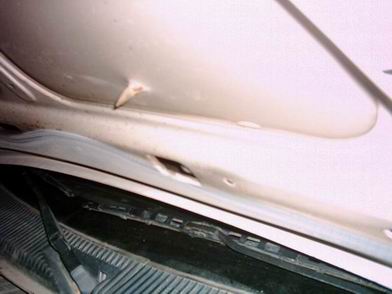
Ak-47 round through the hood of my car, back from July 2004.
So I was in the middle of my task when firefight broke out about a mile away, small arms, machineguns, grenades were used. I immediately ducked at a corner thinking that was a safe spot. I lit up a cigarette and decided to wait it out. My idea of that spot proved wrong immediately when I looked around and saw two ak-47 bullets and a 9mm bullet in the very square meter I was sitting in. seeing the flattened tips of the bullets I realized that they must have bounced to the ground after slamming into the same wall I was leaning on. It's a corner, so there could be no other explanation.
I jumped on my feet and rushed downstairs, wasted a couple hours watching TV until the firing stopped, then I went back up and finished my work. But when I went down to check the connection there was none. Because by the time I finished fixing the antenna it was getting dark and apparently I didn't put it in the correct angle for reception.
Now if you're not familiar with the way we use to get our connection I'll describe here in brief….
Since having your own via-sat link is too expensive for the average household and since we have no DSL service most internet users in Baghdad use the Baghdad-style wireless. By wireless I'm referring to the connection between the provider and the antenna of the user, not the one inside the house. In other words one local provider would set up a via-sat link and puts up a transmitter on his rooftop and subscribers in the neighborhood would point their antennas toward the transmitter, the antenna through a cable sends the signal to an access point and then to the computer either through another cable or wireless depending on the type of the access point.
Back to my stray bullet phobia…Am I overreacting? I don't know but the frequency of incidents has definitely influenced some of my habits.
The other day I was reading in the garden, it's now a habit for me to spend an hour or two reading in the garden when there's no electricity. I put two chairs facing each other one to sit on and the other for my feet and I put my cigarettes, ashtray and cup of tea or coffee on a small table always on my right.
So I was just beginning my reading when I heard some volleys of fire and before I could even make a decision whether to get in or stay a .50 cal round hit the wall. I ran inside and waited leaving my stuff out. It was quiet after maybe ten minutes so I went back to the garden. Another two more pages and the fighting resumed and again another .50 cal round was there, this time hitting the palm tree.
Long story short, after more than an hour of running between the living room and the garden I finally gave up. So I went on one last mission to retrieve the book and cigarettes and continued to read inside taking advantage of the last fading rays of sunlight coming through the window.
I know this was a lot of whining on my part but I just thought it would give you an idea of some of the odd things about living in this city, or maybe because I'm pissed off that Mohammed was laughing watching me running back and forth like an idiot, or perhaps I'm using this as an implicit excuse for not writing more often. Heh.
Anyway, the connection is working fine now, relatively, and I'm about to finish the book I was reading; just some twenty pages left, so excuse me.
Thursday, April 12, 2007
Jisr al-Hadeed
This morning Baghdad lost one of its historic icons when the terrorists blew up the Sarrafiya Bridge. This was an attack on both a vital infrastructure of the city and our morale, let alone the innocent lives that were lost in this vicious attack. What we lost today was not just a bridge, it was a piece of the Baghdad history.
Jisr al-Hadeed (“the iron bridge”), as many Baghdadis like to call it, was the first fixed bridge to be built over the Tigris as a gift from the British to the Iraqi people back in the 1940s.
I have many beautiful memories of Jisr al-Hadeed; memories of how many times I sat in that coffee shop and stared at the glittering reflections of its lights on the water, of how many evenings I sat under it with friends. When we were young and couldn’t drink at home, the Nazla (the river bank immediately under the bridge) was one of our favorite spots. Once there we’d drink cold beers in hot summer nights, with the sound of the slow and small waves of the Tigris as our music….
With several other bridges closed to traffic permanently or occasionally, the Sarrafiya Bridge became of strategic importance to us as more people became dependent on it for their traveling between the two sides of the city.
The terrorists wanted to stop normal life with this attack and they succeeded. Transportation between Karkh and Rasafa just got more difficult than ever. In addition, many people will avoid being on bridges for fear of similar attacks in the future.
Technically, the northern half of the city is now left with no usable bridges. Those in the southern half are either too far for most Baghdadis, closed, or have a dangerous spot at one of their ends.
The timing of the explosion in the early morning suggests the terrorists were more interested in destroying the bridge itself than killing civilians. If the detonation had been by merely 2 or 3 hours later the casualties would’ve been much larger. Now that this has happened the idea that they may be planning more of such attacks is terrifying. It takes months to rebuild a bridge and the damage to the economy and morale is really severe.
Everyone I talked to today was more saddened by the bridge attack than the explosion at the parliament building that killed two of its members. They all seemed to agree that if there’s anyone to blamed for that it’s the members of parliament themselves. Parliament members are famous for complaining about ‘security measures’ in the Green Zone being “insulting” to them and to Iraq’s sovereignty. They didn’t want their vehicles and guards to be searched. This is the result.
The incident was no surprise to me, when we often hear that bombs, explosive vests and illegal weapons have been found in buildings inside the International Zone. You just knew that one day something bad was going to happen. The MPs know very well that there are bad elements among their guards, yet they didn’t move to tighten security measures in the area nor done anything to identify and remove corrupt guards.
Apart from who’s to blame for it, the parliament bombing will reflect in a bad way on its performance. I suspect reaching quorum in future sessions, which is necessary to vote on any law, will now be even more difficult.
Jisr al-Hadeed (“the iron bridge”), as many Baghdadis like to call it, was the first fixed bridge to be built over the Tigris as a gift from the British to the Iraqi people back in the 1940s.
I have many beautiful memories of Jisr al-Hadeed; memories of how many times I sat in that coffee shop and stared at the glittering reflections of its lights on the water, of how many evenings I sat under it with friends. When we were young and couldn’t drink at home, the Nazla (the river bank immediately under the bridge) was one of our favorite spots. Once there we’d drink cold beers in hot summer nights, with the sound of the slow and small waves of the Tigris as our music….
With several other bridges closed to traffic permanently or occasionally, the Sarrafiya Bridge became of strategic importance to us as more people became dependent on it for their traveling between the two sides of the city.
The terrorists wanted to stop normal life with this attack and they succeeded. Transportation between Karkh and Rasafa just got more difficult than ever. In addition, many people will avoid being on bridges for fear of similar attacks in the future.
Technically, the northern half of the city is now left with no usable bridges. Those in the southern half are either too far for most Baghdadis, closed, or have a dangerous spot at one of their ends.
The timing of the explosion in the early morning suggests the terrorists were more interested in destroying the bridge itself than killing civilians. If the detonation had been by merely 2 or 3 hours later the casualties would’ve been much larger. Now that this has happened the idea that they may be planning more of such attacks is terrifying. It takes months to rebuild a bridge and the damage to the economy and morale is really severe.
Everyone I talked to today was more saddened by the bridge attack than the explosion at the parliament building that killed two of its members. They all seemed to agree that if there’s anyone to blamed for that it’s the members of parliament themselves. Parliament members are famous for complaining about ‘security measures’ in the Green Zone being “insulting” to them and to Iraq’s sovereignty. They didn’t want their vehicles and guards to be searched. This is the result.
The incident was no surprise to me, when we often hear that bombs, explosive vests and illegal weapons have been found in buildings inside the International Zone. You just knew that one day something bad was going to happen. The MPs know very well that there are bad elements among their guards, yet they didn’t move to tighten security measures in the area nor done anything to identify and remove corrupt guards.
Apart from who’s to blame for it, the parliament bombing will reflect in a bad way on its performance. I suspect reaching quorum in future sessions, which is necessary to vote on any law, will now be even more difficult.
Tuesday, April 10, 2007
Fierce fighting in central Baghdad.
Ok, let's go over what happened yesterday and today; last thing first. And please forgive me for the lack of chronological order, some information were received or corrected during the preparation of the post.
Unlike yesterday today began with an acute escalation in central Baghdad, particularly in al-Fadh and Sheik Omar districts where an American helicopter was hit around 9:30 this morning with ground fire and crashed near an old cemetery in the area, the Baghdad reporter of al-Arabiya first mentioned. There are also conflicting reports that another helicopter got hit but survived the attack.
I'm looking at this Reuters report (from 4pm) and it says the US military denied a crash occurred and now the latest news from al-Hurra (5pm) said nothing about attacks on helicopters but said the fighting was part of a joint Iraqi US operation to capture large numbers of suspects "in order to gather intelligence"
During the morning more US and Iraqi forces rushed into the scene and cordoned the area while two F-18 fighter jets and some Apache gunships patrolled above. The fighter jets withdrew after a while.
The fighting became more intense and at around 11 am several explosions were heard in the area but the cause remained unknown.
At around noon firefights erupted in the area and the sound of heavy machineguns was heard and from my rooftop I could see Apache helicopters engage at least one target with 30mm canon fire and perhaps small rockets, I couldn't be sure because the sounds were overlapping but zooming in through the finder of my camera I saw lines of smoke behind the patrolling Apaches and seconds later I could hear the sounds.
At 1 in the afternoon the fighter jets returned to the scene but this time only one F-16.
The tension and occasional clashes spread to involve a wide area in the center of eastern Baghdad including parts of Bab al-Mua'dam and al-Kasra.
A friend of mine who's a doctor at Baghdad's medical city said he and his colleagues were afraid to leave the complex because of the fighting going on in the streets.
Between 2 and 3 pm a few more explosions were heard and there was more heavy machinegun fire but now the situation has calmed down. At 5:20 it seems quiet from my place.
Ok, not exactly quiet, the last blast we heard 20 minutes ago turned out to be a suicide bomber who detonated himself (or his vehicle, not sure) somewhere in al-Waziriya not far from the main spot of fighting.
Correction: The last incident was a "controlled" detonation of an IED, not a suicide bombing.
***
Yesterday passed peacefully, that's without any major incident recorded anywhere in the country.
I think it was a good decision to have an extended curfew, it prevented the clowns from organizing demonstrations in Baghdad, otherwise bad things would've been very difficult to avoid.
The situation in Diwaniya has calmed down a little bit and most militiamen are off the street, reportedly after receiving orders from Moqtada.
This didn't mean the operation has ended and the troops are still conducting house to house searches.
Sadr's militias always employ the "hide your weapons" approach to end the crises they start each time they are confronted with overwhelming force from the US and Iraqi military. I can't say for sure what good that does to them in the long run, one simply can't read a mind like Moqtada's but perhaps it's one of their PR stunts that are for domestic consumption, to show that their will to build peace is what ends the fighting and that they withdraw from the streets not out of fear from the troops but because they're doing it for the best of the people.
It's always "we'll get our weapons off the streets" maneuver—the half solution that relieves pressure and allows them to keep their force for future mischief.
Anyway, this might not work our perfectly for them this time in Diwaniya because the troops entered the city with the intent to strike the militia hard and capture its leaders.
A relative who lives there with whom I spoke on the phone last night said the troops are conducting raids on specific targets, aimed at capturing elements identified on a wanted list.
The commander of the 8th IA division in charge of the area was obviously suspicious of the demonstrations organized by the Sadrists in nearby Najaf (about 50km to the west) and he realized that demonstrators would possibly become reinforcements to the militiamen his soldiers are fighting so he made clear last night on TV that no marchers from other cities would be allowed to enter Diwaniya.
Speaking of the Sadrists' pitiful demonstrations. His aides were hoping to gather a million marchers for yesterday but all they could manage were less than ten thousands, that's even when they bussed people from Baghdad and Basra.
The Arabic-speaking al-Alam Iranian channel claims the number was "hundreds of thousands" but that's just al-Alam, other channels and the footage we saw all put the number between 5 and 10 thousand.
I had personally been to a demonstration of 10 thousands once and what I saw yesterday was definitely smaller.
Flying Iraqi flags in large numbers is another exposed cheap trick combining methods from both Hezbollah and Saddam.
Replacing partisan sectarian banners with the national flag was likely inspired from Hezbollah's rallies in Lebanon. Both movements desperately try to show themselves as patriotic movements because they realize the others see them as Iran's tools.
On the other hand the way the flags were gathered is a trademark of the Ba'ath work; the flags that were carried during the demonstration as well as the flags that were seen hanging on walls in Baghdad were not donated by NGO's, nor bought with Sadr's money.
Elements of the Mehdi army paid visits to hundreds of shops and stores in several neighborhoods in Baghdad and "asked" the owners for money to buy flags; 6,000 dinars ($5) from stores on main streets and 2,000 dinars from stores in the alleys. This is exactly what the Ba'ath thugs used to do; using intimidation to steal hard-earned money from hardworking Iraqis to decorate their false demonstrations with posters and portraits.
That's all I have for now. Will make an update if I find more about what's going on.
Unlike yesterday today began with an acute escalation in central Baghdad, particularly in al-Fadh and Sheik Omar districts where an American helicopter was hit around 9:30 this morning with ground fire and crashed near an old cemetery in the area, the Baghdad reporter of al-Arabiya first mentioned. There are also conflicting reports that another helicopter got hit but survived the attack.
I'm looking at this Reuters report (from 4pm) and it says the US military denied a crash occurred and now the latest news from al-Hurra (5pm) said nothing about attacks on helicopters but said the fighting was part of a joint Iraqi US operation to capture large numbers of suspects "in order to gather intelligence"
During the morning more US and Iraqi forces rushed into the scene and cordoned the area while two F-18 fighter jets and some Apache gunships patrolled above. The fighter jets withdrew after a while.
The fighting became more intense and at around 11 am several explosions were heard in the area but the cause remained unknown.
At around noon firefights erupted in the area and the sound of heavy machineguns was heard and from my rooftop I could see Apache helicopters engage at least one target with 30mm canon fire and perhaps small rockets, I couldn't be sure because the sounds were overlapping but zooming in through the finder of my camera I saw lines of smoke behind the patrolling Apaches and seconds later I could hear the sounds.
At 1 in the afternoon the fighter jets returned to the scene but this time only one F-16.
The tension and occasional clashes spread to involve a wide area in the center of eastern Baghdad including parts of Bab al-Mua'dam and al-Kasra.
A friend of mine who's a doctor at Baghdad's medical city said he and his colleagues were afraid to leave the complex because of the fighting going on in the streets.
Between 2 and 3 pm a few more explosions were heard and there was more heavy machinegun fire but now the situation has calmed down. At 5:20 it seems quiet from my place.
Ok, not exactly quiet, the last blast we heard 20 minutes ago turned out to be a suicide bomber who detonated himself (or his vehicle, not sure) somewhere in al-Waziriya not far from the main spot of fighting.
Correction: The last incident was a "controlled" detonation of an IED, not a suicide bombing.
***
Yesterday passed peacefully, that's without any major incident recorded anywhere in the country.
I think it was a good decision to have an extended curfew, it prevented the clowns from organizing demonstrations in Baghdad, otherwise bad things would've been very difficult to avoid.
The situation in Diwaniya has calmed down a little bit and most militiamen are off the street, reportedly after receiving orders from Moqtada.
This didn't mean the operation has ended and the troops are still conducting house to house searches.
Sadr's militias always employ the "hide your weapons" approach to end the crises they start each time they are confronted with overwhelming force from the US and Iraqi military. I can't say for sure what good that does to them in the long run, one simply can't read a mind like Moqtada's but perhaps it's one of their PR stunts that are for domestic consumption, to show that their will to build peace is what ends the fighting and that they withdraw from the streets not out of fear from the troops but because they're doing it for the best of the people.
It's always "we'll get our weapons off the streets" maneuver—the half solution that relieves pressure and allows them to keep their force for future mischief.
Anyway, this might not work our perfectly for them this time in Diwaniya because the troops entered the city with the intent to strike the militia hard and capture its leaders.
A relative who lives there with whom I spoke on the phone last night said the troops are conducting raids on specific targets, aimed at capturing elements identified on a wanted list.
The commander of the 8th IA division in charge of the area was obviously suspicious of the demonstrations organized by the Sadrists in nearby Najaf (about 50km to the west) and he realized that demonstrators would possibly become reinforcements to the militiamen his soldiers are fighting so he made clear last night on TV that no marchers from other cities would be allowed to enter Diwaniya.
Speaking of the Sadrists' pitiful demonstrations. His aides were hoping to gather a million marchers for yesterday but all they could manage were less than ten thousands, that's even when they bussed people from Baghdad and Basra.
The Arabic-speaking al-Alam Iranian channel claims the number was "hundreds of thousands" but that's just al-Alam, other channels and the footage we saw all put the number between 5 and 10 thousand.
I had personally been to a demonstration of 10 thousands once and what I saw yesterday was definitely smaller.
Flying Iraqi flags in large numbers is another exposed cheap trick combining methods from both Hezbollah and Saddam.
Replacing partisan sectarian banners with the national flag was likely inspired from Hezbollah's rallies in Lebanon. Both movements desperately try to show themselves as patriotic movements because they realize the others see them as Iran's tools.
On the other hand the way the flags were gathered is a trademark of the Ba'ath work; the flags that were carried during the demonstration as well as the flags that were seen hanging on walls in Baghdad were not donated by NGO's, nor bought with Sadr's money.
Elements of the Mehdi army paid visits to hundreds of shops and stores in several neighborhoods in Baghdad and "asked" the owners for money to buy flags; 6,000 dinars ($5) from stores on main streets and 2,000 dinars from stores in the alleys. This is exactly what the Ba'ath thugs used to do; using intimidation to steal hard-earned money from hardworking Iraqis to decorate their false demonstrations with posters and portraits.
That's all I have for now. Will make an update if I find more about what's going on.
Whereabouts.
I've been without internet access for a whole 48 hours.
The connection is up again but it's only temporarily fixed and I'm not sure if it's going to hold steady. I'm waiting for a friend to come and fix it right, if he succeeds I will have some updates for you on the quiet yesterday and no-so-quiet today.
If you have sent me emails but received no response from me , I ask for your patience.
The connection is up again but it's only temporarily fixed and I'm not sure if it's going to hold steady. I'm waiting for a friend to come and fix it right, if he succeeds I will have some updates for you on the quiet yesterday and no-so-quiet today.
If you have sent me emails but received no response from me , I ask for your patience.
Friday, April 06, 2007
Baghdad is Quiet, Mosul is Trying to Impose Law.
It seems that in Iraq days just refuse to pass silently and they insist on having their own incidents.
Today and yesterday are no exception and several significant incidents happened, or still happening, in the fourth corners of the country. Except for Baghdad which remained quiet today.
In the west, particularly in Anbar, the Anbar Awakening Council announced the capture of what appears to be an intelligence treasure. This is what sheik Hameed al-Hayis, a member of the Council told al-Sabah yesterday:
The al-Qaeda terrorists in Anbar continue their campaign to terrorize the population that is turning against them. This morning another attack with a chlorine gas bomb struck western Ramadi killing and injuring dozens of civilians and policemen.
No wonder al-Qaeda is sending more of their suicide bombers to murder the people of Anbar; a friend of mine who visited the area just two days ago said he saw a crowd of young men near an ISF recruiting center that was "larger than anything else I had seen in Baghdad"
In Diwaniya, the mid-south city to which many Mehdi army militiamen and commanders escaped from the Baghdad operation, Iraqi and US forces are clashing with elements of the Mehdi army.
The reports we're getting show that 5 were killed and 15 others were injured in the fighting so far.
Al-Arabiya TV reported that the joint force has secured at least two sectors of the city and has also found 2 bomb factories during the ongoing house to house search operations.
It's worth nothing that the situation in the mid-south region provinces has been tense for some time; over the last month or so there have been several minor clashes between the local security forces and the Mehdi army in several places in and around Hilla just north of Diwaniya.
Radio Sawa has a report that adds to the available details on today's clashes:
Official MNF-I report here.
Further south in Basra where 4 British soldiers were killed on early Thursday the police commander thinks the IED that was used in the attack was of a new unusual type, perhaps an EFP. The whole thing just makes me wonder if this was the "gift" Nejad was actually referring to.
In Nineveh in the north it looks like the operation that was announced a few days ago is making some progress. Iraqi and US forces killed 8 militants and captured 179 suspects during recent operations across the province, New Sabah reports:
Finally on a more cheerful note, Iraqi Christians in Kurdistan started their 12 day-long festival to celebrate the new Assyrian-Babylonian year.
You'd think it's 2008 or something? Wrong!
It's year 6757 in the calendar of ancient Mesopotamia and it marks the anniversary of the beginning of a long love story between Tammouz, the god of fertility (or war? Not sure) and Ishtar the goddess of love and beauty.
Today and yesterday are no exception and several significant incidents happened, or still happening, in the fourth corners of the country. Except for Baghdad which remained quiet today.
In the west, particularly in Anbar, the Anbar Awakening Council announced the capture of what appears to be an intelligence treasure. This is what sheik Hameed al-Hayis, a member of the Council told al-Sabah yesterday:
We captured so many of their document and these contain the names of al-Qaeda groups in the province, the letters that were exchanged among those groups, the surveillance reports they were filing to their Emirs about civilian people of Ramadi like clerics and college students as well as details of trials [and executions] to which innocents were subjected.
The al-Qaeda terrorists in Anbar continue their campaign to terrorize the population that is turning against them. This morning another attack with a chlorine gas bomb struck western Ramadi killing and injuring dozens of civilians and policemen.
No wonder al-Qaeda is sending more of their suicide bombers to murder the people of Anbar; a friend of mine who visited the area just two days ago said he saw a crowd of young men near an ISF recruiting center that was "larger than anything else I had seen in Baghdad"
In Diwaniya, the mid-south city to which many Mehdi army militiamen and commanders escaped from the Baghdad operation, Iraqi and US forces are clashing with elements of the Mehdi army.
The reports we're getting show that 5 were killed and 15 others were injured in the fighting so far.
Al-Arabiya TV reported that the joint force has secured at least two sectors of the city and has also found 2 bomb factories during the ongoing house to house search operations.
It's worth nothing that the situation in the mid-south region provinces has been tense for some time; over the last month or so there have been several minor clashes between the local security forces and the Mehdi army in several places in and around Hilla just north of Diwaniya.
Radio Sawa has a report that adds to the available details on today's clashes:
A security official who spoke on condition of anonymity said that paratroopers from the 25th US division arrived in the city on Thursday and on Friday dawn surrounded four districts in the center of the city. The neighborhoods are Jumhoriya, Urooba, Iskan and Nahda.
The sources added that 1,400 Iraqi soldiers arrived from Najaf, Babil, Wasit and Kerbala, supported by an American force, to conduct raids on militants' hideouts.
Official MNF-I report here.
Further south in Basra where 4 British soldiers were killed on early Thursday the police commander thinks the IED that was used in the attack was of a new unusual type, perhaps an EFP. The whole thing just makes me wonder if this was the "gift" Nejad was actually referring to.
In Nineveh in the north it looks like the operation that was announced a few days ago is making some progress. Iraqi and US forces killed 8 militants and captured 179 suspects during recent operations across the province, New Sabah reports:
Governor Duraid Kashmoula said the Iraqi security forces are performing a security operation similar to operation Imposing Law in Baghdad. The goal is to prevent terrorists from establishing bases in Mosul…Soldiers from the 2nd and 3rd Divisions of the Iraqi army and Iraqi police raided targets suspected of being used as bomb-factories and weapon caches. 179 suspects were arrested and 8 militants killed during the two-day operations. The security forces have also found various light arms, munitions and bomb-making materials.
The Iraqi police confiscated amounts of black market fuel [illegally taken from gas stations] and this fuel will be used to run the generators and vehicles of the security forces to increase their capability of performing more frequent patrols and provide better security to the province.
Finally on a more cheerful note, Iraqi Christians in Kurdistan started their 12 day-long festival to celebrate the new Assyrian-Babylonian year.
You'd think it's 2008 or something? Wrong!
It's year 6757 in the calendar of ancient Mesopotamia and it marks the anniversary of the beginning of a long love story between Tammouz, the god of fertility (or war? Not sure) and Ishtar the goddess of love and beauty.
Wednesday, April 04, 2007
Heavy Armor's Here.
“Evacuate all houses in the area around the Americans’ base for we shall attack it soon… Those occupiers will soon be gone from this land. Who will protect you then?”
These were roughly the words in a leaflet the “mujahideen” distributed in Adhamiya a few days ago. A distant relative who lives there received one.
This message reveals that terrorists and insurgents were planning attacks on some of the joint security stations that American and Iraqi forces have established in that section of Baghdad. And, in fact, one such attack happened just this morning. The news reports here said that a joint security station (or JSS) was attacked with a car-bomb. The location was given as Sadr city though, not Adhamiya.
Around Baghdad today, there’s a notable increase in the presence of armored vehicles on the streets, — and I mean heavy armor. Humvees are usually everywhere. Stryker vehicles come second and are more occasionally spotted. The much more serious Bradley’s and tanks are usually quite rare, but today they too are abundant particularly in Rasafa, the eastern half of the Baghdad.
We’ve witnessed patrols of three to four Bradley vehicles rumbling through the streets; at times passing the same street more than a few times. Exactly what this increase in activity portends is always difficult to know until afterwards. The security forces do not share their motives and movements beforehand.
The Iraqi army too has deployed a number of tanks to reinforce some of the major checkpoints around town. My father reported he saw a few tanks added to the bunch of BMP’s that usually group on station at a large checkpoint on the main highway in eastern Baghdad.
An intensified and reinforced security cordon was also visible today around Adhamiya, as well as the adjacent neighborhoods of Raghiba Khatoun, Seleikh and Qahera.
Meanwhile in western Baghdad the Iraqi forces continue adding concrete walls around hot neighborhoods such as Amiriya and Ghazaliya. The walls were to complete the sealing in of these areas. They also function to separate them from adjacent neighborhoods with only one or two guarded entrances that “allow better control on traffic and deny freedom of movement to terrorists” according to an Iraqi officer.
Perhaps among the most significant successes recently made by the troops was the discovery and destruction of bomb-making facilities in Arab Jubour with an air strike.
Throughout the city it is widely believed that this area of farms and palm grooves is where many car-bombs are made and sent to Baghdad. The report on the Arab Jubour action states that the destroyed facilities contained large amounts of bomb-making components. It suggests that this reduction in resources will reduce the terrorists’ access to explosives as well as reducing their ability to distribute their deadly bombs as frequently as they have so far.
In Mosul to the north the governor, Duraid Kashmoula, announced that Nineveh province has just launched its own “Imposing Law” operation. Kashmoula did not give many details and did not state whether additional Iraqi or coalition troops were either provided or requested to assist in conducting the operation.
Finally Baghdad’s seen a reduction of curfew hours in Baghdad from 10 to 7 (10pm to 5 am instead of 8pm to 6am). Nothing indicates this is related to a change in the security situation. It’s apparently an adjustment to the daylight saving change that became active 2 days ago. But it’s good the government acted quickly. Otherwise it would be awkward to have a “nighttime curfew” that begins before it’s actually dark.
This morning Al-Sabah published a report in which they interviewed some Baghdadis who talked about their experience with the security operation. The people intrviewed said they felt the operation is softening up and had begun to loose momentum.
I don’t agree with that take. The developments on the ground and the increased presence of armor actually indicate the troops are still very alert, if not even planning for more action. But still, maybe those Baghdadis live in neighborhoods where they see different things than I do, or perhaps it’s just that people tend to get used to what they see everyday. As in many things in this life during wartime, what you see as unusual a month before, today becomes just a routine, usual scene. And in Baghdad these days, any increase in security just leaves you wanting more.
These were roughly the words in a leaflet the “mujahideen” distributed in Adhamiya a few days ago. A distant relative who lives there received one.
This message reveals that terrorists and insurgents were planning attacks on some of the joint security stations that American and Iraqi forces have established in that section of Baghdad. And, in fact, one such attack happened just this morning. The news reports here said that a joint security station (or JSS) was attacked with a car-bomb. The location was given as Sadr city though, not Adhamiya.
Around Baghdad today, there’s a notable increase in the presence of armored vehicles on the streets, — and I mean heavy armor. Humvees are usually everywhere. Stryker vehicles come second and are more occasionally spotted. The much more serious Bradley’s and tanks are usually quite rare, but today they too are abundant particularly in Rasafa, the eastern half of the Baghdad.
We’ve witnessed patrols of three to four Bradley vehicles rumbling through the streets; at times passing the same street more than a few times. Exactly what this increase in activity portends is always difficult to know until afterwards. The security forces do not share their motives and movements beforehand.
The Iraqi army too has deployed a number of tanks to reinforce some of the major checkpoints around town. My father reported he saw a few tanks added to the bunch of BMP’s that usually group on station at a large checkpoint on the main highway in eastern Baghdad.
An intensified and reinforced security cordon was also visible today around Adhamiya, as well as the adjacent neighborhoods of Raghiba Khatoun, Seleikh and Qahera.
Meanwhile in western Baghdad the Iraqi forces continue adding concrete walls around hot neighborhoods such as Amiriya and Ghazaliya. The walls were to complete the sealing in of these areas. They also function to separate them from adjacent neighborhoods with only one or two guarded entrances that “allow better control on traffic and deny freedom of movement to terrorists” according to an Iraqi officer.
Perhaps among the most significant successes recently made by the troops was the discovery and destruction of bomb-making facilities in Arab Jubour with an air strike.
Throughout the city it is widely believed that this area of farms and palm grooves is where many car-bombs are made and sent to Baghdad. The report on the Arab Jubour action states that the destroyed facilities contained large amounts of bomb-making components. It suggests that this reduction in resources will reduce the terrorists’ access to explosives as well as reducing their ability to distribute their deadly bombs as frequently as they have so far.
In Mosul to the north the governor, Duraid Kashmoula, announced that Nineveh province has just launched its own “Imposing Law” operation. Kashmoula did not give many details and did not state whether additional Iraqi or coalition troops were either provided or requested to assist in conducting the operation.
Finally Baghdad’s seen a reduction of curfew hours in Baghdad from 10 to 7 (10pm to 5 am instead of 8pm to 6am). Nothing indicates this is related to a change in the security situation. It’s apparently an adjustment to the daylight saving change that became active 2 days ago. But it’s good the government acted quickly. Otherwise it would be awkward to have a “nighttime curfew” that begins before it’s actually dark.
This morning Al-Sabah published a report in which they interviewed some Baghdadis who talked about their experience with the security operation. The people intrviewed said they felt the operation is softening up and had begun to loose momentum.
I don’t agree with that take. The developments on the ground and the increased presence of armor actually indicate the troops are still very alert, if not even planning for more action. But still, maybe those Baghdadis live in neighborhoods where they see different things than I do, or perhaps it’s just that people tend to get used to what they see everyday. As in many things in this life during wartime, what you see as unusual a month before, today becomes just a routine, usual scene. And in Baghdad these days, any increase in security just leaves you wanting more.
Monday, April 02, 2007
Creating old "enemies" for new wars.
Since the seizure of the British sailors and marines took place in Iraqi waters, making it an act of aggression against our allies in our territory, we’ve been following the crisis trying to predict out how this standoff’s going to unfold.
Understanding the motives and goals of Iranian government is useful in predicting the way the crisis will end.
Some pundits are comparing the situation with the US embassy crisis in Tehran back in 1979. I don’t find this comparison valid. The abduction of the sailors has more in common with the Bazoft case in Iraq in 1990.
Taking over the American embassy happened during the days of the Islamic revolution that toppled the Shah. The Shah was considered the American-backed puppet by the revolutionaries, and the American embassy was seen as the place from which the imperialist west pulled the strings of the Shah; the tyrant who oppressed the Islamists.
The 1979 embassy attack was meant to send a message to the west from the leaders of the revolution: ‘You Americans can’t control us anymore. We are independent of your manipulation and your presence is not welcome. We will run this country and spread our Islamic revolution as we please’
The regime in Iran has been defiant to the demands of the international community for years now. Nejad and the Mullahs have chosen to set Iran on collision course with the world. What they need today is to convince public opinion in Iran that the west wouldn’t dare attack the Islamic republic. At the same time they need to make the acts of the regime look like acts of defense in response to foreign trespassing—just like Saddam in 1990.
Saddam knew that a confrontation was imminent, but he wanted to tell the people here that he was strong enough and had enough deterrence to make the west think a thousand times before firing a single bullet at him.
The possibility of war creates fear and dismay which might turn into anger and unrest. That’s the last thing tyrants want to happen in their countries.
So in 1990 Saddam found what he was looking for. A showcase he could use to tell the people inside Iraq they were safe under his firm control. He “captured” Farzad Bazoft, declared him a western “Spy”, put him to “trial”, and hung him. At the time he could point to the “facts” and say that all the west could do was object and condemn. So far the parallels with the captured British sailors have held, and threats of a trial and “punishment” are par for the course. Of course at the end there was war for Saddam, but he managed to keep most Iraqis living in illusion until the war actually started.
I’m inclined to believe that the Mullahs are pursuing a similar maneuver here. The Iranian regime wants to tell the Iranian people that ‘See, we arrested their sailors and there’s nothing they can do about it. The west is too scared to attack Iran and that’s why all they can do is to negotiate the problem.’
Still, while the goals are similar, the endings might differ and I hope they do differ.
I hope the sailors will be released unharmed eventually because the mullahs know that executing them would only accelerate the onset of war. Right now what they want more than anything is to buy as much time as possible so that they can continue their policy with as little opposition from inside Iran as possible.
Understanding the motives and goals of Iranian government is useful in predicting the way the crisis will end.
Some pundits are comparing the situation with the US embassy crisis in Tehran back in 1979. I don’t find this comparison valid. The abduction of the sailors has more in common with the Bazoft case in Iraq in 1990.
Taking over the American embassy happened during the days of the Islamic revolution that toppled the Shah. The Shah was considered the American-backed puppet by the revolutionaries, and the American embassy was seen as the place from which the imperialist west pulled the strings of the Shah; the tyrant who oppressed the Islamists.
The 1979 embassy attack was meant to send a message to the west from the leaders of the revolution: ‘You Americans can’t control us anymore. We are independent of your manipulation and your presence is not welcome. We will run this country and spread our Islamic revolution as we please’
The regime in Iran has been defiant to the demands of the international community for years now. Nejad and the Mullahs have chosen to set Iran on collision course with the world. What they need today is to convince public opinion in Iran that the west wouldn’t dare attack the Islamic republic. At the same time they need to make the acts of the regime look like acts of defense in response to foreign trespassing—just like Saddam in 1990.
Saddam knew that a confrontation was imminent, but he wanted to tell the people here that he was strong enough and had enough deterrence to make the west think a thousand times before firing a single bullet at him.
The possibility of war creates fear and dismay which might turn into anger and unrest. That’s the last thing tyrants want to happen in their countries.
So in 1990 Saddam found what he was looking for. A showcase he could use to tell the people inside Iraq they were safe under his firm control. He “captured” Farzad Bazoft, declared him a western “Spy”, put him to “trial”, and hung him. At the time he could point to the “facts” and say that all the west could do was object and condemn. So far the parallels with the captured British sailors have held, and threats of a trial and “punishment” are par for the course. Of course at the end there was war for Saddam, but he managed to keep most Iraqis living in illusion until the war actually started.
I’m inclined to believe that the Mullahs are pursuing a similar maneuver here. The Iranian regime wants to tell the Iranian people that ‘See, we arrested their sailors and there’s nothing they can do about it. The west is too scared to attack Iran and that’s why all they can do is to negotiate the problem.’
Still, while the goals are similar, the endings might differ and I hope they do differ.
I hope the sailors will be released unharmed eventually because the mullahs know that executing them would only accelerate the onset of war. Right now what they want more than anything is to buy as much time as possible so that they can continue their policy with as little opposition from inside Iran as possible.
Friday, March 30, 2007
Midnight Company.
I often find myself in arguments with people about the behavior of American soldiers when they search homes and many of the people I talk to base their argument and negative impression on the footage of some raids we see on TV or on experiences of presumed relatives or friends.
When I try to counter the idea of 'they knock down doors unnecessarily, steal jewelry and treat people bad' by saying that there must be a good reason the troops sometimes act rough and that 'for every reaxction there must have been an action' I often get the response of "what do you know about that? The Americans never searched your home"
Well, last night they did…
It was around midnight and we were gathered around the fire in the backyard when we heard someone talking in English in the street.
Go see what that was, Mohammed told me.
I approached the front door and peeked into the street, a number of Humvees were there.
I returned to the group and told them we might have some company.
Almost every Friday night we gather with some friends for drinks and barbeque and we all take turns hosting the nights. Yesterday it was our turn.
I went to the living room where my father was having a heated political debate with his friend and told them the house would likely be searched. The two men stopped talking, looked at me carelessly for a second and then resumed their loud debate.
I went back to tend the fish we were preparing for our Masgoof dinner and then heard the front door open and a flashlight beamed into the driveway.
I walked to meet the night visitors; 6 or 7 American soldiers and an Iraqi translator wearing a black ski mask walked in.
Good evening gentlemen, how can I help you?
Hi, that's a lot of cars you got here! Are they all yours? The lead soldier said, obviously suspicious about the number of cars we had in the driveway.
That one is ours, the rest belong to our friends. And explained that we had guests and that in order to avoid the curfew they are spending the night here.
As was speaking two of the soldiers were using the lights on their rifles to look through the glass into the cars.
Who are those people back there?
Those are our friends and my brothers, I said as I lead the way into the back yard.
The Iraqis and Americans exchanged words of greetings.

The soldiers now began to feel a bit relaxed seeing the relaxed friendly mood, the barbeque and the drinks in Iraqis' hands.
That's a large fish! Looks good! One soldier noted.
There's enough food and drinks for all of us here, please join us, said one of my friends.
Nah, we can't do that. Thanks anyway.
We know the Americans were on duty and had a job to do so we didn't repeat the offer violating the tribal Iraqi tradition of persistently offering food.
One of the soldiers asked for the keys to the cars and he and his colleague started checking them one after the other.
I lead three others into the house showing them the rooms explaining what each one was.
When we entered the living room they were surprised to see 4 laptops scattered around.
What are these for?
One's mine, the other is my brother's and the rest are our friends', I said and explained that our friends always bring their laptops with them when they come because they can use our wireless.
My brother and I are bloggers, our friends work in the computers business, I added.
Ah, you got wireless! I should bring my laptop too next time I come here, one of the soldiers joked.
We went up to the second floor, then the roof and they looked around around, opened a few drawers, asked if we had any weapons. I told them we didn't have any.
That's fine, no problem.
Within roughly 20 minutes the soldiers had completed searching the house and by now they seemed convinced that this household is 'clean'. So we all went back to the back yard and gathered around the tasty-smelling fish and we all had some short friendly talk about food, booze, the city, the war, the internet, etc.
At the end we stood to take some pictures together.
These are bloggers dude, cover your face if you don't want to be seen nude on the internet tomorrow! One soldier said to his colleague as I snapped this photo, and we all chuckled.

And I know what you're thinking; Mohammed and I do not appear in this one.
The Americans and Iraqis shook hands and exchanged take care's and stay safe's.
They went on to continue their patrol, and we went back to our fish.
Some of us will definitely have a joke or a short story to tell from this night, I thought.
I realize that for some other Iraqis having their homes searched wasn't as smooth or as pleasant an experience as ours but this is my story and I thought I'd share it.
When I try to counter the idea of 'they knock down doors unnecessarily, steal jewelry and treat people bad' by saying that there must be a good reason the troops sometimes act rough and that 'for every reaxction there must have been an action' I often get the response of "what do you know about that? The Americans never searched your home"
Well, last night they did…
It was around midnight and we were gathered around the fire in the backyard when we heard someone talking in English in the street.
Go see what that was, Mohammed told me.
I approached the front door and peeked into the street, a number of Humvees were there.
I returned to the group and told them we might have some company.
Almost every Friday night we gather with some friends for drinks and barbeque and we all take turns hosting the nights. Yesterday it was our turn.
I went to the living room where my father was having a heated political debate with his friend and told them the house would likely be searched. The two men stopped talking, looked at me carelessly for a second and then resumed their loud debate.
I went back to tend the fish we were preparing for our Masgoof dinner and then heard the front door open and a flashlight beamed into the driveway.
I walked to meet the night visitors; 6 or 7 American soldiers and an Iraqi translator wearing a black ski mask walked in.
Good evening gentlemen, how can I help you?
Hi, that's a lot of cars you got here! Are they all yours? The lead soldier said, obviously suspicious about the number of cars we had in the driveway.
That one is ours, the rest belong to our friends. And explained that we had guests and that in order to avoid the curfew they are spending the night here.
As was speaking two of the soldiers were using the lights on their rifles to look through the glass into the cars.
Who are those people back there?
Those are our friends and my brothers, I said as I lead the way into the back yard.
The Iraqis and Americans exchanged words of greetings.

The soldiers now began to feel a bit relaxed seeing the relaxed friendly mood, the barbeque and the drinks in Iraqis' hands.
That's a large fish! Looks good! One soldier noted.
There's enough food and drinks for all of us here, please join us, said one of my friends.
Nah, we can't do that. Thanks anyway.
We know the Americans were on duty and had a job to do so we didn't repeat the offer violating the tribal Iraqi tradition of persistently offering food.
One of the soldiers asked for the keys to the cars and he and his colleague started checking them one after the other.
I lead three others into the house showing them the rooms explaining what each one was.
When we entered the living room they were surprised to see 4 laptops scattered around.
What are these for?
One's mine, the other is my brother's and the rest are our friends', I said and explained that our friends always bring their laptops with them when they come because they can use our wireless.
My brother and I are bloggers, our friends work in the computers business, I added.
Ah, you got wireless! I should bring my laptop too next time I come here, one of the soldiers joked.
We went up to the second floor, then the roof and they looked around around, opened a few drawers, asked if we had any weapons. I told them we didn't have any.
That's fine, no problem.
Within roughly 20 minutes the soldiers had completed searching the house and by now they seemed convinced that this household is 'clean'. So we all went back to the back yard and gathered around the tasty-smelling fish and we all had some short friendly talk about food, booze, the city, the war, the internet, etc.
At the end we stood to take some pictures together.
These are bloggers dude, cover your face if you don't want to be seen nude on the internet tomorrow! One soldier said to his colleague as I snapped this photo, and we all chuckled.

And I know what you're thinking; Mohammed and I do not appear in this one.
The Americans and Iraqis shook hands and exchanged take care's and stay safe's.
They went on to continue their patrol, and we went back to our fish.
Some of us will definitely have a joke or a short story to tell from this night, I thought.
I realize that for some other Iraqis having their homes searched wasn't as smooth or as pleasant an experience as ours but this is my story and I thought I'd share it.
Thursday, March 29, 2007
Quoted and Proud!
I would like to say a few words to the new visitors who are not so familiar with this blog. I have noticed that our traffic nearly tripled today and that most of the extra traffic is coming from pages talking about the recent speech by President Bush in which he mentioned a quote from our March 5 article on the WSJ…New visitors, welcome to ITM!
First of all we're proud of it. It's the ultimate ambition for a political blogger to have his or her words heard and better reach the desks of decision-makers.
Second I would like to make clear one point to bloggers like dailykos and some MSM supported blogs who seem so upset for some reason that the voice of some Iraqis is being heard.
I've seen some of them publish stories full of lies and accusations they can't support and I think it's pathetic to throw the "you're a sold-out propaganda" accusation at people just because they don't share the same point of view…This only reflects their lack of knowledge and the bankruptcy of ideas they suffer.
We speak the language of facts, supported by images and statistics and more important, we live here while they don't. We write about the good days as well as the bad days in Iraq's journey to a better future.
You don't even have to search in this blog's archives, just scroll down this page and you'll see both good and bad news—we witness an explosion and we write about it and we see progress and we write about it.
If they can't see that it's their problem, not ours.
I invite them to come visit my town, see what I see, compare it with what I write and then they can say whatever they like.
Now excuse me, it's Thursday and I have barbeque and cold beers waiting for me.
Regular blogging resumes tomorrow.
First of all we're proud of it. It's the ultimate ambition for a political blogger to have his or her words heard and better reach the desks of decision-makers.
Second I would like to make clear one point to bloggers like dailykos and some MSM supported blogs who seem so upset for some reason that the voice of some Iraqis is being heard.
I've seen some of them publish stories full of lies and accusations they can't support and I think it's pathetic to throw the "you're a sold-out propaganda" accusation at people just because they don't share the same point of view…This only reflects their lack of knowledge and the bankruptcy of ideas they suffer.
We speak the language of facts, supported by images and statistics and more important, we live here while they don't. We write about the good days as well as the bad days in Iraq's journey to a better future.
You don't even have to search in this blog's archives, just scroll down this page and you'll see both good and bad news—we witness an explosion and we write about it and we see progress and we write about it.
If they can't see that it's their problem, not ours.
I invite them to come visit my town, see what I see, compare it with what I write and then they can say whatever they like.
Now excuse me, it's Thursday and I have barbeque and cold beers waiting for me.
Regular blogging resumes tomorrow.
Monday, March 26, 2007
A plateau for now, but more action is in the air.

A US Predator UAV conducts an air surveillance mission over Baghdad in support of operation Imposing Law
Little has changed in Baghdad since the last Imposing Law update we made a week ago. After the first month of the operation in which we saw dramatic developments, things in Baghdad seem to have reached some kind of plateau.
Still there were some interesting bits of news today, with both political and operational significance.
Ahmed Farhan Hassan has been captured. This operative is described as a senior aide to Abu Omar al-Baghdadi the leader of al-Qaeda’s so-called Islamic State in Iraq. That would make him a reasonably big fish, one from which, it would seem, good intelligence can be extracted.
Local Iraqi TV aired recorded confessions of Ahmed Farhan Hassan. Hassan, who was captured in Abu Ghraib west of Baghdad a few days ago, spoke about his connection to al-Baghdadai, and I’m paraphrasing:
“I have four emirs operating under my command. I receive money directly from Abu Omar and then I distribute it among the members of my units according to the number and size of operations they carry out.”
Quoting Iraqi military officials, the TV report added that Hassan admitted to have been responsible for some 300 murders and about 200 kidnapping incidents since he joined al-Qaeda three years ago.
Overall, the security operation continues to gain more support among the political parties, including some that were skeptical in the beginning out of fear the operation would not be impartial. Today a spokesman of the Accord Front, to which VP Hashimi and deputy PM Zobaie belong, affirmed the AF’s support for the ongoing operation saying, “Our bloc, seeing the security forces covering Baghdad’s districts and operating without discrimination, is now convinced that the operation is unbiased.”
On the other hand extremist parties of both sects continue their criticism of the operation, in stupid and somewhat amusing ways. One case I found funny is related to the recent discovery of a large weapon cache that included 470 anti-tank land-mines in Jameela district near Sadr city. The discovery of the stash was reported by MNF-I website, as well as Qasim Ata the official spokesman of Baghdad operations.
Neither report accused a specific entity of being responsible for possessing the cache, but then I saw the Sadrist lawmakers (I mean lawbreakers) on TV gather reporters to tell them that the whole story about finding weapons is a lie!
It was a textbook example of how denying involvement in a crime can only make people believe that you are indeed responsible.
Last but not least, there are now rumors that major operations will be launched soon on the outskirts of Baghdad to extend Imposing Law to adjacent provinces. This according to al-Sabah citing anonymous sources:
“Commanders of Baghdad operations will attempt to clear and seal the circle around Baghdad to prepare for directing military effort toward adjacent provinces where militants who fled Baghdad sought safe havens. Sealing the circle around the capital means starting a massive offensive on militant hideouts in Anbar and Diyala provinces in the first major effort to extend Imposing Law beyond Baghdad”
This expanded offensive, the report says, will begin pretty soon. We shall see.
Update:
Looks like a second big fish has been captured! A terror cell responsible for bombings that killed and injured nearly three thousand Iraqi civilians is now in custody.
Friday, March 23, 2007
The real front in the war on terror.
"When The Taliban regime in Afghanistan fell young men waited in lines to get a haircut and when Saddam fell barbers became targets."
My father offered this simple example during a discussion we had about war on terror the other day. Although the example is very simple but the idea behind it is deep and aims at identifying the change of the main battleground for war with terror.
I wanted to talk about this because recently we've been watching the debate in America about redeployment of troops and identifying the real front we must focus on.
I see that al-Qaeda and terrorists in general didn't hide their position in this respect—despite the fact that they still operate in many parts of the world, they are clearly redirecting most effort and resources to the war in Iraq.
The war here has a lot that to do with drawing the future prospects of spreading religious extremism and this in turn is connected to the agendas of countries that have mutual goals with al-Qaeda in spite of the difference in ideology. This collaboration is complex but it clearly shows the priorities of the terrorists and rogue regimes and in turn suggests what our strategic priorities should be.
There are greater examples than killing barbers of course so I'd like to include some more to remind those who try to naively oversimplify the issue in the context that the commanders of al-Qaeda are hiding in a cave in the mountains of Afghanistan or Pakistan far away from civilization.
Al-Qaeda and its supporters are using most of the capabilities of their propaganda machine to cover their effort in Iraq, and so is the case with financial resources. All evidences indicate that most of the money is used to support the terror activity in Iraq.
Let's not forget recruiting networks that are discovered constantly in many European and Arab countries; we rarely, if ever, hear that those networks were sending recruits to Afghanistan because recruits are being sent to Iraq all the time. Even more telling, some of the prominent lieutenants of al-Qaeda left Afghanistan to fight in Iraq. One example I remember was Omar al-Farouk who escaped from Bagram to be later captured in Basra!
Al-Qaeda itself boasts about the great "sacrifices" of more than 4,000 "martyrs" to emphasize the importance of the war here. And the hundreds of suicide bombers preferred to blow themselves up in Iraq than anywhere else should remind us that if al-Qaeda considers this the main war then why talk about redeployment?
Walking away from the main war is not redeployment, it's quitting.
But why Iraq became the main front?
Iraq can simply not be equated with Afghanistan which the bulk of al-Qaeda largely abandoned after few weeks of battles—that doesn't sound like al-Qaeda!
Iraq, weak after a war that toppled the regime but rich-relatively-with resources and scientific base is a greater temptation than Afghanistan, and at the same time the possibility of a democracy arising in Iraq posed a great threat to the ideology of caliph state. Therefore al-Qaeda and whoever is backing it directly or indirectly felt they had to move the front to Iraq instead of staying in Afghanistan.
Let's imagine that the world left Iraq alone before the country is able to defend itself and let it fall in the hands of extremists, what would happen then?
Can we compare the opium fields with the massive oilfields of Mesopotamia? Can we afford to leave these resources in the service of the terrorists?
The other point is scientific infrastructure, especially when it comes to military technology such infrastructure almost doesn't exist in Afghanistan while Saddam celebrated 17 years ago in launching a rocket to space. The same "accomplishment' Iran claimed to have made just days ago.
This infrastructure, while still humble compared to advanced countries, could be very dangerous if captured by terrorists.
An Islamic state in Iraq whether to be led by al-Qaeda or one of the local extreme religious parties would be an enormous threat to the security of the region and the world and a turning point that might encourage fence-sitters to join the terrorists…the tide would be much more difficult to stop then.
It's true that what's happening in Iraq doesn't meet the ambitions of Iraqis or Americans and everyone admits that many mistakes were made.
I agree that the Iraqi government should be pressed to speed up the effort to establish rule of law and achieve reconciliation. And I also agree that the American administration needs to revise the way it's been handling and planning for this critical war.
But abandoning this front or failing to recognize its priority is a terrible mistake that can lead to disastrous consequences to all of us.
My father offered this simple example during a discussion we had about war on terror the other day. Although the example is very simple but the idea behind it is deep and aims at identifying the change of the main battleground for war with terror.
I wanted to talk about this because recently we've been watching the debate in America about redeployment of troops and identifying the real front we must focus on.
I see that al-Qaeda and terrorists in general didn't hide their position in this respect—despite the fact that they still operate in many parts of the world, they are clearly redirecting most effort and resources to the war in Iraq.
The war here has a lot that to do with drawing the future prospects of spreading religious extremism and this in turn is connected to the agendas of countries that have mutual goals with al-Qaeda in spite of the difference in ideology. This collaboration is complex but it clearly shows the priorities of the terrorists and rogue regimes and in turn suggests what our strategic priorities should be.
There are greater examples than killing barbers of course so I'd like to include some more to remind those who try to naively oversimplify the issue in the context that the commanders of al-Qaeda are hiding in a cave in the mountains of Afghanistan or Pakistan far away from civilization.
Al-Qaeda and its supporters are using most of the capabilities of their propaganda machine to cover their effort in Iraq, and so is the case with financial resources. All evidences indicate that most of the money is used to support the terror activity in Iraq.
Let's not forget recruiting networks that are discovered constantly in many European and Arab countries; we rarely, if ever, hear that those networks were sending recruits to Afghanistan because recruits are being sent to Iraq all the time. Even more telling, some of the prominent lieutenants of al-Qaeda left Afghanistan to fight in Iraq. One example I remember was Omar al-Farouk who escaped from Bagram to be later captured in Basra!
Al-Qaeda itself boasts about the great "sacrifices" of more than 4,000 "martyrs" to emphasize the importance of the war here. And the hundreds of suicide bombers preferred to blow themselves up in Iraq than anywhere else should remind us that if al-Qaeda considers this the main war then why talk about redeployment?
Walking away from the main war is not redeployment, it's quitting.
But why Iraq became the main front?
Iraq can simply not be equated with Afghanistan which the bulk of al-Qaeda largely abandoned after few weeks of battles—that doesn't sound like al-Qaeda!
Iraq, weak after a war that toppled the regime but rich-relatively-with resources and scientific base is a greater temptation than Afghanistan, and at the same time the possibility of a democracy arising in Iraq posed a great threat to the ideology of caliph state. Therefore al-Qaeda and whoever is backing it directly or indirectly felt they had to move the front to Iraq instead of staying in Afghanistan.
Let's imagine that the world left Iraq alone before the country is able to defend itself and let it fall in the hands of extremists, what would happen then?
Can we compare the opium fields with the massive oilfields of Mesopotamia? Can we afford to leave these resources in the service of the terrorists?
The other point is scientific infrastructure, especially when it comes to military technology such infrastructure almost doesn't exist in Afghanistan while Saddam celebrated 17 years ago in launching a rocket to space. The same "accomplishment' Iran claimed to have made just days ago.
This infrastructure, while still humble compared to advanced countries, could be very dangerous if captured by terrorists.
An Islamic state in Iraq whether to be led by al-Qaeda or one of the local extreme religious parties would be an enormous threat to the security of the region and the world and a turning point that might encourage fence-sitters to join the terrorists…the tide would be much more difficult to stop then.
It's true that what's happening in Iraq doesn't meet the ambitions of Iraqis or Americans and everyone admits that many mistakes were made.
I agree that the Iraqi government should be pressed to speed up the effort to establish rule of law and achieve reconciliation. And I also agree that the American administration needs to revise the way it's been handling and planning for this critical war.
But abandoning this front or failing to recognize its priority is a terrible mistake that can lead to disastrous consequences to all of us.
Thursday, March 22, 2007
The future of an Islamic state in Iraq.
Politicians, pundits and observers differ in their assessment as to what faction poses the greatest threat in Iraq; some, including the pentagon put the Mehdi Army on top of the list while others believe it's al-Qaeda.
Who is number one is not really the most important point because both groups are almost equally extremely dangerous and both had already caused so much mess and cost Iraq and America a heavy price in blood, treasure and precious time. Both need to be dealt with.
I think it's important to note that since any kind of theocratic rule in Iraq is a threat then it would make sense to add a third group which is religious political parties both Sunni or Shia. While the former two groups are so radical that they can't be reasoned with the third is relatively open to dialogue and when not under pressure from their radical counterparts, diplomacy and negotiations can play a role in reaching a solution.
In fact the correlation between the two main extremist groups is some sort of catch 22, though it really isn't. it might be believed that the attacks of al-Qaeda led to retaliation from the Mehdi army and at the same time that the attacks of Mehdi army's death squads left many Sunni with no choice but to seek protection under the umbrella of al-Qaeda; as if the two militant groups were enemies, while there's good evidence that they work jointly at some level to escalate the violence in Iraq.
We had said many times that Iraq's neighbors support both groups and since the most involved neighbors Syria and Iran are closest allies with mutual goals in Iraq, then there's a lot of reasons to believe that the two surrogates are receiving orders from the same top of the pyramid of the chain of command of the Tehran-Damascus axis. What I'm trying to say here is that when either wing is weakened, the whole structure of the evil plot of the bad neighbors is directly affected. And that any progress for Iraq and America at either front would be progress toward ultimately neutralizing both.
Nearly five weeks into operation Imposing Law in Baghdad the movement of the Mehdi Army has been largely restrained and its coercion and arm-twisting capacity is at least temporarily contained and with a policy of sustained pressure this threat can be drastically reduce. But what has it been like lately for the plans of al-Qaeda et al in establishing the core of a radical Islamist terror state in Iraq?
The "Islamic State in Iraq" a branch of al-Qaeda has been dealt several good blows recently in the same city they were planning to announce as the first capital of their state.
For four years since the liberation of Iraq Anbar remained distant from the rest of the country, defiant to the central government and a dangerous place for everyone including its own sons…this is slowly, yet clearly, changing now.
For a few months after more than two dozens of tribes formed the "Anbar Awakening Council" not much success was reported but recently there's been a constant stream of reports on battles between the tribes and al-Qaeda in several towns and villages across the vast western province; in most cases the tribes came out triumphant but sacrifices were also made.
The restive province is finally coming back into the arms of the state.
While I wouldn't take any poll results to be accurate assessment of the public attitude, they are useful in determining the general direction of changes in attitude among the population.
Recently there were two separately conducted polls in the news, and the results were contradictory to each other in more than one point which is not surprising at all but one item of the poll conducted for the BBC and ABC that caught my attention.
The poll shows that only about 4% of the Sunni are in favor of an Islamic rule. This is interesting and worth noting even if the error margin for this one was three times what the pollsters claimed, which is somewhat unlikely for an error margin. This extremely low approval rate is understandable given all what the Sunni had suffered under the extremists who touted the idea of Islamic rule in the Sunni areas for four years.
The city that at some point was about to become the new Talibanistan is now working hand in hand with the government in Baghdad and the coalition forces to defeat al-Qaeda. Maliki's and Petraeus's visit to the province were not only of symbolic value. The visit and the meeting with the heads of tribes marked the beginning of the return of the once stray province to where it belongs.
The clash between the tribe and the mosque was inevitable. For centuries and since the early days of Islam the two institutions squabbled for power and dominance and while tribe sheiks are diplomats by nature and always seek to resole conflicts and find compromises between the two sides of a conflict, clerics, especially extreme ones, do not recognize the idea of compromise; to them there is halal and haram (or allowed and forbidden) with absolutely no gray area in between whatsoever.
Iraq and the western part in particular is a very tribal community and so the increased influence and interference of clerics became a serious threat to the position of sheiks.
Sheiks are more businessmen than ideological leaders, like my tribe's sheik put it once "the hell with them [clerics] we want to live like normal people and all they care about is death".
By no means I'm trying to say that al-Qaeda is defeated. This is still far away but we can say that the in order for al-Qaeda to continue its plan to establish a safe haven in Iraq it will have to search for alternatives to Anbar. Their primary alternative is Diyala where demographics are already not as favorable for al-Qaeda as Anbar was.
There are signs that the tribes in Diyala too are changing their attitude and there are signs that they are slowly following the steps of their peers in Anbar. If this change is encouraged and supported al-Qaeda will not have many, if any, good alternative plans.
Who is number one is not really the most important point because both groups are almost equally extremely dangerous and both had already caused so much mess and cost Iraq and America a heavy price in blood, treasure and precious time. Both need to be dealt with.
I think it's important to note that since any kind of theocratic rule in Iraq is a threat then it would make sense to add a third group which is religious political parties both Sunni or Shia. While the former two groups are so radical that they can't be reasoned with the third is relatively open to dialogue and when not under pressure from their radical counterparts, diplomacy and negotiations can play a role in reaching a solution.
In fact the correlation between the two main extremist groups is some sort of catch 22, though it really isn't. it might be believed that the attacks of al-Qaeda led to retaliation from the Mehdi army and at the same time that the attacks of Mehdi army's death squads left many Sunni with no choice but to seek protection under the umbrella of al-Qaeda; as if the two militant groups were enemies, while there's good evidence that they work jointly at some level to escalate the violence in Iraq.
We had said many times that Iraq's neighbors support both groups and since the most involved neighbors Syria and Iran are closest allies with mutual goals in Iraq, then there's a lot of reasons to believe that the two surrogates are receiving orders from the same top of the pyramid of the chain of command of the Tehran-Damascus axis. What I'm trying to say here is that when either wing is weakened, the whole structure of the evil plot of the bad neighbors is directly affected. And that any progress for Iraq and America at either front would be progress toward ultimately neutralizing both.
Nearly five weeks into operation Imposing Law in Baghdad the movement of the Mehdi Army has been largely restrained and its coercion and arm-twisting capacity is at least temporarily contained and with a policy of sustained pressure this threat can be drastically reduce. But what has it been like lately for the plans of al-Qaeda et al in establishing the core of a radical Islamist terror state in Iraq?
The "Islamic State in Iraq" a branch of al-Qaeda has been dealt several good blows recently in the same city they were planning to announce as the first capital of their state.
For four years since the liberation of Iraq Anbar remained distant from the rest of the country, defiant to the central government and a dangerous place for everyone including its own sons…this is slowly, yet clearly, changing now.
For a few months after more than two dozens of tribes formed the "Anbar Awakening Council" not much success was reported but recently there's been a constant stream of reports on battles between the tribes and al-Qaeda in several towns and villages across the vast western province; in most cases the tribes came out triumphant but sacrifices were also made.
The restive province is finally coming back into the arms of the state.
While I wouldn't take any poll results to be accurate assessment of the public attitude, they are useful in determining the general direction of changes in attitude among the population.
Recently there were two separately conducted polls in the news, and the results were contradictory to each other in more than one point which is not surprising at all but one item of the poll conducted for the BBC and ABC that caught my attention.
The poll shows that only about 4% of the Sunni are in favor of an Islamic rule. This is interesting and worth noting even if the error margin for this one was three times what the pollsters claimed, which is somewhat unlikely for an error margin. This extremely low approval rate is understandable given all what the Sunni had suffered under the extremists who touted the idea of Islamic rule in the Sunni areas for four years.
The city that at some point was about to become the new Talibanistan is now working hand in hand with the government in Baghdad and the coalition forces to defeat al-Qaeda. Maliki's and Petraeus's visit to the province were not only of symbolic value. The visit and the meeting with the heads of tribes marked the beginning of the return of the once stray province to where it belongs.
The clash between the tribe and the mosque was inevitable. For centuries and since the early days of Islam the two institutions squabbled for power and dominance and while tribe sheiks are diplomats by nature and always seek to resole conflicts and find compromises between the two sides of a conflict, clerics, especially extreme ones, do not recognize the idea of compromise; to them there is halal and haram (or allowed and forbidden) with absolutely no gray area in between whatsoever.
Iraq and the western part in particular is a very tribal community and so the increased influence and interference of clerics became a serious threat to the position of sheiks.
Sheiks are more businessmen than ideological leaders, like my tribe's sheik put it once "the hell with them [clerics] we want to live like normal people and all they care about is death".
By no means I'm trying to say that al-Qaeda is defeated. This is still far away but we can say that the in order for al-Qaeda to continue its plan to establish a safe haven in Iraq it will have to search for alternatives to Anbar. Their primary alternative is Diyala where demographics are already not as favorable for al-Qaeda as Anbar was.
There are signs that the tribes in Diyala too are changing their attitude and there are signs that they are slowly following the steps of their peers in Anbar. If this change is encouraged and supported al-Qaeda will not have many, if any, good alternative plans.
Wednesday, March 21, 2007
This one was close.
I was on my way home from downtown Baghdad and as usual I took the 'Mohammed al-Qasim' highway which is the fastest connection and most reliable road that runs across Baghdad from north to south.
Just before reaching my exit I found that the army had closed the highway and saw American soldiers nearby. First I thought it was a routine security operation or a new checkpoint.
I and the dozens of drivers around me were expecting traffic to reopen at any minute but then happened what we didn't expect; a massive explosion rocked the area and huge plumes of smoke rose high in the sky.
It took more than a few seconds to collect my thoughts realize what happened…looks like we just had a controlled detonation.
The smoke obscured the scene that it took another minute till I could see where the smoke was coming from. It was the beautiful building of the finance ministry.

The damage as you can see is tragic and even worse the explosion caused part of the highway bridge on the other side to collapse to the ground.
This building is an icon of this city; I knew it for many years and I pass by it almost every day. I even wrote two years ago on how it was reconstructed after it was looted and set on fire in 2003.
Watching that building in ruins again is painfully sad, but we shall rebuild it again.
Just before reaching my exit I found that the army had closed the highway and saw American soldiers nearby. First I thought it was a routine security operation or a new checkpoint.
I and the dozens of drivers around me were expecting traffic to reopen at any minute but then happened what we didn't expect; a massive explosion rocked the area and huge plumes of smoke rose high in the sky.
It took more than a few seconds to collect my thoughts realize what happened…looks like we just had a controlled detonation.
The smoke obscured the scene that it took another minute till I could see where the smoke was coming from. It was the beautiful building of the finance ministry.

The damage as you can see is tragic and even worse the explosion caused part of the highway bridge on the other side to collapse to the ground.
This building is an icon of this city; I knew it for many years and I pass by it almost every day. I even wrote two years ago on how it was reconstructed after it was looted and set on fire in 2003.
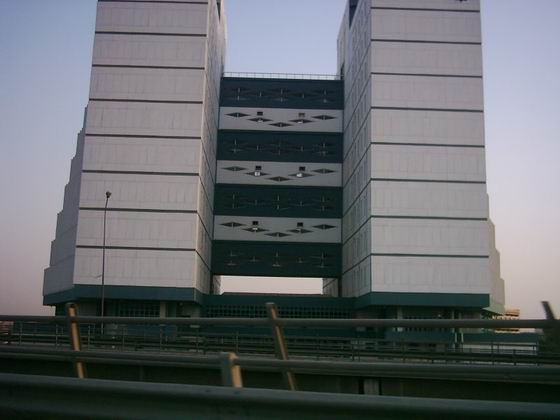
Watching that building in ruins again is painfully sad, but we shall rebuild it again.
Tuesday, March 20, 2007
Tribes and police kill 39 terrorists in Anbar.
The Al-bu Issa tribes in Amiriyat al-Fallujah backed by local police and the MNF clashed with members of the l-Qaeda linked "Islamic State in Iraq" terror organization today, according to al-Hurra TV.
The tribe involved in the clashes has opposed al-Qaeda for months now and is part of the Awakening Council.
The battles that are still ongoing have so far left 39 terrorists killed including the “ministers of oil and war” of the terror organization. Six policemen and 11 tribal fighters were also killed during the fighting.
The report adds that US troops found and securely detonated a tanker filled with chlorine gas the terrorists were planning to use in chemical attacks on the area.
Meanwhile, a police force of 500, conducting raids in northern and central parts of Ramadi, captured weapons and bomb-making material, and arrested dozens of suspects.
The tribe involved in the clashes has opposed al-Qaeda for months now and is part of the Awakening Council.
The battles that are still ongoing have so far left 39 terrorists killed including the “ministers of oil and war” of the terror organization. Six policemen and 11 tribal fighters were also killed during the fighting.
The report adds that US troops found and securely detonated a tanker filled with chlorine gas the terrorists were planning to use in chemical attacks on the area.
Meanwhile, a police force of 500, conducting raids in northern and central parts of Ramadi, captured weapons and bomb-making material, and arrested dozens of suspects.
Monday, March 19, 2007
Checkpoint and double checkpoint.
STOP! Official Checkpoint By orders of the Prime Minister and Commander of Baghdad Operations Checkpoint No. 4 Sector No. 6
A sign similar to this one greets you at all fixed checkpoints in Baghdad. These words authenticate the legitimacy of the checkpoint and emphasize who’s in charge in this or that area.
With the constant force buildup many streets now host multiple checkpoints, both fixed and mobile. All are positioned in a manner that allows soldiers in one to have visual contact with those in the next one.
As the operations continue, the interior ministry is introducing new identification measures for vehicles used by its personnel. The new armored vehicles are unique and leave no room for confusion, while the SUV’s are getting new light-green paint with the words ‘National Police’ well visible on the sides.
From my personal experience I can tell that the men staffing the checkpoints do not take their job lightly. One can feel that a long month of hard work did not exhaust them, and I am awed by the courage of those soldiers and policemen. In a city which has absorbed more suicide bombings than all other cities in the world combined every passing vehicle or motorcycle is a threat.
I can’t imagine myself in a position where my job requires I open dozens of trunks every day and each one of those moments might be the end of my life and those of the people around me. The physical and psychological pressure is enormous, yet those brave men continue to be our shield.
I was listening to the radio this morning and the first headline was ‘Policeman killed in an explosion south of Baghdad’. The story later explains that ‘south of Baghdad’ actually meant Babil. Babil is actually 60 miles away from Baghdad. The misleading headline underscored again how most media try to associate every piece of bad news with Baghdad to maintain the image of violence associated with the city.
No doubt people who follow the news as it is being reported in the West get the impression that we’re fighting a lost war, and I feel that there won’t be a day when our struggle to live a normal life and what we achieve in this path will make headlines that run above those of death.
You look around in Baghdad now and see hundreds of men working in the streets to pick up garbage; to plant flowers and paint the blast walls in joyful colors. Many of Baghdad’s squares are becoming green and clean. The picture isn’t perfect, but it’s a clear attempt to beat violence and ease pain through giving the spring a chance to shine.
Nights in Baghdad now are far from quiet, but the sounds cause less anxiety for me than they did before. I recognize the rumble of armor and thump of guns and they assure me that the gangs and militias do not dominate the night as they once did.
When an Arabs or westerners ask me about the situation and I answer that hope remains and that we’re looking forward to a better future most would say ‘Are you living in this world?’ I answer, ‘Yes, it’s you who live in the parallel world the media built for you with images of only death and destruction’.
If it surprised some of them that a poll found Iraqis optimistic, then I’m surprised that someone finally bothered to ask Iraqis how they feel.
Just as free birds would never return to the cage, we don’t want to return to the days of the tyrant. Birds do not care that beasts roam outside and would not feel nostalgic for a home or meal mixed with humiliation.
All that a free bird cares about is to spread wings and fly as it pleases.
A sign similar to this one greets you at all fixed checkpoints in Baghdad. These words authenticate the legitimacy of the checkpoint and emphasize who’s in charge in this or that area.
With the constant force buildup many streets now host multiple checkpoints, both fixed and mobile. All are positioned in a manner that allows soldiers in one to have visual contact with those in the next one.
As the operations continue, the interior ministry is introducing new identification measures for vehicles used by its personnel. The new armored vehicles are unique and leave no room for confusion, while the SUV’s are getting new light-green paint with the words ‘National Police’ well visible on the sides.
From my personal experience I can tell that the men staffing the checkpoints do not take their job lightly. One can feel that a long month of hard work did not exhaust them, and I am awed by the courage of those soldiers and policemen. In a city which has absorbed more suicide bombings than all other cities in the world combined every passing vehicle or motorcycle is a threat.
I can’t imagine myself in a position where my job requires I open dozens of trunks every day and each one of those moments might be the end of my life and those of the people around me. The physical and psychological pressure is enormous, yet those brave men continue to be our shield.
I was listening to the radio this morning and the first headline was ‘Policeman killed in an explosion south of Baghdad’. The story later explains that ‘south of Baghdad’ actually meant Babil. Babil is actually 60 miles away from Baghdad. The misleading headline underscored again how most media try to associate every piece of bad news with Baghdad to maintain the image of violence associated with the city.
No doubt people who follow the news as it is being reported in the West get the impression that we’re fighting a lost war, and I feel that there won’t be a day when our struggle to live a normal life and what we achieve in this path will make headlines that run above those of death.
You look around in Baghdad now and see hundreds of men working in the streets to pick up garbage; to plant flowers and paint the blast walls in joyful colors. Many of Baghdad’s squares are becoming green and clean. The picture isn’t perfect, but it’s a clear attempt to beat violence and ease pain through giving the spring a chance to shine.
Nights in Baghdad now are far from quiet, but the sounds cause less anxiety for me than they did before. I recognize the rumble of armor and thump of guns and they assure me that the gangs and militias do not dominate the night as they once did.
When an Arabs or westerners ask me about the situation and I answer that hope remains and that we’re looking forward to a better future most would say ‘Are you living in this world?’ I answer, ‘Yes, it’s you who live in the parallel world the media built for you with images of only death and destruction’.
If it surprised some of them that a poll found Iraqis optimistic, then I’m surprised that someone finally bothered to ask Iraqis how they feel.
Just as free birds would never return to the cage, we don’t want to return to the days of the tyrant. Birds do not care that beasts roam outside and would not feel nostalgic for a home or meal mixed with humiliation.
All that a free bird cares about is to spread wings and fly as it pleases.
Subscribe to:
Posts (Atom)