Hotel owners in Kerbala complained that an Iranian company took over exclusive rights to bring in Iranian pilgrims to the city. Kerbala is a city famous for being home to two important Shiite shrines. The economy of the city depends largely on revenues generated from religious tourism. Alaa Mahfouz, a hotel owner, said the Iraqi embassy in Iran is issuing visas to Iranian pilgrims through one particular government-owned Iranian company. Zuhair Mahmoud, who runs a tourism company lamented that such practices would undermine religious tourism business.
I would love to know the story behind this company.

New points of view about the future of Iraq and the Middle East.
Sunday, July 19, 2009

Kurdish delegates in Baghdad to discuss IA deployments
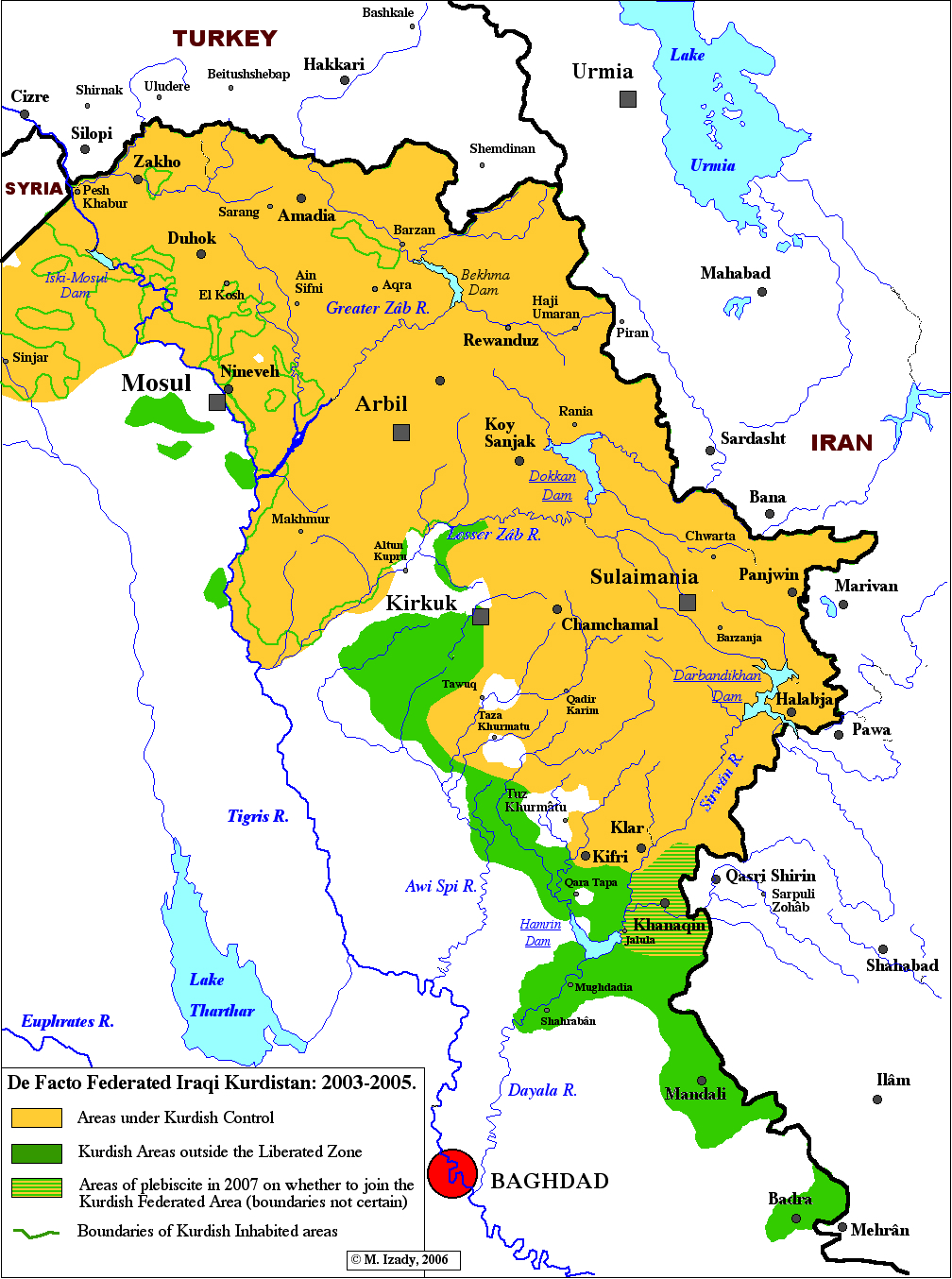
A senior Kurdish official visited Baghdad to discuss Iraqi Army (IA) deployments to the so-called disputed territories. Mohammed Ihsan, minister of “territories outside the region affairs” said he met the defense minister and other senior officers to discuss Iraqi Army movements in Makhmour.
According to Ihsan, an IA brigade was to be redeployed from Diyala province to Makhmour, southeast of Mosul. The Kurdish official described the planned deployment as “unnecessary because Makhmour is safe area. No terrorist activity, comparable to other regions, exists there”. He went on to say that there needs to be coordination between Baghdad and Irbil regarding military movements in disputed territories; otherwise “such movements would be seen as provocations”. Despite the obvious anxiety, the Kurdish official says an understanding was reached with Baghdad, “The minister of defense understood the situation and took steps to resolve the issue…we agreed on a mechanism for coordination among the main parties that exist in those regions”.
For more details on the confrontation in Makhmour, I recommend this article from the Washington Post.
PM Nouri al-Maliki has adopted a more belligerent stance in dealing with the issue of “disputed territories”. He seems to be emboldened by the growing sense of unity among Sunni and Shiite Arabs in the face of Kurdish ambitions in areas outside the three provinces; Irbil, Duhok and Sulaymaniah.
Both Arab and Kurdish keep saying that these problems must be solved by adhering to what the constitution says. Beautiful! If negotiations, compromises and the law are sufficient to avert catastrophe, that would be great. My only concern is that for more than eighty years, armed conflict has been the state of affairs between Baghdad and the Kurds. It was only constant U.S. intervention since 1991 that produced the current state of peace. It will be a huge challenge for Arab and Kurdish leaders to perpetuate this peace when the American peacemaker leaves.
*For an approximate map of Kurdistan and disputed territories click here.
Friday, July 17, 2009
Kurdish Politician Plays Down the Risk of Armed Conflict
The secretary of Kurdistan’s presidency Fouad Hussein played down the possibility of an armed conflict between Kurdistan and the central government.
However, Hussein blamed PM Nouri al-Maliki for the deterioration in relations between Irbil and Baghdad. He claimed that the policy of the central government “particularly that of the PM and his office” is to postpone and ignore issues that represent “Kurdistan’s priorities”.
However, Hussein blamed PM Nouri al-Maliki for the deterioration in relations between Irbil and Baghdad. He claimed that the policy of the central government “particularly that of the PM and his office” is to postpone and ignore issues that represent “Kurdistan’s priorities”.
I Hate Rap...
But it's an interesting story nonetheless. The Danger Zone Killer (or DZK) claim to be Iraq's first rap group. They have recently performed in Baghdad's National Theater.
Way to go!

Way to go!

Islamic Party MP resigns from the party, forms own bloc.
Accord Front MP Nour-Iddin al-Hiyali announced his resignation from the Islamic Party and the formation of a new political body; the United National Assembly of Nineveh.
Al-Hiyali told reporters that “The Assembly consists of Arab and Kurdish political and tribal powers” adding that the goal is “to preserve the unity of Nineveh province”. He pointed out that the reason this Assembly was created was “to confront the expansionist plots of Kurdish authorities to annex parts of Nineveh to Kurdistan region”.
Al-Hiyali told reporters that “The Assembly consists of Arab and Kurdish political and tribal powers” adding that the goal is “to preserve the unity of Nineveh province”. He pointed out that the reason this Assembly was created was “to confront the expansionist plots of Kurdish authorities to annex parts of Nineveh to Kurdistan region”.
Kurdistan Election Results to be Verified in Baghdad
The Higher Electoral Commission in Baghdad and other election monitors will oversee the vote count for the upcoming elections for the Kurdish region's parliament.
According to Hamdiyah Husseini of the Electoral Commission, ballots from the 5369 stations will be counted in 1184 centers in the Kurdish provinces. The count from each station will be recorded on special forms in the presence of election monitors, the media, and representatives of political parties. Those forms will then be sent in secure boxes to a national counting center in Baghdad to produce and announce the final results.
Husseini added that paper ballots will be stored in secure boxes at the main electoral centers of each province. Those boxes are to be opened only under the supervision of monitors and representatives of political parties in cases of objections to the results.
Islamic Party MP: Political Powers to Run on Liberal, Secular Platforms
From Radio Sawa:
Of course we cannot expect parties that are founded on religious and sectarian premises to become secular and liberal overnight. However, this statement indicates that politicians realize that today, voters are less eager to buy the “Islamic” brand than before.
Leading member of the Islamic Party Omar Karbouli says he thinks political powers are inclined to form new coalitions that transcend sectarian and ethnic lines. Karbouli told Radio Sawa that “political powers are moving towards entering the general elections with a liberal, secular platform”
Of course we cannot expect parties that are founded on religious and sectarian premises to become secular and liberal overnight. However, this statement indicates that politicians realize that today, voters are less eager to buy the “Islamic” brand than before.
Northern Oilfield Boosts Iraq's Exports
Reuters:
The gas sector, however, still lags behind, Azzaman reports:
Oil production from Iraqi Kurdistan's Taq Taq oil field fluctuates between 20,000 and 40,000 barrels per day, of which exports range between 12,000 and 30,000 bpd, a senior engineer at the site said on Friday.
Iraq's finance minister this week said Iraqi oil exports, of which the majority is produced in the country's south, reached 2.1 million bpd in July so far, putting the country on track for its highest oil export volume since the 2003 U.S.-led invasion.
The gas sector, however, still lags behind, Azzaman reports:
Iraq’s natural gas reserves are the tenth largest in the world but its output hardly meets domestic needs, a senior government official said.
Ali Al-Dabagh said the government is not in a position to consider exporting its natural gas. “We cannot make promises as far as exporting natural gas is concerned due to rising domestic needs,” Dabagh said.
Dabagh’s the remarks come following a statement by Prime Minister Nouri al-Maliki in which he said Iraq could commit 15,000 cubic meters of natural gas for export to Europe. “Iraq may become a good exporter of gas to Europe but there will be no exports in the foreseeable future,” Dabagh said.
Sunni Arabs in Favor of UK Security Deal
The Accord Front expressed support for a security agreement with the UK to help build the Iraqi Navy. Meanwhile Salih Mutlaq, chief of the Dialogue Front emphasized the need to protect Iraq’s territorial waters.
Accord Front spokesman Saleem Jubouri pointed out that “the lack of Iraqi forces capable of protecting national waters from external aggression means there must be an agreement [with the UK] until Iraqi forces can fill the security vacuum”.
The proposed deal between Iraq and the UK would allow 100 British military personnel to stay in Iraq to train and instruct the infant Iraqi naval force. A vote on the agreement was obstructed earlier this week when Sadrist MPs walked out of a parliament session, disrupting quorum requirements for a vote.
Police: Amarah is Ratline for Iranian Weapons
Police sources in Maysan province (200 miles southeast of Baghdad) admitted to Azzaman that the province and its capital city of Amarah have become a hub for the distribution of munitions coming from Iran. From Amarah, these weapons would later be smuggled to Baghdad and other cities to support IED and indirect fire attacks.
Iraqi List: No chance for an alliance with Maliki
Iraqi List MP Maysoun Damlouji said the group (whose leader is former PM Iyad Allawi) was unlikely to join forces with the Da’awa Party of PM Nouri al-Maliki. Damlouji asserted that the List is speaking with all political powers to negotiate future alliances, with the exception of the Da’awa Party.
Kurdistan Authorities Deny Assembly Right to Opposition Group
The Independent Elections Committee penalized the Change Slate, one of the main rivals to the two ruling parties in Kurdistan. The Slate was fined 2 million dinars (approximately $1,700) for violating campaigning rules. Meanwhile, security authorities did not permit the Change Slate to organize a demonstration that was planned from Friday in Sulaymaniyah. The Elections Committee said in a statement that Sulaymaniyah’s governor and security authorities first authorized the demonstration. However, the governor later told the Committee that a high ranking official in Kurdistan’s government that “public gatherings are not allowed on Fridays” and that security forces “would not be responsible for protecting the safety of demonstrators”.
Iran Protesters: 'Death to China, Death to Russia'
Iranian opposition took to the streets again in massive protests after Friday prayers. For a change, an angry mob in the Middle East is not chanting "Death to America"!
From AP:
From AP:
Some in the sermon and afterward chanted "death to Russia" and "death to China," referring to Ahmadinejad's alliance with both countries. Ahmadinejad has come under criticism in Iran for not criticizing Beijing over Muslim deaths in China's western Xinjiang province.
Thursday, July 16, 2009
Abdul-Mahdi: Ongoing Negotiations to Reestablish the UIA
From the ISCI website:
Answering a question about reestablishing the UIA, VP Abdul-Mahdi said there is real progress, not just expectations. “There are meetings within the framework of the UIA, and the Sadr movement was there. Yesterday we finalized a paper that defines the principles and a general structure. There is progress regarding the UIA. All the founding parties are attending these meetings, except for the brothers in the Fadheela Party”
Abu Risha Sends a Stern Message to Kurdish Leaders
The chief of the Awakening Councils in Iraq Ahmed Abu Risha told the press that it was not unlikely to form an alliance with PM Nouri al-Maliki in the future because Maliki “presented a national project that transcends ethnic and sectarian lines that strengthens Iraq’s unity”.
When asked about Iran, Abu Risha called Iran’s role in Iraq “worrisome” and that “facing this [intervention] requires that Iraqis adhere to their choice of national independence and reject interference in their internal affairs”.
Abu Risha then addressed Kurdish leaders and asked them to “choose one of two options; a unified Iraq, or face isolation in three provinces (Irbil, Sulaymaniyah and Duhok) and give up on other dreams”.
Obviously this message is a response to Masoud Barazani’s recent statement, where he said that the Kurds are not going to give up on Kirkuk, “even if it took a thousand years”.
Islamic Fadheela Party Rejects the UIA
Just in; a press release from the Islamic Fadheela Party:
Excerpt:
One more serious challenge for Abdul-Mahdi's efforts to put the UIA back together.
Excerpt:
Since the UIA has not changed its agenda, the Islamic Fadheela Party finds no need or incentives to join it. Anything being said about our rejoining the UIA is unfounded speculations. We continue to believe that three must be a nationalist platform and a nationalist coalition. These are the sufficient and necessary means to solve Iraq’s problems and preserve Iraq’s unity...
Dr. Basim Sherif
Media Bureau Manager
Islamic Fadheela Party
One more serious challenge for Abdul-Mahdi's efforts to put the UIA back together.
Parliament to Replace Deputy Speaker Atiyah
From Radio Sawa:
The cleaning up of the parliament continues. Many feel the legislature was struck with paralysis because of its former leadership. Now that former speaker Mahmoud Mashhadani is, well, former, it seems that it is Atiyah’s turn to be replaced. Not a day goes by without him being criticized for obstructing parliamentary scrutiny over government officials.
It’s worth mentioning that hearing session met with approval and satisfaction among the public who believe that corruption is the main root of problems.
Chief of the integrity committee in the parliament Sabah Sa’aidi said there are movements in the parliament to replace the first deputy speaker Khalid al-Atiyah. Sa’aidi called on parliamentary blocs to stand against “Atiyah’s violations of the constitution and his obstruction for the parliament’s plan to summon oil minister Hussein Shahristani for a hearing session”.
Meanwhile, Kurdish MP Sami al-Atroushi said that continued cabinet pressure on the parliament would obstruct hearing sessions for other officials.
The cleaning up of the parliament continues. Many feel the legislature was struck with paralysis because of its former leadership. Now that former speaker Mahmoud Mashhadani is, well, former, it seems that it is Atiyah’s turn to be replaced. Not a day goes by without him being criticized for obstructing parliamentary scrutiny over government officials.
It’s worth mentioning that hearing session met with approval and satisfaction among the public who believe that corruption is the main root of problems.
Abdul-Mahdi discusses UIA future with Sistani
The website of the Islamic Supreme Council of Iraq announced that VP Aadil Abdul-Mahdi has just arrived in Najaf to visit Ayatollah Ali al-Sistani.
The report adds that a source close to Abdul-Mahdi said the purpose of the visit is to discuss the “new” Shiite political alliance.
The ISCI is working tirelessly to reconstruct the UIA. Sisitani is of course an important source of support. However, he may not have the final word. Neither the Sadrists nor Maliki’s Da’awa party seem excited about reviving the UIA with the same distribution of roles under ISCI leadership.
Massive weapons cache uncovered in Thi-Qar
From Buratha News:
The weapons cache was uncovered only a few days after an attack on the convoy of U.S. ambassador Christopher Hill. Is Thi-Qar becoming the new home of Special Groups?
Security forces uncovered a massive weapons cache in the town of Rifa’ai in Thi-Qar province. A source in Thi-Qar police said a SWAT team found large amounts of weapons including 35 Katyusha rockets, 4 large warheads, 190 anti-tank mines, 23 mortar rounds, 5 rocket fuses, a box of TNT and a large amount of electronic devices used in rocket launchers.
The weapons cache was uncovered only a few days after an attack on the convoy of U.S. ambassador Christopher Hill. Is Thi-Qar becoming the new home of Special Groups?
Accordance Front to Maliki: Consult with us before going to Washington
From Elaph:
Not only Sunni Arabs are anxious these days. Many of the other political powers are afraid that Maliki will take the liberty to present only his vision to use this visit to serve his own purposes.
On another note, I think Maliki will also use the visit thank the U.S. for the services and sacrifices of its military; something he overlooked in his June 30th speech, which primarily targeted a domestic audience.
It is also expected that Maliki will try hard to get guarantees form Washington that Iraq will not be abandoned. This is after all what the Iraqi government fears most as many serious challenges remain.
Accordance Front spokesman Saleem Jubouri said the Front hopes that Maliki will consult extensively with other political powers before his planned Washington visit.
Jubouri added that the Front thinks it is necessary to "build mutual understanding and coordination among all political powers to formulate a national consensus that does not exclude any one"
Not only Sunni Arabs are anxious these days. Many of the other political powers are afraid that Maliki will take the liberty to present only his vision to use this visit to serve his own purposes.
On another note, I think Maliki will also use the visit thank the U.S. for the services and sacrifices of its military; something he overlooked in his June 30th speech, which primarily targeted a domestic audience.
It is also expected that Maliki will try hard to get guarantees form Washington that Iraq will not be abandoned. This is after all what the Iraqi government fears most as many serious challenges remain.
Subscribe to:
Posts (Atom)