Monday, May 28, 2007

And so they met today!

Iran's and America's ambassadors to Baghdad met here today. Iran's attitude didn't only make the meeting unproductive, it made it insulting.

Ignore the meaningless diplomatic pleasantries of "the meeting was positive" or "we'd like to meet you again in the future" and stuff like that that we hear after almost every meeting between diplomats.

Iran mocked Iraq and America today, their ambassador was here just to laugh at us and buy time for his regime by trying to fool us with his we-want-to-work-this-out-through-negotiations.
Take a look at this part:

He [Qomi] said Iran had offered to help train and arm Iraq's security forces, presently the job of the U.S. military...
He [Crocker] said he had told the Iranians they must end their support for the militias, stop supplying them with explosives and ammunition and rein in the activities of Iran's Revolutionary Guards Qods Force in Iraq.
The Iranians had rejected the allegations but did not respond in detail. In turn, they had criticized the "occupying" U.S. military's training and equipping of the new Iraqi army, saying it was "inadequate to the challenges faced."

How nice and how convenient! The Iranians want to train and arm our new army and they think they can do this better than America.
Thanks but no thanks Mr. Qomi! We know what kind of training and arming you're good at and we're frankly not interested.
All in All, I see that the regime in Iran doesn't want to limit its interference in Iraq, it's simply hoping to give this interference a cover of legitimacy, and that's what I believe isn't going to happen.

You may want to check out yesterday's post to read my earlier thought prior to the meeting.

Sunday, May 27, 2007

Pre-Dialogue Dialogue

Iranian and American officials (their ambassadors to Baghdad as far as I know) will meet to talk tomorrow in Baghdad. The dialogue, however, started about a week ago. Let’s see what we have…

-America sends two carrier groups the gulf, flexing muscles near Iran's coast in broad daylight.

-Iran sends us Sadr back three days before the planned meeting. What a wonderful gift!

-Abdul Aziz al-Hakeem the leader of the largest bloc in the parliament is diagnosed with cancer but prefers a Tehran hospital over Houston medical center; perhaps the nurses are cuter in Tehran!?

-British and American forces conduct a series of concentrated offensives against top Mehdi army lieutenants in Basra and Sadr city comes under air-strikes for two days in a row.


And perhaps there were smaller signs that I overlooked but this is the kind of pre-dialogue dialogue that's been going on between Iran and America in these interesting times. Each side wants to improve its position on the ground so that it enters the meeting with better cards at the negotiations table.

I'm honestly not expecting much good from such meetings, not in the foreseeable future because the tone of their dialogue on the ground suggests that each side believes (or wants to show) that it has the upper hand in Iraq and the region.
I can't see the slightest hint to concessions from either side so I strongly think that tomorrow's meeting will be only about America and Iran telling each other what they want. The face to face part is the only difference.

It's common wisdom that negotiations are always the hardest at the beginning, but they often become easier and productive with time. The problem is that common wisdom means very little when you are dealing with a revolutionary regime.

I'll keep an eye on it though, maybe we'll have something interesting to discuss tomorrow.

Thursday, May 24, 2007

Coup Panic

Fear from coups and implied threats with coups have been a common feature of the political scene in Iraq.
After the formation of Maliki's government with all the rifts inside the major political blocs that accompanied that stage, the political map became quite complex that groups within the same bloc were sometimes thought to be conspiring against each other.
At the center of most coup rumors was almost always the Iraqi List and its leader Ayad Allawi.

Right now there's a new uproar, a panic attack in Baghdad about an alleged coup plan, again, by Allawi.
Yesterday al-Sabah gave half of its front page to a story condemning the alleged coup as well as a column by the editor in chief on the same topic.
The long piece is full of quotes from members of the parliament (4 from the UIA, one Kurd and one from the Accord Front) condemning, mocking, attacking and warning from the consequences of attempting to override the constitutional process but the paper fails to offer the slightest clue as to the nature and seriousness of this great "threat".
The half-page long story had only these lines about it:

The lawmakers gave these comments in response to news that alluded to discussions about the possibility of withdrawing trust from the government during a meeting organized by the Iraqi list led by Dr. Iyad Allawi in Amman May 17-19

As you can see there's no mention whatsoever of a coup or about overriding the constitutional process.
Requesting a vote on withdrawing trust from the government is not unconstitutional at all, on the contrary it's one of the most important mechanism put in the constitution to protect the country in cases of government failure, treason or massive corruption.
Since putting this mechanism into action requires approval from the majority in the parliament and since the angry MP's who spoke on al-Sabah think Allawi can't secure this majority I see that their panic is unjustified. Well, unless they know something we don't and they're hiding it from us.

I have checked out al-Mada and found they ran three updates on the story in 24 hours which is quite rare of an Iraqi paper. The coverage there is basically the same in essence; lots of condemnation, panic and resentment from our MP's except that al-Mada offered a little bit more info about what Allawi and his bloc are doing, not cear enough info though. The paper is just saying that Allawi is trying to attract some individual MP's and groups of MP's from other blocs and get them to join him in forming a new larger bloc. The paper adds that Allawi has been using support from Iraq's Arab neighbors for his project. Excerpt:

Sources who attended the conference said it wad dedicated to discussing the political situation in Iraq and its ramifications. The prevailing sense was that the situation in Iraq was deterioration and thus requires exceptional measures. The sources relayed that Allawi asserted that his political moves were supported by regional and Arab countries, particularly Jordan, Saudi Arabia, UAE, Libya, Egypt, Turkey, Yemen and Syria.

The conference discussed the formation of a new political bloc that would take the burden of dealing with the situation Iraq is going through. The conference discussed the position of the parties that are involved in the formation like the Dialogue Front led by Salih Mutlaq and the Dialogue Council (part of the Accord Front) led by Khalaf Ilayan. There are also indications that an understanding was reached with some members of the Fadheela Party, the Sadr movement and the Islamic Party, as well as Kurdish elements.

Senior members of the Iraqi list said the main meetings and the talks on the sidelines of the conference revolved around joining efforts and finding a way through which the current political alliances could be broken.

Not exactly news since we had talked about a similar move a few months ago.

Here too, in al-Mada's report, there was no mention of any possible use of force by Allawi in his venture so I don't understand the panic especially that Allawi is very unlikely to get the required 51% of MP's around him.

And it's even stranger that no one in our media bothered to interview Allawi himself and give us a better idea of what his intentions are.

Giving it a second thought I think insisting on describing Allawi's maneuver as a coup and showing signs of panic is a defensive measure to discredit Allawi's plan, whatever that is. The word "coup" in the minds of Iraqis would be immediately associated with the followers of the former regime and their attempts to undo the change in Iraq that followed toppling the Baath regime and so anything associated with a coup will not be received well by most Iraqis.
At the same time there's a reason for our parliament and government to be afraid. The government is vulnerable because of all the challenges it facing and the poor performance it has shown so far. The panicking politicians know that America has been paying more attention lately to Iraq's Arab neighbors, the same neighbors that Allawi seems to draw support for his plan from. So perhaps the fear is about the possibility that Allawi and those countries could convince America that a shake up of Iraq's government at the highest level is the only way to have a stable Iraq within an acceptable timeline if the domestic and international pressure on Maliki doesn't succeed in pushing him to show the desired progress.

Anyway, the ministers from Allawi's list are not leaving the government soon. Al-Mada reported in an update that Adnan Pachachi "who returned to Baghdad yesterday to announce the withdrawal of the Iraqi list from the government has delayed the announcement out of fear that the list's ministers would not answer the demand of the bloc" while al-Sabah had a slightly different account of the delay this morning: "The ministers who belong to the Iraqi list decided to stay in the national unity government even if the head of the list Iyad Allawi decided to withdraw from the cabinet and parliament". Both accounts suggest division inside Allawi's bloc itself.

Just to be clear, I'm personally neither for, nor against Allawi in what he's planning to do because like I said we still don't know enough about the whole subject. I wrote this just to keep you as informed as possible about Iraq's politics these days.

On a final though, those who plan for actual coups cannot not hide their intentions and I see quite a difference between Allawi's plan to walk away from the government and those of Sadr. Looks like some of our earlier specualtions were correct.
Let's take a look at the explicit coup intentions that don't only want to return to the days of dictatorship but want to take us back to the dark ages:

One of the six Sadr movement officials told AP that "The Sadr movement offered Maliki a historic opportunity but the Prime Minister didn't use it. That's why we are planning to form the new leadership of Iraq" and added that Iraq will be Islamic under the leadership of the Sadr movement.

Sources close to Moqtada Sadr affirmed that the coming stage in Iraq will witness the control of Sadr's followers over the government through avoiding confronting the American forces and using verbal escalation to demand the departure of foreign troops, improving political gains in Baghdad and the south and strengthening the relations with Iran.


We're keeping an eye on this subject and will try to keep you informed.

Monday, May 21, 2007

Security Update

There hasn’t been any major security incidents in Baghdad since the attacks on three bridges in both its northern and southern suburbs on Friday May 11, more than a week ago. This doesn’t mean Baghdad is essentially calm: there are episodes -albeit minor and limited- still happening from time to time. They often go unreported, so there’s no information on whether they leave any casualties. Anyway, we do hear small blasts and bursts of machine guns a few times a day. In most cases it’s impossible to know whether those were raids by security forces or attacks by militants.


While there’s a decline in significant violence in the capital, there has been an increase in mortar and rocket attacks on the Green Zone as well as heavy attacks on other provinces, namely Diyala and Mosul. In Diyala the increase in violence is just relative, since the province and Baghdad were racing against each other in terms of violence. On the other hand, Mosul has recently been the scene of organized, large-scale attacks after months of relative calm. Mosul is luckier than Diyala, though, as the security forces have usually managed to repel the attacks and limit the losses.

The recurrence of terror attacks in the last few weeks has put a small town in Diyala at the forefront: Khalis. Northeast of Baghdad and the northwest of Baqubah, Khalis’ situation is somewhat similar that of Hibhib, a smaller town only a few miles from Khalis, one year ago. In the spring of 2006, Hibhib came under a series of repeated and concentrated terror attacks well above average in intensity and brutality, particularly after a string of beheadings. A few months later, in June 2006, Zarqawi was killed in an airstrike in Hibhib.


Similar incidents have been taking place recently in Khalis. The town suddenly registered more car bombs than any other in Iraq -in fact more than entire provinces-and last week teachers were ordered at gun point to shut down all the schools. That was only a few days after terrorists raided one school and beheaded two teachers, a man and a woman, in front of students and colleagues. In my opinion these attacks have the signature of the ‘mother cell,’ so to speak, and are very likely to be part of a slaughter and intimidation campaign in order to ‘prepare’ the town into becoming the new headquarters of al-Qaeda in Iraq or one of its main branches. I wouldn’t be surprised to hear that the chiefs of the network are present over there right now.

Disturbing reports are coming from another town in the Diyala province: last week, terrorists murdered more than a dozen civilians in a village near Mendili called Qara Lus, in a largely peaceful Kurdish area at the eastern end of the province. This poor town’s problem is that it lies on the shortest road between Khalis and the border through Baqubah, which turns it into a strategic crossing point into Iran and back.
Even more telling, Qara Lus is where, in May 2006, the Diyala police disrupted a weapons smuggling operation from Iran that included antiaircraft weapons.

Let’s go back to the attacks on bridges. Cutting the Diyala river bridges and another one in Taji was likely not an offensive but a defensive action meant to deny US and Iraqi troops quick access to the main terrorists’ strongholds. The same measure was used by the Republican Guard during the late stages of Operation Iraqi Freedom in April 2003. If I’m not mistaken, the same three bridges were blown up back then in an attempt to slow the progress of coalition troops towards Baghdad. The only difference I see now is that the troops’ movement is largely from the center fanning out in raids on Baghdad suburbs. The terrorists probably thought that cutting the bridges would prevent US troops, mostly concentrated in Baghdad, from reacting fast to incidents in areas across those bridges.

I’ve also been following the worrisome news about the three missing US soldiers —most likely kidnapped— and I have to say that I found some parallels with the kidnapping of two other soldiers in the same area last year: they all took place only days after the capture or killing of senior al-Qaeda leaders and the launch of major security operations. Last year, the two soldiers were kidnapped only a week after Zarqawi was killed and two days after the government launched Operation Forward Together in Baghdad; this time, there were also a few senior al-Qaeda commanders killed just two weeks ago. And although Operation Imposing Law is three months old, a new campaign is just starting in Diyala.

US commanders recently announced that 3,000 additional troops would be sent there to reinforce the units already there, and it looks like the kidnapping is an act of distraction or, rather, an attempt to force US commanders to redirect thousands of troops to a rescue mission, preventing the troop buildup in the region where the main bases of al-Qaeda are located. In other words, to keep pressure off the mother cells.
Identifying the actual main base of al-Qaeda isn’t easy to do. Looking at the two main routes of al-Qaeda and how the main strongholds around Baghdad are aligned, they suggest that the Fallujah area and its immediate surroundings still remain the main hub for terrorists.

Sunday, May 20, 2007

The Three Councils of Anbar.

A lot has been said about the Awakening, Salvation and Revolts councils of Anbar and I noticed there was some confusion about which is which, this is why I think this short report from Al-Mada could be useful:

A member of the Anbar Awakening Council said that forces loyal to the council are close to clear Ramadi from terrorists who destroyed the city with the sabotage acts against society and infrastructure, adding that these forces are almost done clearing Heet, Kubeisa, Rutba, Barwana and Baghdadi while progress toward Fallujah, Huseiba and Haditha remains slow because the formations of the Awakening are still humble (in those areas).
This member explained that the Awakening relies essentially on the residents of the towns themselves to deal with terrorists since they know the routes and places they use to move and hide as well as other factors that make the locals much better than others at chasing down the terrorists.

The member, who's close to Sheik Sattar chief of the Awakening Council, denied any connection or cooperation between their fighters and the Anbar Rebels organization pointing out that the mission of the latter is to take revenge upon criminals who had murdered people related to the members of the group.
He stressed that the Awakening forces do not use assassinations or unnecessary killing but rather tries to establish rule of law through putting the elements they capture in jail until they get what they deserve under the law, yet he said it wasn't unlikely that some mistakes were made by some of the council's elements but also asserting that the council holds accountable anyone who makes mistakes.

On the other hand the member said the council is planning to form a political body that will have independent elements—judges, intellectuals, and people who possess the ability to run the country. This council will participate in future elections under the title "Iraq Awakening Council" and will be headed by Sheik Sattar followed by the Anbar Salvation Council whose chief if Sheik Hameed al-Hayis.
The council member clarified that the council itself will not practice actual leadership, instead it will be left to the technocrats to assume positions of leadership, adding that the political platform isn't complete yet and would be announced soon.


One of the reassuring things is that the fighters in the Awakening and Salvation realize what their role is about. I think announcing that they will transform into a political body when the war with al-Qaeda is over reflects maturity and consciousness about the nature and requirements of the next phase. Even better we hear them say they want to include technocrats and men of law and even give them the lead, and this is a healthy attitude because it shows that this group recognizes that the next phase will need qualified civilians, not rebels.

The other pleasing part of the news is that the council prefers handing detainees over to the authorities so the law can take its course instead of assassinations and unsanctioned killing and this is essential for rule of law to take root.

It looks like the evil and violence that gripped Anbar was truly an awakening provoking experience; it awakened them from the illusions of the past years and showed them a better way.
All in all the news from Anbar sounds quite good but it would be a good idea to keep an eye on the Anbar Rebels who while are fighting al-Qaeda it seems they can use some guidance so as they stop being rebels longer than necessary.

Thursday, May 17, 2007

I realized I could use some time off from blogging.
Will be back next week I hope.

Friday, May 11, 2007

It's a rough time but I wouldn't panic.

The political process in Iraq has reached another very critical and important stage. This is the time that will decide if Iraq will emerge as a country that can sustain itself and where groups of people-while have many differences-can share this nation and coexist peacefully.

There's no doubt that this is going to be a difficult journey until key requirements to reconciliation, especially the oil distribution law and the Justice and Accountability law (which will replace the debaathification law) see the light. Many concessions will have to be made by every one of the major constituents of this country before the final compromise is reached.

The challenge this time is not about logistics as it was with holding elections. This time we're asking Iraq's political leaders to strike a deal that will shape this country and draw the prospects of the future of their corresponding public bases.
The efforts to reach a final agreement will be faced by many obstacles. Some of those are coming or will come from parties that simply want to get a better deal for themselves and their public bases while other obstacles will come from parties that simply do not want to see any compromise take place even if that meant the disintegration of the country and the failure of the democratic project.

As an example of the first category we have influential people like Ayatollah Sistani who told the delegates sent by Maliki two days ago that he was against making hasty legislations. Sistani isn't against stability or peaceful coexistence with Sunni Arabs or Kurds but emotions and history make him and others around him wary from rushing toward accepting former Baathists among them.
Sadr and his movement are the biggest example of the second category; they are not interested in nation-building and will keep opposing every sincere effort in this direction, thus their attempt to undermine Maliki's efforts and Bush's new strategy. But I wouldn't panic about that because I can tell their bill will be blocked. Critical decision require more than a vote, they require consensus among the leaders of the blocs and the people in top offices and such consensus is unlikely. And I wouldn't panic about the two-month recess either because the lawmakers know it's political suicide to insist on such a childish inconsiderate demand especially with a public long angered by all the vacations and benefits the lawmakers give themselves; I think all they wanted was to not look as if they were taking orders from America.

The major representatives of Sunni Arabs have varying attitudes as well. There are people like VP Hashimi who sat down with Maliki on Wednesday to figure out a way to reach an agreement and there people like Khalaf Ilayan who is sitting in Jordan and threatening from there to withdraw from the government.

Meanwhile the Kurds are staying as neutral as they can so far, which is their usual attitude whenever their direct interests are not seriously threatened—debaathification is not a big concern for them and equal distribution of oil revenues would give them a bigger share of the oil than if they get control over Kirkuk's oil alone, at least for years to come given the current rates of production and export. Even if my math isn't very accurate then the newly estimated additional 100 billion barrels of oil in the western part of the country will make equal distribution a good idea in the long run.
However they agreed to send one of their senior guys Barham Saleh-as duputy PM of Iraq, not as a Kurdish politician though-to Washington to seek support for the ongoing security and political efforts among the Congress.

While it is frustrating to see this process take relatively so much time-and I say relatively because we're talking about only a few months but even this is too much time given the current situation an pressures-I can see that the negotiations among Iraq's leaders tell us who are watching whether from within Iraq or from afar that the difficulty in the negotiations is because the political leaders know this deal and these legislations will not be mere ink on paper.
They view these legislations and their effects as the contract that will define their and their people's position and rights in this country for a long time to come. Perhaps the politicians themselves might not be aware of this particular idea but to me I see that their yelling, disagreements yeas and nays in fact reflect a will to establish rule of law but that will first go through passing the laws they agree to rule and be ruled by.

On the other hand those who are opposed to reaching a compromise unfortunately might have the power to delay the progress through the votes they have in the parliament as well as through violent means, therefore we will need to win every positive voice we can to override those who are against the effort to reach stability and rule of law.
It's not going to be easy though, no one said it would be—we're stuck for another two and a half years with a parliament that has plenty of people who don't respect the concepts of dialogue and compromise and neutralizing their destructive effect will require a lot of courage and hard work from those how do and a good deal of understanding and patience from our friends in the world.

Monday, May 07, 2007

Don't bury your heads in the sand.

I had said it over and over again that some of us in Iraq and America are sending wrong messages to the terrorists and the dictators behind them; in fact I wasn't surprised when I saw Zawahiri appear on al-Jazeera to announce America's defeat, not long after Reid did.

Zawahiri claims al-Qaeda has won and Reid claims America has lost but I see only a war that's still ongoing and I see no victory for al-Qaeda or any other entity. On the contrary I see that al-Qaeda has the shortest stick.
We are going through a fierce war and sending more wrong messages could only further complicate an already complicated situation and create more mess that would be exploited by Iran, Syria and Saudi Arabia for their own purposes—more iron-fist control on the peoples and treasures of the region and pushing the middle east to crises and confrontations with the world not forgetting spreading their dark, backward ideologies.

The American forces should stay in Iraq and yes, reinforcements should be sent if the situation required. Not only that, these forces should be prepared to expand their operations whenever and wherever necessary in the region to strike hard on the nests of evil that not only threaten the middle east but seeking to blackmail the whole world in the ugliest way through pursuing nuclear weapons in a feverish desire to destroy themselves along with everyone else. It's a delusional obsession with power derived from the false belief that only they possess absolute justice while denying the right to exist to anyone who disagrees with them.

We must keep fighting those criminals and tyrants until they realize that the freedom-loving peoples of the region are not alone. Freedom and living in dignity are the aspirations of all mankind and that's what unites us; not death and suicide. When freedom-lovers in other countries reach out for us they are working for the future of everyone tyrants and murderers like Ahmedinejad, Nesrallah, Assad and Qaddafi must realize that we are not their possessions to pass on to their sons or henchmen. We belong to the human civilization and that was the day we gave what we gave to our land and other civilizations. They can't take out our humanity with their ugly crimes and they can't force us to back off. The world should ask them to leave our land before asking the soldiers of freedom to do so.

The cost of liberating Europe was enormous in blood and treasure and thereafter it took half a century of American military presence to protect Europe's nations from subsequent threats—now if that made sense during a cold war, and it did, then I don't understand why would anyone demand a pullout from Iraq (and maybe later the middle east) when the enemies are using every evil technique, from booby trapped dead animals to hijacked civilian aircrafts to kill us and destroy the human civilization.

Yes my friends, I will call for war just as powerfully the bad guys do and I must show them that I'm stronger than they are because those do not understand the language of civilization and reason. They understand only power, and with power they took over their countries and held their peoples hostages. Everything they accomplished was through absolute control over the assets of their nations through murder, torture, repression and intimidation.

The policy of the United States and her allies needs to adjust to make better use of the energy God-or nature or whatever you name it-blessed them with. We need to see a firm policy not afraid of making tough decisions replace the Byzantine debate of withdrawal. This became America's destiny the day it became a superpower. A destiny to show responsibility toward her own people and toward the world, and running away from this responsibility won't do any good.
Otherwise those who prefer to bury their heads in the dirt today will be cursed forever for abandoning their duty when they were most capable. I don't understand why someone who has all the tools for victory would refuse to fight the enemy that reminds us every day that it's evil with all the daily beheadings, torture and violations of all humane laws and values.

Some will keep on blaming America and her policies and they will consider anything America did and does wrong whether America stayed or left, fought or ran away, negotiated or boycotted. There will always be those who blame America for everything that goes wrong in this world but that doesn't mean America has to listen to them. America instead should listen to the spirit of America and what it stands for.
Reaping the fruit won't be today, it will be in the future after patience and great fighting.

Friday, May 04, 2007

ISF clash with militia in Najaf.

Our sources in Najaf mentioned that clashes erupted between the Iraqi army and police on one side and members of the Sadr militia on the other.

The available information so far indicates that the clashes began this afternoon after the vehicle (or convoy) of a senior Sadr aide named Salah al-Obeidi didn't obey an order to stop at an army checkpoint. The soldiers manning the checkpoint reportedly opened fire and wounded al-Obeidi.

Our sources added that militiamen have taken positions in the Najaf cemetery while the army deployed units to the streets of the old city around the shrine of Imam Ali.

No casualties were reported so far.

More:

Voices of Iraq confirms the news but says the clashes broke out "after an official from Sadr's office was denied entry to the old part of Najaf". Meanwhile NINA news reports that curfew was imposed at 6 pm by orders from the governor.

Later:

A spokesman of the governor's office speaking on al-Hurra denied a curfew was imposed and said everything is back to normal in the city yet he confirmed that Sadr's aide was indeed shot. It doesn't add up but while I hope he's telling the truth previous encounters tell us that escalations with Sadr militia tend to take time before they subside. We'll see…

Saturday:

The situation in Najaf returned to normal this morning after militiamen retreated without resistance reportedly obeying an order from Sadr.
This wasn't the type of the usually exciting stories from Iraq but I'm pleased with the way it ended.
If it's true that Sadr gave that order, I think it's not because he's trying to be nice but perhaps because he's beginning to realize that his militia can't afford open confrontations with government and coalition forces.
Having the ability to deter thugs from making trouble is better than having to fight in order to end the trouble.

Thursday, May 03, 2007

Al-Baghdadi Killed?

Early afternoon today news came in that Abu Omar al-Baghdadi, chief of the so called Islamic State in Iraq has been killed in Ghazaliya district in western Baghdad.
Uncertainty about the identity of the killed senior terrorist was soon in place, while the Iraqi interior ministry insists it was al-Baghdadi, US officials think otherwise, they confirmed that a senior al-Qaeda operative name Muharib Abdul Latif al-Jubouri was killed though.

So were Jubouri and Baghdadi the same person?

We are following the story @ Pajamas, stay tuned.

Sunday, April 29, 2007

Artillery in Baghdad.

This →[ U.S. launches artillery barrage in Baghdad ] explains what those loud sounds we heard this morning were except that what we heard in northern Baghdad were the sounds of the shells being fired not exploding.

It’s interesting how huge the difference between the two sounds is. I remember the sound of outgoing artillery from the days March 2003. At that time, Saddam’s Iraqi army deployed artillery units inside residential neighborhoods to “protect” them from within civilian homes. In my neighborhood our unwelcome guest was a 155mm howitzer. We called it the “Austrian” in reference to some artillery pieces Saddam had purchased from Austria.

That howitzer was less than half a mile from our home. Every time it went off our doors shook and our windows made a sound as if they were about to shatter. On the other hand when the shell itself detonates -as in many of the countless IEDs I’ve heard and sometimes seen- the sound from a similar distance is by far less aggressive.

If this morning’s blasts have an explanation last night’s explosions remain of unknown origin and nature. Last night there were more than two dozen explosions that could be heard from somewhere around the city. Some sounded like artillery shelling, others like air strikes. There’s still no word anywhere about what they actually were.

During the last couple of days two significant operations were conducted by Iraqi and American forces. There’s some conflict in the reports that there might be a third significant operation that is being confused with one of the other two.
On Friday night, soldiers from the 5th brigade 6th division of the Iraqi army captured 75 militants and confiscated their weapons in al-Yarmouk district in western Baghdad. Qasim Ata the spokesman of Baghdad operations said the militants were found hiding in a large container loaded on a truck. It’s not clear what the militants’ destination or plans were.

In the second operation 72 suspected terrorists were captured in raids in Samrra and Anbar. Bomb-making material was discovered too.
The details of the third operation are yet to be confirmed but if the report of al-Hurra is true then this one is the most significant of the three. Al-Hurra said that the artillery barrage was followed by raids by joint Iraqi-American forces on militants’ positions in Albu Eitha and around Dora and reported that the overall operation left 70 militants killed.

Meanwhile, something small in size, big in meaning is brewing in Adhamiya. Yesterday I was asked by our friend Bill Roggio (whose reporting I admire and recommend) whether I thought the Sunni in Baghdad would follow the example of the Awakening Council of Anbar. That council is made up of Sunni tribes that have turned against al-Qaeda and are now fighting a fierce war against them side by side with government forces.

I couldn’t answer that question. The difference in social structures between tribal Ramadi and urban Baghdad alters everything. The tribal structure allows for safe communication among the members of the same tribe or clan. They most often live in the same geographic area and tend to consider themselves “cousins”. In Baghdad this doesn’t exist, making it difficult to safely spread the word among many people.
Even so, it seems that the question might have an answer now, and a positive one.
Al-Sabah reported today that “some community leaders in Adhamiya are working on forming a salvation council for their own district they will be calling The Adhamiya Awakening. Sources close to the leaders said they (the leaders) have managed to win the support of some hundred people who agree with the new position. The sources asserted that the goal of the Awakening is to rid Adhamiya of the terrorists.”

Last but not least I’d like you to read this story “Iraqi artists find canvas in the cruel concrete of war”. Those brave artists are risking their lives to simply offer fellow Baghdadis a glimmer of hope, something beautiful to look at and remember that not everything about their life is dark. Remember that those artists are standing on both sides of Blast Walls. It’s this kind of spirit that helps me and other Baghdadis remain hopeful.

Friday, April 27, 2007

Why Are the Democrats Doing This?

Instead of trying to come up with ideas to help they try to halt the sincere effort to stabilize Iraq and rescue the Middle East from a catastrophe.

I am Iraqi and to me the possible consequences of this vote are terrifying. Just as we began to see signs of progress in my country the Democrats come and say ‘well, it’s not worth it, so it’s time to leave’.
Evidently to them my life and the lives of twenty five million Iraqis are not worth trying for and they shouldn’t expect us to be grateful for this.

For four years everybody made mistakes; the administration made mistakes and admitted them and my people and leaders made mistakes as well and we regret them.
But now we have a fresh start; a new strategy with new ideas and tactics reached after studying previous mistakes and designed to reverse the setbacks we witnessed in the course of this war.

This strategy although its tools are not fully deployed yet is showing promising signs of progress.
General Petraeus said yesterday that things will get tougher before they get easier in Iraq and this is the kind of fact-based realistic assessment of the situation which politicians should listen to when they discuss the war thousands of miles away.
We must give this effort the chance it deserves and provide all the support and constructive critique, not the ‘war is lost’ empty rhetoric.

Quitting is not an option we can afford—not in America and definitely not in Iraq.
I said it before and I say it again; this war must be won by all means, otherwise the world as you know it today (or as we here dream for it to be) will exist only in books of history. The forces of extremism are more determined, more resourceful and more barbaric than the Nazi or the communists of the past. And with weapons they can improvise or acquire through their unholy alliance with rogue regimes-combined with their fluid structure and mobility-well, they can be even deadlier.

The political game the democrats are playing has gone farther than it should have. Before they took over the congress they were complaining that there had been no feasible plan for winning the war but now such plan exists and thousands of American soldiers are working hard with the millions of good Iraqis to make it work.
I understood that by having the majority in the legislature the democrats were supposed to guide America to victory by correcting the mistakes of the past. Obviously I was wrong; they have put all their efforts into making sure the exact opposite outcome happens.

Just look at this one example of how the terrorists are going to make benefit from the defeatism of democrats. Al-Jazeera, the unofficial mouthpiece of al-Qaeda posted this on the same day the House passed the wretched bill:
Dadullah said: “Thank God, he is alive, we get updated information about it. Thank God, he plans the operations in both Iraq and Afghanistan."
In no time al-Qaeda and all similarly extremist factions will start boasting about how America is fleeing Iraq under the heavy blows of the “Mujahideen” planned by OBL himself.

The democrats just offered al-Qaeda victory on a silver plate, and for free. An imaginary victory for sure, for now, but it can still be used by al-Qaeda to promote their ideology of death and attract more recruits.
America’s will can be broken, America is not invincible. Is this the kind of message you want to send to the enemy?
Reconsider your position before it’s too late.

Tuesday, April 24, 2007

The Wall.

The decision to build security walls around some Baghdad districts is getting a lot of attention in the local and world media. It’s creating many questions and even more rumors. Here are thoughts, just as protests may be making both Iraqi and American officials reconsider the plan, according to some press reports.

First and foremost, I don’t know why “The Wall” is becoming such an issue now. Work to construct similar walls started weeks ago in the Amiriya and Ghazaliyah districts. The “news” went utterly unnoticed then.

But that’s not what matters. What does matter is effectiveness versus side-effects. Neither should be neglected.

Yesterday leaflets were distributed in the streets of Adhamiya (or Azamiya, English doesn’t have the exact sound anyway). The leaflets — printed and distributed by persons unknown — called on residents to protest the building of the wall. Knowing that the only organized entity capable of such quick response to events in Adhamiya are either the insurgents or al-Qaeda strongly indicates that they were behind the planned protest. More important still is that it indicates they see the wall as a threat to their movement and ability to carry out their actions.

From a tactical point of view these walls can be very useful in reducing the levels of violence in targeted areas. Militants will have to stay in their home areas to avoid passing through the controlled gates. This reduces their ability to transport weapons and munitions for storage or operations in other districts. Failing that they will have to relocate to a district where it would be easier for them to operate. In either case the capacity of the militants to sustain their current level of operations would be impaired.

Having walls and barriers that seal off an area also means that troops don’t have to worry watching the numerous routes that connect Baghdad’s interlacing districts that militants use to maneuver around security operations. By extension it means that unit commanders would have a higher percentage of their troops free to conduct real missions against the militants. This makes the “clear and hold” strategy much easier to implement and sustain.

The wall strategy is pretty much like trying to control or protect a small crowd of, say, 50 people. If they are milling about in the street you’ll probably need a dozen cops to control the situation. But if you move the small crowd to a hall with one door one cop can stand at the door and control the movement in and out of the hall, while two cops can sort out the good guys from the bad guys. The remaining nine cops can move on to take care of other situations at other locations.

On the other hand one of the risks that needs to be taken into consideration when adopting this tactic of gated communities is that the main gate could itself become a target for spectacular suicide attacks. In the case of Adhamiya, (population estimated at 500,000 +) or other districts with large populations, the gates are likely to see a lot of traffic every day. There will be inevitably long waiting lines. That alone could attract suicide bombers or mortar barrages.

There are definitely downsides that come from surrounding communities with walls, mostly psychological and social. It’s sad to watch the capital of your country become the only city in the world that resembles a compartmentalized fortress where you need tall concrete walls to slightly improve the margin of safety.

But this is war and we can’t afford living in denial of the seriousness of threats. Emotions must not be allowed to disrupt taking practical steps that can save lives.

So while I understand where PM Maliki is coming from in his opposition to the wall I have to disagree with him. The other thing I don’t like about Maliki’s move is that he broke the promise he made when he announced the security plan: he said he would not allow political interference in the work of the military. So his opposition to this particular plan is purely political in nature with disregard to the facts on the ground, and an obvious result of pressure from some politicians around him.

However from his tone I suspect that he will eventually change his mind and deal practically with the issue.

Saturday, April 21, 2007

End the war: Right message sent to the wrong address.

What did the last wave of terror attacks and the many crimes committed against our people all this time reveal?

If we look at how the media handles the situation we'll find something like this almost everywhere;

Dozens killed, scores wounded in attacks suggest failure of security measures…

It's as if the speaker here wants to only emphasize the defect in security measures in a way that honestly angers and disgusts me.
When shall they realize, if ever, that we are dealing with brutal crimes against humanity, a genocide against the people of Iraq? Why don't people talk about the cruelty of the crimes and expose the obvious goals of the terrorists behind the crimes?

Isn't it everyone's duty to expose the criminals, describe their sick ways and purposes and alert the world about the danger?

Where are the media when terrorists use chlorine poisonous gas, acids, and ball bearings to kill and hurt more and more civilians in utter disregard to all written and unwritten laws, ethics and values?
I understand it's the duty of the media to practice scrutiny over the work of governments but isn't it equally their duty to expose criminals and their evil deeds?

It's frustrating to see the media turn a blind eye to the nature of the crimes and open fire on an honest endeavor to restore peace to a bleeding nation. I'm sure the terrorists are pleased by the coverage. Why not, when their crimes are being portrayed as successful breakthroughs against the efforts of Iraq and America it's likely motivating them to keep up the killing.

Would it be "hate speech" to expose the terrorists for what they are?
I think our hate for their crimes must not be hidden; there is no shame in hating those blood-thirsty monsters.
Even more appalling I see and hear some people who think the solution is to end the war from our end and I can't find an argument more naïve than this—I've seen enough wars in my life that I can't remember a day when there was peace and I hate wars more than they can imagine. But we didn't start his war; it's the terrorists who started this war against life.

Instead of telling us to stop fighting back, I'd like to see some people stand up and protest the crimes of the terrorists and tell them to stop the killing and destruction…turn the stop-the-war campaign against the terrorists, is that too much to ask for?
Tell the criminals to stop killing us and stop attacking the people who are risking their lives fighting for liberty and equality.
We're not asking the media and the stop-the-war crowd to carry arms and shoot the terrorists; we just want them to stop shooting at us.

Tuesday, April 17, 2007

Sadr ministers out, now what?

In a sudden move, Shiite Muslim cleric Muqtada al-Sadr has pulled his ministers out of the Iraqi cabinet. Many people are asking me why. It’s a good question, and I’ve being thinking about the reasons and implications. They aren’t very easy to determine because of the jumpy, and often illogical, way that this political faction thinks and behaves.

One possible theory being circulated is the six ministers were already on their way to be replaced according to PM Maliki’s cabinet reshuffle plan. So the resignations were like quitting your job before your boss fires you in order to preserve your dignity and save face.

But this explanation strikes me as overly simplistic.
The faction’s threat to leave the government, and the decision to go forward with it, took place while other developments elsewhere, in the country in which the Sadr group is a major player, were taking place and may have played a role in the decision..

What I think is that Sadr is making a decision in which he plans to switch from half-government-half-opposition status to all-out opposition.
This has not been declared explicitly so far.
Why? Because while Sadr’s followers are still quite strong, whether in the political wing or in the Mehdi army, they haven’t and appear incapable of achieving the level of exclusive dominance they aspire to. They can make serious trouble and occupy the streets for a while when they want, but those periods of time aren’t enough for them anymore.

Thus far, the results of the war between Sadr on one side and the government and the coalition on the other side - particularly in the southern part of the country- have been a disappointment for Sadr. It’s likely that he’s considering adopting a new approach by openly declaring his party in the opposition.


In Diwaniya, his militiamen have been defeated and the Iraqi and coalition forces are back in control. In Hilla, the Mehdi army members are being dealt with as outlaws by the local security forces. At least one of Sadr’s offices was burned a few weeks ago, and the statements by local officials during the last month or two clearly showed determination on not letting the militia take over the city.
It’s actually a complex situation because this approach will very likely be different from the one Sadr used back in 2003 and 2004 when his group was yet to become part of the political process. Back then, Sadr was the spiritual leader as well as the field commander of his militia, publicly endorsing his fighters and not hiding his involvement in the armed “resistance”.

In my opinion, Sadr and his political wing will now pretend to distance themselves from the armed wing, which is what they’ve been doing for some time now, while actually keeping -if not increasing- the support for armed operations against military and civilian targets. at the same time, they will try to drive more people into opposing the government and the presence of coalition troops with spectacular protests here and there. And they will find nothing wrong if those “peaceful protesters” occasionally decide to use force and shoot at Iraqi and US soldiers or eliminate those who collaborate with the government and the coalition, because “that’s not us, not the Mehdi army. It’s the people’s reaction to an incompetent government and an illegal occupation”.

Now that they have left the government, they’re going to take advantage of simple-minded people who will no longer blame them for lack of basic services, because the Sadrists are not part of this government anymore. They will redirect all the blame onto Maliki and the coalition, when in fact, it was the Sadr bloc ministers who were controlling three of the most important ministries in charge of basic services: Health, Education and Transportation, in addition to three others.
That’s a point dwarfed by the militia’s direct role in Iraqi’s suffering.

Hints of this new policy are already in the air: the Sadrists organized large protests in Basra yesterday, in which reportedly thousands chanted against the local government in demand of better services and warning of an escalation if their demands are not met. Meanwhile the al-Fadheela Party, to which the governor belongs, said it was afraid some group might assassinate him. Of course, Sadr’s aides denied any involvement in the planning of the protests and protestors were carrying Iraqi flags instead of Sadr’s banners as usual. Still, not many people really bought the act.

Sadr is of the kind of tyrant who would try all methods he can to either control the entire nation of Iraq or, if he fails, destroy it altogether.
His inability to control the country from within the political process makes me think that he’ll try for the latter.

Finally, it’s worth noting that the words which Sadr used to close his message to Maliki this week, were technically an open threat.
In the Islamic culture, the expression “Assalam ala man Ittaba’ al-Huda” (or “peace be upon those who follow the right path”) includes more threats than wishes for peace: its implied meaning is “Follow the right path [our path] or face the consequences.”

Monday, April 16, 2007

Rain isn't always drops of water.

I've always had scary experiences with stray bullets falling from the sky.

A night of heavy rain and high winds last week knocked down the antenna through which I get my internet connection. The tower (actually it's a 6 meter-long metal pipe with a makeshift base of rusty bars) was hanging between the roof and the back yard and the antenna itself was smashed when it hit a wall.
Yesterday I went out and got a new antenna and in the afternoon I was preparing to put things back together and this part is what I particularly hate; it means that I should spend one or two hours on the exposed rooftop.

The chance for being hit with one of those falling bullets is of course small and takes a bad coincidence of time and place but for some reason our rooftop seems to be a bullet magnet that I collect an average of 3 bullets every week or ten days not counting the ones that fall in the garden and end up buried in the dirt.


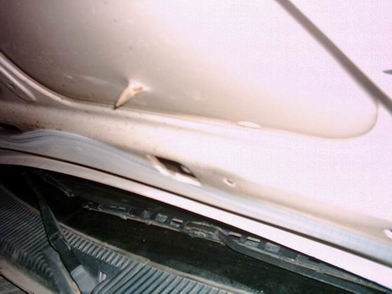
Ak-47 round through the hood of my car, back from July 2004.

So I was in the middle of my task when firefight broke out about a mile away, small arms, machineguns, grenades were used. I immediately ducked at a corner thinking that was a safe spot. I lit up a cigarette and decided to wait it out. My idea of that spot proved wrong immediately when I looked around and saw two ak-47 bullets and a 9mm bullet in the very square meter I was sitting in. seeing the flattened tips of the bullets I realized that they must have bounced to the ground after slamming into the same wall I was leaning on. It's a corner, so there could be no other explanation.

I jumped on my feet and rushed downstairs, wasted a couple hours watching TV until the firing stopped, then I went back up and finished my work. But when I went down to check the connection there was none. Because by the time I finished fixing the antenna it was getting dark and apparently I didn't put it in the correct angle for reception.

Now if you're not familiar with the way we use to get our connection I'll describe here in brief….
Since having your own via-sat link is too expensive for the average household and since we have no DSL service most internet users in Baghdad use the Baghdad-style wireless. By wireless I'm referring to the connection between the provider and the antenna of the user, not the one inside the house. In other words one local provider would set up a via-sat link and puts up a transmitter on his rooftop and subscribers in the neighborhood would point their antennas toward the transmitter, the antenna through a cable sends the signal to an access point and then to the computer either through another cable or wireless depending on the type of the access point.

Back to my stray bullet phobia…Am I overreacting? I don't know but the frequency of incidents has definitely influenced some of my habits.

The other day I was reading in the garden, it's now a habit for me to spend an hour or two reading in the garden when there's no electricity. I put two chairs facing each other one to sit on and the other for my feet and I put my cigarettes, ashtray and cup of tea or coffee on a small table always on my right.

So I was just beginning my reading when I heard some volleys of fire and before I could even make a decision whether to get in or stay a .50 cal round hit the wall. I ran inside and waited leaving my stuff out. It was quiet after maybe ten minutes so I went back to the garden. Another two more pages and the fighting resumed and again another .50 cal round was there, this time hitting the palm tree.

Long story short, after more than an hour of running between the living room and the garden I finally gave up. So I went on one last mission to retrieve the book and cigarettes and continued to read inside taking advantage of the last fading rays of sunlight coming through the window.

I know this was a lot of whining on my part but I just thought it would give you an idea of some of the odd things about living in this city, or maybe because I'm pissed off that Mohammed was laughing watching me running back and forth like an idiot, or perhaps I'm using this as an implicit excuse for not writing more often. Heh.

Anyway, the connection is working fine now, relatively, and I'm about to finish the book I was reading; just some twenty pages left, so excuse me.

Thursday, April 12, 2007

Jisr al-Hadeed

This morning Baghdad lost one of its historic icons when the terrorists blew up the Sarrafiya Bridge. This was an attack on both a vital infrastructure of the city and our morale, let alone the innocent lives that were lost in this vicious attack. What we lost today was not just a bridge, it was a piece of the Baghdad history.

Jisr al-Hadeed (“the iron bridge”), as many Baghdadis like to call it, was the first fixed bridge to be built over the Tigris as a gift from the British to the Iraqi people back in the 1940s.
I have many beautiful memories of Jisr al-Hadeed; memories of how many times I sat in that coffee shop and stared at the glittering reflections of its lights on the water, of how many evenings I sat under it with friends. When we were young and couldn’t drink at home, the Nazla (the river bank immediately under the bridge) was one of our favorite spots. Once there we’d drink cold beers in hot summer nights, with the sound of the slow and small waves of the Tigris as our music….

With several other bridges closed to traffic permanently or occasionally, the Sarrafiya Bridge became of strategic importance to us as more people became dependent on it for their traveling between the two sides of the city.

The terrorists wanted to stop normal life with this attack and they succeeded. Transportation between Karkh and Rasafa just got more difficult than ever. In addition, many people will avoid being on bridges for fear of similar attacks in the future.
Technically, the northern half of the city is now left with no usable bridges. Those in the southern half are either too far for most Baghdadis, closed, or have a dangerous spot at one of their ends.

The timing of the explosion in the early morning suggests the terrorists were more interested in destroying the bridge itself than killing civilians. If the detonation had been by merely 2 or 3 hours later the casualties would’ve been much larger. Now that this has happened the idea that they may be planning more of such attacks is terrifying. It takes months to rebuild a bridge and the damage to the economy and morale is really severe.

Everyone I talked to today was more saddened by the bridge attack than the explosion at the parliament building that killed two of its members. They all seemed to agree that if there’s anyone to blamed for that it’s the members of parliament themselves. Parliament members are famous for complaining about ‘security measures’ in the Green Zone being “insulting” to them and to Iraq’s sovereignty. They didn’t want their vehicles and guards to be searched. This is the result.

The incident was no surprise to me, when we often hear that bombs, explosive vests and illegal weapons have been found in buildings inside the International Zone. You just knew that one day something bad was going to happen. The MPs know very well that there are bad elements among their guards, yet they didn’t move to tighten security measures in the area nor done anything to identify and remove corrupt guards.

Apart from who’s to blame for it, the parliament bombing will reflect in a bad way on its performance. I suspect reaching quorum in future sessions, which is necessary to vote on any law, will now be even more difficult.

Tuesday, April 10, 2007

Fierce fighting in central Baghdad.

Ok, let's go over what happened yesterday and today; last thing first. And please forgive me for the lack of chronological order, some information were received or corrected during the preparation of the post.


Unlike yesterday today began with an acute escalation in central Baghdad, particularly in al-Fadh and Sheik Omar districts where an American helicopter was hit around 9:30 this morning with ground fire and crashed near an old cemetery in the area, the Baghdad reporter of al-Arabiya first mentioned. There are also conflicting reports that another helicopter got hit but survived the attack.

I'm looking at this Reuters report (from 4pm) and it says the US military denied a crash occurred and now the latest news from al-Hurra (5pm) said nothing about attacks on helicopters but said the fighting was part of a joint Iraqi US operation to capture large numbers of suspects "in order to gather intelligence"

During the morning more US and Iraqi forces rushed into the scene and cordoned the area while two F-18 fighter jets and some Apache gunships patrolled above. The fighter jets withdrew after a while.
The fighting became more intense and at around 11 am several explosions were heard in the area but the cause remained unknown.

At around noon firefights erupted in the area and the sound of heavy machineguns was heard and from my rooftop I could see Apache helicopters engage at least one target with 30mm canon fire and perhaps small rockets, I couldn't be sure because the sounds were overlapping but zooming in through the finder of my camera I saw lines of smoke behind the patrolling Apaches and seconds later I could hear the sounds.

At 1 in the afternoon the fighter jets returned to the scene but this time only one F-16.
The tension and occasional clashes spread to involve a wide area in the center of eastern Baghdad including parts of Bab al-Mua'dam and al-Kasra.

A friend of mine who's a doctor at Baghdad's medical city said he and his colleagues were afraid to leave the complex because of the fighting going on in the streets.

Between 2 and 3 pm a few more explosions were heard and there was more heavy machinegun fire but now the situation has calmed down. At 5:20 it seems quiet from my place.
Ok, not exactly quiet, the last blast we heard 20 minutes ago turned out to be a suicide bomber who detonated himself (or his vehicle, not sure) somewhere in al-Waziriya not far from the main spot of fighting.

Correction: The last incident was a "controlled" detonation of an IED, not a suicide bombing.

***

Yesterday passed peacefully, that's without any major incident recorded anywhere in the country.
I think it was a good decision to have an extended curfew, it prevented the clowns from organizing demonstrations in Baghdad, otherwise bad things would've been very difficult to avoid.

The situation in Diwaniya has calmed down a little bit and most militiamen are off the street, reportedly after receiving orders from Moqtada.
This didn't mean the operation has ended and the troops are still conducting house to house searches.

Sadr's militias always employ the "hide your weapons" approach to end the crises they start each time they are confronted with overwhelming force from the US and Iraqi military. I can't say for sure what good that does to them in the long run, one simply can't read a mind like Moqtada's but perhaps it's one of their PR stunts that are for domestic consumption, to show that their will to build peace is what ends the fighting and that they withdraw from the streets not out of fear from the troops but because they're doing it for the best of the people.
It's always "we'll get our weapons off the streets" maneuver—the half solution that relieves pressure and allows them to keep their force for future mischief.

Anyway, this might not work our perfectly for them this time in Diwaniya because the troops entered the city with the intent to strike the militia hard and capture its leaders.
A relative who lives there with whom I spoke on the phone last night said the troops are conducting raids on specific targets, aimed at capturing elements identified on a wanted list.

The commander of the 8th IA division in charge of the area was obviously suspicious of the demonstrations organized by the Sadrists in nearby Najaf (about 50km to the west) and he realized that demonstrators would possibly become reinforcements to the militiamen his soldiers are fighting so he made clear last night on TV that no marchers from other cities would be allowed to enter Diwaniya.

Speaking of the Sadrists' pitiful demonstrations. His aides were hoping to gather a million marchers for yesterday but all they could manage were less than ten thousands, that's even when they bussed people from Baghdad and Basra.
The Arabic-speaking al-Alam Iranian channel claims the number was "hundreds of thousands" but that's just al-Alam, other channels and the footage we saw all put the number between 5 and 10 thousand.
I had personally been to a demonstration of 10 thousands once and what I saw yesterday was definitely smaller.

Flying Iraqi flags in large numbers is another exposed cheap trick combining methods from both Hezbollah and Saddam.
Replacing partisan sectarian banners with the national flag was likely inspired from Hezbollah's rallies in Lebanon. Both movements desperately try to show themselves as patriotic movements because they realize the others see them as Iran's tools.

On the other hand the way the flags were gathered is a trademark of the Ba'ath work; the flags that were carried during the demonstration as well as the flags that were seen hanging on walls in Baghdad were not donated by NGO's, nor bought with Sadr's money.
Elements of the Mehdi army paid visits to hundreds of shops and stores in several neighborhoods in Baghdad and "asked" the owners for money to buy flags; 6,000 dinars ($5) from stores on main streets and 2,000 dinars from stores in the alleys. This is exactly what the Ba'ath thugs used to do; using intimidation to steal hard-earned money from hardworking Iraqis to decorate their false demonstrations with posters and portraits.


That's all I have for now. Will make an update if I find more about what's going on.

Whereabouts.

I've been without internet access for a whole 48 hours.
The connection is up again but it's only temporarily fixed and I'm not sure if it's going to hold steady. I'm waiting for a friend to come and fix it right, if he succeeds I will have some updates for you on the quiet yesterday and no-so-quiet today.

If you have sent me emails but received no response from me , I ask for your patience.

Friday, April 06, 2007

Baghdad is Quiet, Mosul is Trying to Impose Law.

It seems that in Iraq days just refuse to pass silently and they insist on having their own incidents.
Today and yesterday are no exception and several significant incidents happened, or still happening, in the fourth corners of the country. Except for Baghdad which remained quiet today.

In the west, particularly in Anbar, the Anbar Awakening Council announced the capture of what appears to be an intelligence treasure. This is what sheik Hameed al-Hayis, a member of the Council told al-Sabah yesterday:

We captured so many of their document and these contain the names of al-Qaeda groups in the province, the letters that were exchanged among those groups, the surveillance reports they were filing to their Emirs about civilian people of Ramadi like clerics and college students as well as details of trials [and executions] to which innocents were subjected.


The al-Qaeda terrorists in Anbar continue their campaign to terrorize the population that is turning against them. This morning another attack with a chlorine gas bomb struck western Ramadi killing and injuring dozens of civilians and policemen.
No wonder al-Qaeda is sending more of their suicide bombers to murder the people of Anbar; a friend of mine who visited the area just two days ago said he saw a crowd of young men near an ISF recruiting center that was "larger than anything else I had seen in Baghdad"

In Diwaniya, the mid-south city to which many Mehdi army militiamen and commanders escaped from the Baghdad operation, Iraqi and US forces are clashing with elements of the Mehdi army.
The reports we're getting show that 5 were killed and 15 others were injured in the fighting so far.
Al-Arabiya TV reported that the joint force has secured at least two sectors of the city and has also found 2 bomb factories during the ongoing house to house search operations.
It's worth nothing that the situation in the mid-south region provinces has been tense for some time; over the last month or so there have been several minor clashes between the local security forces and the Mehdi army in several places in and around Hilla just north of Diwaniya.

Radio Sawa has a report that adds to the available details on today's clashes:

A security official who spoke on condition of anonymity said that paratroopers from the 25th US division arrived in the city on Thursday and on Friday dawn surrounded four districts in the center of the city. The neighborhoods are Jumhoriya, Urooba, Iskan and Nahda.
The sources added that 1,400 Iraqi soldiers arrived from Najaf, Babil, Wasit and Kerbala, supported by an American force, to conduct raids on militants' hideouts.


Official MNF-I report here.

Further south in Basra where 4 British soldiers were killed on early Thursday the police commander thinks the IED that was used in the attack was of a new unusual type, perhaps an EFP. The whole thing just makes me wonder if this was the "gift" Nejad was actually referring to.

In Nineveh in the north it looks like the operation that was announced a few days ago is making some progress. Iraqi and US forces killed 8 militants and captured 179 suspects during recent operations across the province, New Sabah reports:

Governor Duraid Kashmoula said the Iraqi security forces are performing a security operation similar to operation Imposing Law in Baghdad. The goal is to prevent terrorists from establishing bases in Mosul…Soldiers from the 2nd and 3rd Divisions of the Iraqi army and Iraqi police raided targets suspected of being used as bomb-factories and weapon caches. 179 suspects were arrested and 8 militants killed during the two-day operations. The security forces have also found various light arms, munitions and bomb-making materials.
The Iraqi police confiscated amounts of black market fuel [illegally taken from gas stations] and this fuel will be used to run the generators and vehicles of the security forces to increase their capability of performing more frequent patrols and provide better security to the province.


Finally on a more cheerful note, Iraqi Christians in Kurdistan started their 12 day-long festival to celebrate the new Assyrian-Babylonian year.
You'd think it's 2008 or something? Wrong!
It's year 6757 in the calendar of ancient Mesopotamia and it marks the anniversary of the beginning of a long love story between Tammouz, the god of fertility (or war? Not sure) and Ishtar the goddess of love and beauty.