
New points of view about the future of Iraq and the Middle East.
Monday, February 28, 2005

Big Pharaoh posted an initial analysis for Mubarak's latest announcement of constitutional amendment and changes in presidential election rules.
If you apply for a job then you're an "agent" and if you want to see democracy and freedom in your country then you're an "infidel" and if you say that resistance is terrorism then you're a "traitor".
In all cases your blood is cheap and you have to die.
This is the philosophy of the criminal gangs we're facing and this morning they declared it again in the bloodiest way they could find.
In all cases your blood is cheap and you have to die.
This is the philosophy of the criminal gangs we're facing and this morning they declared it again in the bloodiest way they could find.
The oppressive regimes in the region do not seem willing to allow free speech, blogging is no exception and unfortunately there will be more arrests and injustice against bloggers and real journalists as long as there are no serious reforms.
Mahmood reports that a Bahraini blogger has been arrested yesterday without definite charges so far. Jeff Jarvis has more details on this.
Mahmood reports that a Bahraini blogger has been arrested yesterday without definite charges so far. Jeff Jarvis has more details on this.
Quote of the day:
The fact that so many people, and not just the Sunni sheikhs, now want the piece of the Iraqi action perhaps tells us more about the true situation and future prospects in Iraq than most current news reports. As the old saying goes; victory has many fathers, defeat is an orphan. That the waiting room of the Middle Eastern maternity ward is getting increasingly crowded with paternity claimants is a good - if an indirect sign - that the things in Iraq might be going better than one would think based on the mainstream media coverage.
From Chrenkoff's latest piece of "Good news from Iraq".
The fact that so many people, and not just the Sunni sheikhs, now want the piece of the Iraqi action perhaps tells us more about the true situation and future prospects in Iraq than most current news reports. As the old saying goes; victory has many fathers, defeat is an orphan. That the waiting room of the Middle Eastern maternity ward is getting increasingly crowded with paternity claimants is a good - if an indirect sign - that the things in Iraq might be going better than one would think based on the mainstream media coverage.
From Chrenkoff's latest piece of "Good news from Iraq".
Sunday, February 27, 2005
I guess it's time for some photo-blogging tonight but this time it's not going to be from Baghdad.
As I mentioned yesterday I was out Baghdad for a couple of days. More precisely I was in Erbil and this was my 1st trip to the north in general and to this city in particular. I noticed a few things up there that caught my attention; the 1st one is that Iraqi flags are absent and instead there are the flags of Kurdistan and this is something that I can't blame the Kurds for because of what they suffered under this flag which is still considered a reminder of the dark past for many Iraqis.
Anyway, these are formalities that will be discussed later after the permanent constitution is written approved and it's a waste of time to be concerned about it at the moment.
Still there's one thing that smelled fishy; there were offices for the KDP in almost every street of the city. In Baghdad we have many parties' offices too but here they're for different parties not for one party like in Erbil. I don't know whether we should be concerned about this but I don't feel comfortable with the idea.
I have also noticed that the city is more organized in general; police and Army forces have a strong presence and they're doing their job in a good way and it's fair to say that security is not a concern for the citizens of Erbil. The city has witnessed only one or two big suicide attacks since 2003 and the last one was about a year ago.
The most interesting finding was that traffic lights are functioning there! Something Baghdadis and Iraqis in most of the country's cities have been missing for a long time now.
The infra structure of the city seems like one that has been neglected for a long time and just starting to develop now and this is understandable because of the low budgets assigned for the 3 northern provinces of Kurdistan before April 2003.
But now one could see too many projects and facilities under construction. As a matter of fact there are whole neighborhoods popping up around the city center with municipal services being worked on by the authorities at the same time that people are building their new houses.
I've got some other pictures for you to see, the 1st one is for a housing compound of some 500 apartments at the gate of the city and it's going to be ready soon as you can judge from the picture. This picture is for the TOYOTA agency while this one is for the cultural center that belongs to the University.
Here's a photo for an old prison on the road between Kirkuk and Erbil that Saddam used to lock Iranian POWs in during the war in the 80s and by the way, there are more like this one and they're all in ruins now.
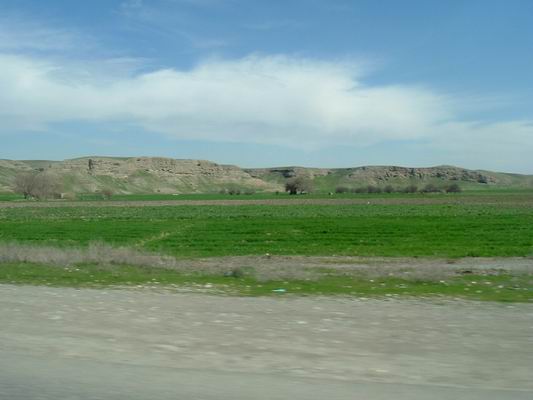
Finally, a few shots for the green fields and hills to consider if someone is planning for a picnic!
As I mentioned yesterday I was out Baghdad for a couple of days. More precisely I was in Erbil and this was my 1st trip to the north in general and to this city in particular. I noticed a few things up there that caught my attention; the 1st one is that Iraqi flags are absent and instead there are the flags of Kurdistan and this is something that I can't blame the Kurds for because of what they suffered under this flag which is still considered a reminder of the dark past for many Iraqis.
Anyway, these are formalities that will be discussed later after the permanent constitution is written approved and it's a waste of time to be concerned about it at the moment.
Still there's one thing that smelled fishy; there were offices for the KDP in almost every street of the city. In Baghdad we have many parties' offices too but here they're for different parties not for one party like in Erbil. I don't know whether we should be concerned about this but I don't feel comfortable with the idea.
I have also noticed that the city is more organized in general; police and Army forces have a strong presence and they're doing their job in a good way and it's fair to say that security is not a concern for the citizens of Erbil. The city has witnessed only one or two big suicide attacks since 2003 and the last one was about a year ago.
The most interesting finding was that traffic lights are functioning there! Something Baghdadis and Iraqis in most of the country's cities have been missing for a long time now.
The infra structure of the city seems like one that has been neglected for a long time and just starting to develop now and this is understandable because of the low budgets assigned for the 3 northern provinces of Kurdistan before April 2003.
But now one could see too many projects and facilities under construction. As a matter of fact there are whole neighborhoods popping up around the city center with municipal services being worked on by the authorities at the same time that people are building their new houses.
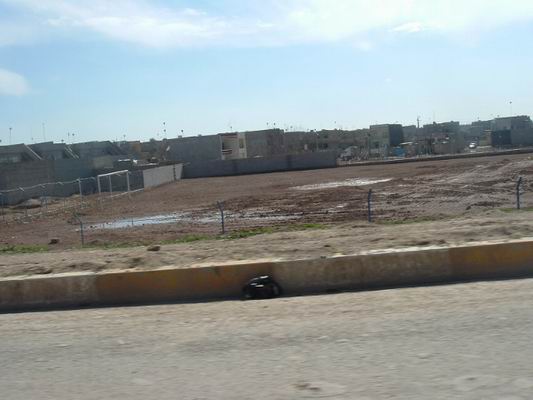
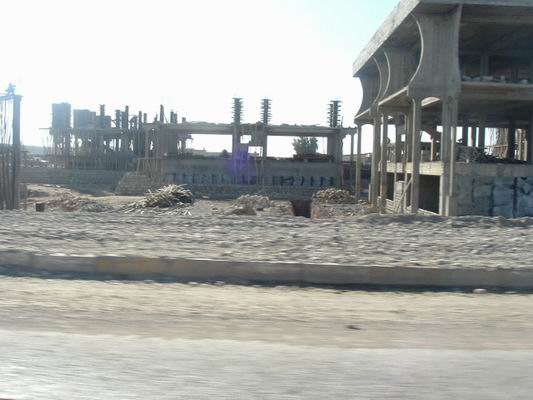
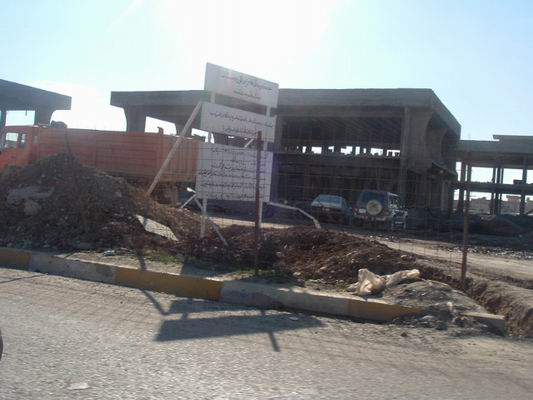
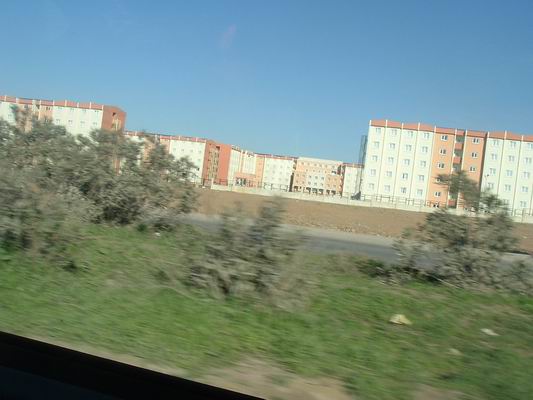
I've got some other pictures for you to see, the 1st one is for a housing compound of some 500 apartments at the gate of the city and it's going to be ready soon as you can judge from the picture. This picture is for the TOYOTA agency while this one is for the cultural center that belongs to the University.
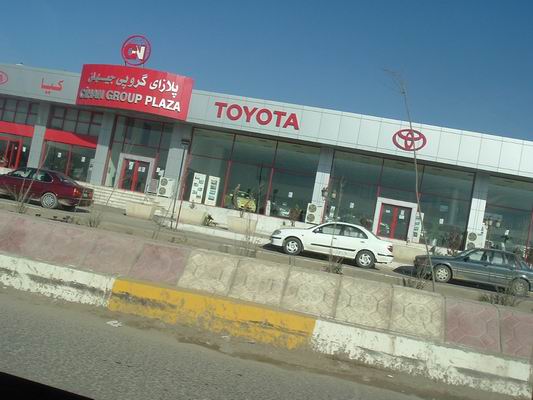
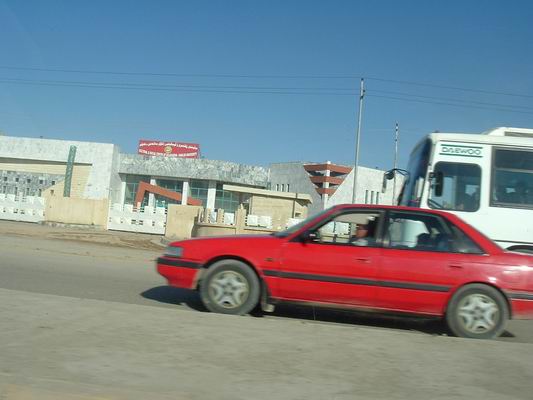
Here's a photo for an old prison on the road between Kirkuk and Erbil that Saddam used to lock Iranian POWs in during the war in the 80s and by the way, there are more like this one and they're all in ruins now.
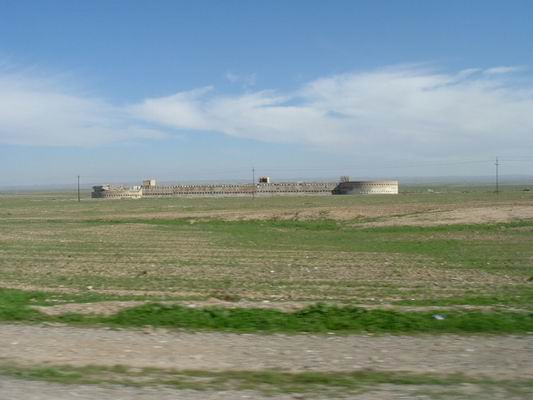
Finally, a few shots for the green fields and hills to consider if someone is planning for a picnic!
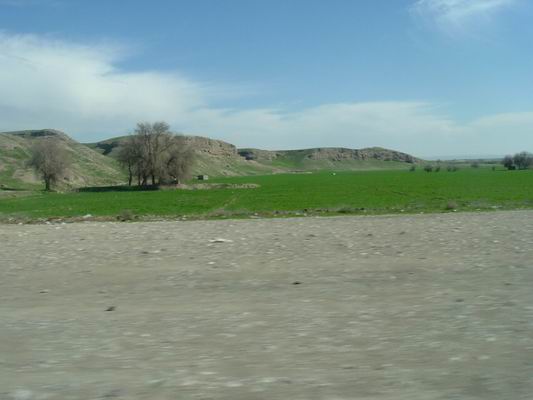
Saturday, February 26, 2005
Blogging Vs Terror (Part 1)
I had a date with Najaf yesterday. The trip this time was a special one because I was there to give lectures to spread blogging and to talk about the importance of blogging and the ways to get blogs and use them. It is a part of the Arabic blogging project of the Friends of Democracy that aims at connecting intellectuals, students and NGOs (especially women NGOs) through a network of blogs that facilitates communication and gives democratic debates a push forward through exchanging opinions and sharing ideas among all the parties and the communities in different cities, all through blogging.
That's why our team was so excited and we were talking all the way about the significance of this networking project, the obstacles and the goals.
Our destination this time was Najaf, the holy city for She'at Muslims and the cultural center for their religious teachings. The city has preserved its traditions and heritage over centuries and it's a strictly conservative city and you can't see a single woman walking in the street without wearing Hijab. There are also no liquor stores or night clubs or cinemas in the city which is full of shrines for great men in the Islamic history and contains many religious schools that surround the shrine of Imam Ali (the cousin of Prophet Mohammed).
We arrived at noon to find that the atmosphere was tense, we asked the restaurant keeper while we were waiting for our lunch to be served about the reason behind the extensive security measurements on the streets:
"it's the last day for the Ashoura ceremonies and Muqtada's followers have come in large numbers to show respect for the holy city and practice the ceremonies" the restaurant keeper clarified "but we don't feel comfortable with them being around, the troubles started like this last year; the came to visit the shrine but later they refused to leave and occupied the shrine" the worried man added.
The people I met later were also skeptical and scared form the idea that what happened last year can happen again.
We walked through the crowds of the visitors to the hotel we were supposed to stay at for the night.
The hotel wasn't in a good condition as there were some evidence of the battles that took place in the city but the owner who's a friend of mine managed to prepare a couple of nice and clean rooms for us.
We sat together discussing tomorrow's plans and the current situation in the city while watching the Iraqiya TV. This channel has a daily broadcast now that shows samples of the arrested terrorists who are responsible for beheadings and other disgusting crimes.
We were divided; some of us were with the broadcast while the others were against it. One guy who's a Najaf resident said:
"these butchers are not like a simple flu, they're a malignant disease and we need a bitter and rough medicine to get rid of. Showing their pictures on TV is a crucial thing that is needed to expose them to the people. Iraqis need to know who those masked men really are. Iraqis in majority are shocked by the huge amounts of reveled facts as most of the animals we're watching on TV are serious criminals trained and paid for by the intelligence systems of a terror-supporting regime; that is Syria".
I have pointed this out in a previous post, the Ba'ath regime throughout its criminal history has depended from its early days back in the 50s on criminal elements and local thugs in Baghdad and other cities. The most prominent example was hiring Saddam at that time who was already accused of murdering his own cousin.
And the Ba'athists still adopt this tactic until this moment. The Syrian regime is no exception for this and is also trying-through recruiting paid killers in Iraq-to spread terror and fear and put obstacles on the road of the change.
I think this is also going to happen in Lebanon too after the Syrian troops are withdrawn. The Syrian regime will recruit (if not doing so right now) criminals to carry out sabotage and assassinations after the Syrians leave the country in an attempt to say "we have warned you from the dangers of withdrawal and now you've got to face the consequences ".
The broadcasted confessions of Syrian elements who work for the intelligence give a clue about what's being planned for Lebanon.
Some of us got panicked by the scenes and the statements of those butchers but one guy from the team said "we will strike back through blogs" I agreed with his words so I told my friends about a short conversation I had with someone a few months ago; that person said that terrorists have the capability to prepare video clips for their operations and have them broadcasted on the web in less than 48 hours.
Well, that's fine, now we're going to expose the terrorists and their evil doings and show it to the public opinion in Iraq and the world in a matter of few hours or even sometimes in minutes and the world then will hear our voice first before the terrorists can get their ugly voice out.
Most of the terror activities are run from bases in Syria and a few other places outside Iraq but the future blogs will be here right on the event spot itself. The people will have the ability to show their activities and thoughts and publish them faster and more often than the idiotic terrorists and this way the people (the freedom lovers) will feel stronger and more united and this can make them even more determined to confront the threats.
We've already seen this happening in a limited manner through the number of blogs that are linked to by the friends of democracy website; they were able to get the news to the readers way faster than the media did.
One blog has exposed a few aspects of the crimes of the Syrian regime against the Kurds in Syria and today, one blogger from Najaf was the 1st source to publish pictures for some terrorists trying to enter the Iraqi lands from Saudi Arabia.
The blogs can be a powerful weapon in the face of terror and we will have our network which will be for sure stronger than the terrorists'. There is just a few of them while we are the majority and this was seen clearly on the great elections day.
All we have to do is to organize ourselves using what modern technology has offered us.
I think this is enough for now and I will save the rest of the story for another post, maybe tomorrow. And then I will tell you the reaction of the people to the lectures we held in Najaf which were attended also by interested people from Samawa, Hilla and Diwaniyah.
To be continued.
Mohammed.
That's why our team was so excited and we were talking all the way about the significance of this networking project, the obstacles and the goals.
Our destination this time was Najaf, the holy city for She'at Muslims and the cultural center for their religious teachings. The city has preserved its traditions and heritage over centuries and it's a strictly conservative city and you can't see a single woman walking in the street without wearing Hijab. There are also no liquor stores or night clubs or cinemas in the city which is full of shrines for great men in the Islamic history and contains many religious schools that surround the shrine of Imam Ali (the cousin of Prophet Mohammed).
We arrived at noon to find that the atmosphere was tense, we asked the restaurant keeper while we were waiting for our lunch to be served about the reason behind the extensive security measurements on the streets:
"it's the last day for the Ashoura ceremonies and Muqtada's followers have come in large numbers to show respect for the holy city and practice the ceremonies" the restaurant keeper clarified "but we don't feel comfortable with them being around, the troubles started like this last year; the came to visit the shrine but later they refused to leave and occupied the shrine" the worried man added.
The people I met later were also skeptical and scared form the idea that what happened last year can happen again.
We walked through the crowds of the visitors to the hotel we were supposed to stay at for the night.
The hotel wasn't in a good condition as there were some evidence of the battles that took place in the city but the owner who's a friend of mine managed to prepare a couple of nice and clean rooms for us.
We sat together discussing tomorrow's plans and the current situation in the city while watching the Iraqiya TV. This channel has a daily broadcast now that shows samples of the arrested terrorists who are responsible for beheadings and other disgusting crimes.
We were divided; some of us were with the broadcast while the others were against it. One guy who's a Najaf resident said:
"these butchers are not like a simple flu, they're a malignant disease and we need a bitter and rough medicine to get rid of. Showing their pictures on TV is a crucial thing that is needed to expose them to the people. Iraqis need to know who those masked men really are. Iraqis in majority are shocked by the huge amounts of reveled facts as most of the animals we're watching on TV are serious criminals trained and paid for by the intelligence systems of a terror-supporting regime; that is Syria".
I have pointed this out in a previous post, the Ba'ath regime throughout its criminal history has depended from its early days back in the 50s on criminal elements and local thugs in Baghdad and other cities. The most prominent example was hiring Saddam at that time who was already accused of murdering his own cousin.
And the Ba'athists still adopt this tactic until this moment. The Syrian regime is no exception for this and is also trying-through recruiting paid killers in Iraq-to spread terror and fear and put obstacles on the road of the change.
I think this is also going to happen in Lebanon too after the Syrian troops are withdrawn. The Syrian regime will recruit (if not doing so right now) criminals to carry out sabotage and assassinations after the Syrians leave the country in an attempt to say "we have warned you from the dangers of withdrawal and now you've got to face the consequences ".
The broadcasted confessions of Syrian elements who work for the intelligence give a clue about what's being planned for Lebanon.
Some of us got panicked by the scenes and the statements of those butchers but one guy from the team said "we will strike back through blogs" I agreed with his words so I told my friends about a short conversation I had with someone a few months ago; that person said that terrorists have the capability to prepare video clips for their operations and have them broadcasted on the web in less than 48 hours.
Well, that's fine, now we're going to expose the terrorists and their evil doings and show it to the public opinion in Iraq and the world in a matter of few hours or even sometimes in minutes and the world then will hear our voice first before the terrorists can get their ugly voice out.
Most of the terror activities are run from bases in Syria and a few other places outside Iraq but the future blogs will be here right on the event spot itself. The people will have the ability to show their activities and thoughts and publish them faster and more often than the idiotic terrorists and this way the people (the freedom lovers) will feel stronger and more united and this can make them even more determined to confront the threats.
We've already seen this happening in a limited manner through the number of blogs that are linked to by the friends of democracy website; they were able to get the news to the readers way faster than the media did.
One blog has exposed a few aspects of the crimes of the Syrian regime against the Kurds in Syria and today, one blogger from Najaf was the 1st source to publish pictures for some terrorists trying to enter the Iraqi lands from Saudi Arabia.
The blogs can be a powerful weapon in the face of terror and we will have our network which will be for sure stronger than the terrorists'. There is just a few of them while we are the majority and this was seen clearly on the great elections day.
All we have to do is to organize ourselves using what modern technology has offered us.
I think this is enough for now and I will save the rest of the story for another post, maybe tomorrow. And then I will tell you the reaction of the people to the lectures we held in Najaf which were attended also by interested people from Samawa, Hilla and Diwaniyah.
To be continued.
Mohammed.
Announcement.
I was out of town for the last few days and that's why I haven't been posting anything and I actually haven't read the comments that came in response to my last post until yesterday night. Well, not exactly in response and that's what I want to talk about. Frankly speaking, I'm so pissed off. Not of any of the commentors in person but of the whole comments section and the ways it's being used.
Many of you are close to my heart like friends and I don't want anyone to feel offended but this has gone far beyond tolerable; the comments section of this blog is being ABUSED.
I spent a long time thinking of a way to bring order and respect back again to the section but couldn't find a real cure. So here's the new rule that will be applied until I find a better idea.
Each reader will have the right to post ONLY 2 COMMENTS and nothing more than that. Any reader who violates this temporary rule will be banned for indefinite time. Moreover, anonymously posted comments will be deleted. I don't know if I'm going to have the time to keep monitoring the section but I will do my best to keep the section clean.
We have always enjoyed reading your comments and we still enjoy reading most of them but there is a number of comments that are unacceptable and can harm the reputation of this blog and it's readers as well.
This rule is active starting from this moment.
And I don't think I need to remind you that comments that incite violence and/or racism and comments that contain threats and/or effensive language are not permitted on this blog's comment section too.
By the way, the contact e mail address for this blog has been changed. Now it's itmblog@gmail.com
Many of you are close to my heart like friends and I don't want anyone to feel offended but this has gone far beyond tolerable; the comments section of this blog is being ABUSED.
I spent a long time thinking of a way to bring order and respect back again to the section but couldn't find a real cure. So here's the new rule that will be applied until I find a better idea.
Each reader will have the right to post ONLY 2 COMMENTS and nothing more than that. Any reader who violates this temporary rule will be banned for indefinite time. Moreover, anonymously posted comments will be deleted. I don't know if I'm going to have the time to keep monitoring the section but I will do my best to keep the section clean.
We have always enjoyed reading your comments and we still enjoy reading most of them but there is a number of comments that are unacceptable and can harm the reputation of this blog and it's readers as well.
This rule is active starting from this moment.
And I don't think I need to remind you that comments that incite violence and/or racism and comments that contain threats and/or effensive language are not permitted on this blog's comment section too.
By the way, the contact e mail address for this blog has been changed. Now it's itmblog@gmail.com
Tuesday, February 22, 2005
Comparing tyrannies
Big Pharaoh has brough an interesting point to the surface that illustrates one of the most important differences between Saddam's regime and the rest of the dictatorships in the region.
When people outside Egypt see such demonstrations, they think that the entire Egyptian population is asking Mubarak to step down. This is not true. While millions of Egyptians are dismayed at the state of the country, they are living in political stagnation because they're busy striving to put food on the table. They simply don't want troubles.
While Egyptians for example are busy finding a way to put food on the table, for Iraqis, the situation was like no matter what you do you won't be sure you can do that.
In other words; regimes such as the Egyptian one have given their people a tiny window to breathe through while Saddam and the Ba'athists strangled the people with all the power they could find.
For example, in these countries, you have the freedom to travel, to use the internet and communicate with the out world, to start a political party and to even declare your opposition to the government publicly. Doing such things in Saddam's time would in most cases lead to death punishment.
I recalled a short conversation I had a year ago with an Egyptian dentist who lived in Iraq (don't know whether he's still here till now).
I met the man in a dental conference in Baghdad and we had a short discussion on the situation here and the close similarities between the two regimes; the one that was defeated in Iraq two years ago and the one that is still in power in the man's homeland.
I was literally shocked when he told me how he witnessed the eruption of the extremist Ayman Al-Zawahiri, the no 2 man in Al-Qaeda. They were both studying in the same university (in Alexandria I guess) back in the seventies. I was trying to hear the full story, something that he apparently didn't like to do so he suddenly interrupted me and ignored my ton of question saying:
No, the regime you had here was more brutal, that's true but the regime in Egypt is worse
I was a little confused here and he saw the questioning look on my face and went on explaining
In Iraq, the moment you oppose the regime, you're dead or if you were lucky you would get locked in a one square meter cell for the rest of your life while in my country they would let you talk as long as you're just talking and when you switch to the active ways of opposition, they would arrest you and put you in prison for a couple of years. After you're out they would keep watching you and if they found that you didn't learn the lesson then you'd get another sentence in prison, only this time you would spend more years than in the 1st time. And the game can last forever until you lose all hope inside and you're completely depleted and you decide to give up or take the risk of facing worse consequences.
I think I agree with this man's perspective, not only because he's a fellow dentist! but because what he said makes a lot of sense and there are facts that support his opinion.
The people in Iraq as a result of the extreme brutality of the past regime had put the regime out of their lives and they chose to live on their own and not depending on the charity Saddam offered every other decade while in Egypt or even Syria the simple people still feel somewhat connected to the regimes and depend on them in many aspects of their lives.
We saw in 1991 how the people in Iraq stood against the regime and carried their arms to get their freedom after seeing the 1st signals of Saddam losing control. At that time there were no coalition troops on Iraqi soil to help them and the people seized what they considered a good chance and they looked for troubles! Again, in March 2003 Iraqis in general didn't resist the change and they took a passive stand not because they don't want the change but because they were afraid of being left alone again.
What I want to say here is that a high percentage of the people in countries like Egypt have lost the motivations or more accurately, they are afraid of what might happen if their countries undergo a premature change.
I say, take a look at my country and learn from my people and have faith in yourselves because if you keep thinking with such negativity you will never get the change you want. If the people really want something they can achieve it and they will find many hands reaching out for them with support and advice.
We in Iraq weren't fully prepared for the change here as well but we took advantage of the moment and we believed that this is what we want. Many spectators were expecting a civil war in Iraq and it didn't happen and won't happen and many are still warning of a possible theocracy in Iraq and I believe that this is impossible too.
Bottom line is: the world has changed, we're not living in the fifties anymore and when a tyrant is kicked out, no other tyrant can claim his place. Why? Because nothing can be done behind closed doors anymore, the whole world can watch and have a say in almost everything everywhere and the era when thugs could reach power against a nation's choice is over. The world has simply changed and the change cannot be reversed.
When people outside Egypt see such demonstrations, they think that the entire Egyptian population is asking Mubarak to step down. This is not true. While millions of Egyptians are dismayed at the state of the country, they are living in political stagnation because they're busy striving to put food on the table. They simply don't want troubles.
While Egyptians for example are busy finding a way to put food on the table, for Iraqis, the situation was like no matter what you do you won't be sure you can do that.
In other words; regimes such as the Egyptian one have given their people a tiny window to breathe through while Saddam and the Ba'athists strangled the people with all the power they could find.
For example, in these countries, you have the freedom to travel, to use the internet and communicate with the out world, to start a political party and to even declare your opposition to the government publicly. Doing such things in Saddam's time would in most cases lead to death punishment.
I recalled a short conversation I had a year ago with an Egyptian dentist who lived in Iraq (don't know whether he's still here till now).
I met the man in a dental conference in Baghdad and we had a short discussion on the situation here and the close similarities between the two regimes; the one that was defeated in Iraq two years ago and the one that is still in power in the man's homeland.
I was literally shocked when he told me how he witnessed the eruption of the extremist Ayman Al-Zawahiri, the no 2 man in Al-Qaeda. They were both studying in the same university (in Alexandria I guess) back in the seventies. I was trying to hear the full story, something that he apparently didn't like to do so he suddenly interrupted me and ignored my ton of question saying:
No, the regime you had here was more brutal, that's true but the regime in Egypt is worse
I was a little confused here and he saw the questioning look on my face and went on explaining
In Iraq, the moment you oppose the regime, you're dead or if you were lucky you would get locked in a one square meter cell for the rest of your life while in my country they would let you talk as long as you're just talking and when you switch to the active ways of opposition, they would arrest you and put you in prison for a couple of years. After you're out they would keep watching you and if they found that you didn't learn the lesson then you'd get another sentence in prison, only this time you would spend more years than in the 1st time. And the game can last forever until you lose all hope inside and you're completely depleted and you decide to give up or take the risk of facing worse consequences.
I think I agree with this man's perspective, not only because he's a fellow dentist! but because what he said makes a lot of sense and there are facts that support his opinion.
The people in Iraq as a result of the extreme brutality of the past regime had put the regime out of their lives and they chose to live on their own and not depending on the charity Saddam offered every other decade while in Egypt or even Syria the simple people still feel somewhat connected to the regimes and depend on them in many aspects of their lives.
We saw in 1991 how the people in Iraq stood against the regime and carried their arms to get their freedom after seeing the 1st signals of Saddam losing control. At that time there were no coalition troops on Iraqi soil to help them and the people seized what they considered a good chance and they looked for troubles! Again, in March 2003 Iraqis in general didn't resist the change and they took a passive stand not because they don't want the change but because they were afraid of being left alone again.
What I want to say here is that a high percentage of the people in countries like Egypt have lost the motivations or more accurately, they are afraid of what might happen if their countries undergo a premature change.
I say, take a look at my country and learn from my people and have faith in yourselves because if you keep thinking with such negativity you will never get the change you want. If the people really want something they can achieve it and they will find many hands reaching out for them with support and advice.
We in Iraq weren't fully prepared for the change here as well but we took advantage of the moment and we believed that this is what we want. Many spectators were expecting a civil war in Iraq and it didn't happen and won't happen and many are still warning of a possible theocracy in Iraq and I believe that this is impossible too.
Bottom line is: the world has changed, we're not living in the fifties anymore and when a tyrant is kicked out, no other tyrant can claim his place. Why? Because nothing can be done behind closed doors anymore, the whole world can watch and have a say in almost everything everywhere and the era when thugs could reach power against a nation's choice is over. The world has simply changed and the change cannot be reversed.
Monday, February 21, 2005
It seems that the demand on freedom and democracy in the ME is increasing even faster than we expected. Obviously the effects of the Tsunami of Jan 30 in Iraq and the September 11 of Lebanon have already started to play their role in shaping the region.
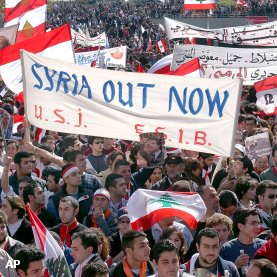
Instapundit links to news about an anti-Syriademonstrations in lebanon.
I also found a photo for the demonstrators.
Meanwhile, there were demonstartions in Egypt (photo here) asking Mubarak to step out and calling for elections rejecting a 5th term for the president that has been ruling the country with emergency law since 1981 after the assassination of president Anwar Sadat. The slogan held by the demonstrators was "Kifayah" which means "enough is enough".
This is the latest among a number of similar demontsrations that took place in Cairo in the past few months.
Link In Arabic.
Instapundit links to news about an anti-Syriademonstrations in lebanon.
I also found a photo for the demonstrators.
Meanwhile, there were demonstartions in Egypt (photo here) asking Mubarak to step out and calling for elections rejecting a 5th term for the president that has been ruling the country with emergency law since 1981 after the assassination of president Anwar Sadat. The slogan held by the demonstrators was "Kifayah" which means "enough is enough".
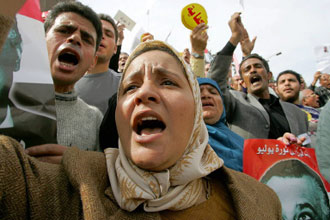
This is the latest among a number of similar demontsrations that took place in Cairo in the past few months.
Link In Arabic.
The price paid for blogging in Iran, a BBC story on the dangers associated with blogging and some of the atrocities bloggers are being subjected to in a country under Mullahs.
Sunday, February 20, 2005
**A couple of days ago, my father and I were having a conversation about the current hot topic of the middle east which is the assassination of Rafik Hariri. One ironic thought that always surfaces when the subject is tyrants and totalitarian regimes is the fact that they repeat each other's mistakes and they use exactly the same old silly tricks.
An example of that is the "decision" of Bashar Asad to send his military intelligence chief general to retirement because "he reached the official retirement age". This is something that Saddam used to do whenever there's a scandal or a big failure surrounding any critical governmental institution or personnel in an attempt to direct the attention to that unfortunate official showing him as the main source of trouble and the cause of the failure.
Well, back to my father, he made one interesting comment that I couldn't agree fully with; he said "This is September 11 of the ME" in reference to the situation in Lebanon.
But it seems that there are other people and bloggers who share my father's point of view; Chrenkoff shares this thought and has an informative update on the investigations.
Meanwhile, public opinion polls in Arab countries show that the majority supports the idea of an international investigation on the attack (69.59% on the BBC Arabic and 58.8% on Alarabiya) but it's also interesting to see that around 99% of the samples in Ramalla/Palestine oppose the international investigation!
**Back from Lebanon to Baghdad with a quick update on fuel situation; the fuel (gasoline in particular) shortage is reaching an end after several tough months. It took me less than 15 minutes yesterday to fill the car with gasoline as there were only 11 vehicles waiting in the line ahead of me. The lines are shorter in all gas stations in Baghdad but vary relatively from one region to another.
An example of that is the "decision" of Bashar Asad to send his military intelligence chief general to retirement because "he reached the official retirement age". This is something that Saddam used to do whenever there's a scandal or a big failure surrounding any critical governmental institution or personnel in an attempt to direct the attention to that unfortunate official showing him as the main source of trouble and the cause of the failure.
Well, back to my father, he made one interesting comment that I couldn't agree fully with; he said "This is September 11 of the ME" in reference to the situation in Lebanon.
But it seems that there are other people and bloggers who share my father's point of view; Chrenkoff shares this thought and has an informative update on the investigations.
Meanwhile, public opinion polls in Arab countries show that the majority supports the idea of an international investigation on the attack (69.59% on the BBC Arabic and 58.8% on Alarabiya) but it's also interesting to see that around 99% of the samples in Ramalla/Palestine oppose the international investigation!
**Back from Lebanon to Baghdad with a quick update on fuel situation; the fuel (gasoline in particular) shortage is reaching an end after several tough months. It took me less than 15 minutes yesterday to fill the car with gasoline as there were only 11 vehicles waiting in the line ahead of me. The lines are shorter in all gas stations in Baghdad but vary relatively from one region to another.
Friday, February 18, 2005
The terrorist attacks have increased once again in cities like Baghdad and Mosul after the period of relative peace that followed the elections.
The terrorists were obviously stunned the for a while and we expected that the terror groups would change their strategy of obstructing the elections and now they adopted a new-old plan as a reaction to the big achievement of the She'at in the elections which made the terror groups consider going back to the old idea of provoking a civil war.
Now they're targeting the She'at citizens and their religious symbols and mosques and I think this is a proof that they're losing and that their pre-election strategy was wrong and going back to the civil war plan that was previously applied (and proved to be ineffective) after the liberation indicates their bankruptcy and their inability to find a new effective strategy to face the huge success great determination of the people. Now it seems that the terrorists are recycling their stupid.
Terror has received so many severe blows in the last few weeks and I still believe that we should make use of the high morale of the people after the success in the elections and build more bridges between the security forces and the coalition on one side and the people on the other side.
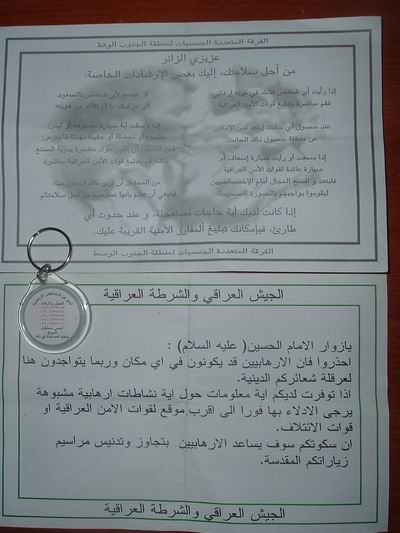
And I think that the coalition and the Iraqi forces are making efforts to make this happen; on my way back to Baghdad from Samawa last week, some Iraqi soldiers and IP men stopped us an handed the passengers-with a nice language-a number of leaflets that urge the people to report any suspicious activities and/or elements and encourage people to report and assuring them that they don't have to fear from being tracked by the thugs.
Few miles later we were stopped by an American checkpoint and they didn't stop us for an inspection procedure, after greeting us they were glad to see that some of us speak English well, one of them said that a coalition point was attacked with mortars and so he was asking us for any information or observations about this attack.
I told them that we're only passers by and we don't know the area very well and I asked if there were any casualties but gladly the answer was "no but we want to gather information about the attackers".
And I also noticed that Iraqi soldiers on other checkpoints started friendly conversations with the people and this is a good indication; searching isn't enough alone, bridging the gaps is what really matters.
Security will not be achieved if the people do not cooperate with the authorities and I think now it's due the time for the people to take bigger role in a nation-wide action against terror.
A few days ago a coalition convoy was patrolling our district and they were stopping every other hundred meters talking to the people and distributing key chains and leaflets that carry secure phone numbers for the people to use in reporting criminal activities and this is a smart idea as key chains are always in one's hands or pocket and phones are a reliable contact route and I think using the internet and e mails for the same task is another option that can be helpful as it's untraceable and people, especially the educated segment use the internet very often and they would feel more secure comfortable that way than with the phones.
I have no estimations about how many people will provide information that way but I feel that the rate has increased after the elections. Moreover, the Iraqi media is also playing a good role in exposing criminals and there are some local channels that broadcast the confessions of arrested terrorists.
I think that the local TV station in Mosul has done a good job recently and the people are now even more disgusted from the doings of the terrorists and the terrorists reaction by attacking the station's HQ more than once in the past days indicates that they're really pissed off from this station's shows.
The confessions have shown that some criminals have strong connections with the Syrian authorities from where they get instructions and support.
The interesting part of the show was the interrogation with Khalidah Jasim the sister of Khalid Zakiyah who's one of the most wanted criminals in Mosul who got arrested a while ago in Tikrit.
She stated that she was in her 2nd year in college studying psychiatry and that she was a member of a Palestinian military organization that was lead by George Habash.
She confessed that she has taken her brother's place in leading the terror group and she's specialized in preparing TNT used in roadside bombs.
She also didn't deny one of the group members statements that she offered to sleep with him twice in order to persuade him to plant landmines and perform attacks against Iraqi and American troops.
More details about this in the Friends of Democracy Arabic website.
The Iraqi security forces are now deployed everywhere in Baghdad and there are checkpoints at every corner.
The ceremonies of Ashoura have begun and people are practicing the cooking tradition in the streets and distributing food through to their neighbors and inviting anyone passing by. And people come walking on foot to visit the shrines of Imam Kadhum in Baghdad as well as other shrines in Najaf and kerbala to hold their ceremonies.
We still remember the bloody attacks of last year and we hope that this year's ceremonies pass peacefully.
Terrorism knows no religion and attacking people while doing their prayers or holding their ceremonies in their mosques is enough to tell the people inside and outside the country that those criminals do not represent any legitimate resistance or a rebellion; they're simply criminals.
Here are pictures for the leaflets and key chain (the upper one was distributed by the MNF while the one below was distributed by the ISF) Face...Back.
Mohammed.
The terrorists were obviously stunned the for a while and we expected that the terror groups would change their strategy of obstructing the elections and now they adopted a new-old plan as a reaction to the big achievement of the She'at in the elections which made the terror groups consider going back to the old idea of provoking a civil war.
Now they're targeting the She'at citizens and their religious symbols and mosques and I think this is a proof that they're losing and that their pre-election strategy was wrong and going back to the civil war plan that was previously applied (and proved to be ineffective) after the liberation indicates their bankruptcy and their inability to find a new effective strategy to face the huge success great determination of the people. Now it seems that the terrorists are recycling their stupid.
Terror has received so many severe blows in the last few weeks and I still believe that we should make use of the high morale of the people after the success in the elections and build more bridges between the security forces and the coalition on one side and the people on the other side.
And I think that the coalition and the Iraqi forces are making efforts to make this happen; on my way back to Baghdad from Samawa last week, some Iraqi soldiers and IP men stopped us an handed the passengers-with a nice language-a number of leaflets that urge the people to report any suspicious activities and/or elements and encourage people to report and assuring them that they don't have to fear from being tracked by the thugs.
Few miles later we were stopped by an American checkpoint and they didn't stop us for an inspection procedure, after greeting us they were glad to see that some of us speak English well, one of them said that a coalition point was attacked with mortars and so he was asking us for any information or observations about this attack.
I told them that we're only passers by and we don't know the area very well and I asked if there were any casualties but gladly the answer was "no but we want to gather information about the attackers".
And I also noticed that Iraqi soldiers on other checkpoints started friendly conversations with the people and this is a good indication; searching isn't enough alone, bridging the gaps is what really matters.
Security will not be achieved if the people do not cooperate with the authorities and I think now it's due the time for the people to take bigger role in a nation-wide action against terror.
A few days ago a coalition convoy was patrolling our district and they were stopping every other hundred meters talking to the people and distributing key chains and leaflets that carry secure phone numbers for the people to use in reporting criminal activities and this is a smart idea as key chains are always in one's hands or pocket and phones are a reliable contact route and I think using the internet and e mails for the same task is another option that can be helpful as it's untraceable and people, especially the educated segment use the internet very often and they would feel more secure comfortable that way than with the phones.
I have no estimations about how many people will provide information that way but I feel that the rate has increased after the elections. Moreover, the Iraqi media is also playing a good role in exposing criminals and there are some local channels that broadcast the confessions of arrested terrorists.
I think that the local TV station in Mosul has done a good job recently and the people are now even more disgusted from the doings of the terrorists and the terrorists reaction by attacking the station's HQ more than once in the past days indicates that they're really pissed off from this station's shows.
The confessions have shown that some criminals have strong connections with the Syrian authorities from where they get instructions and support.
The interesting part of the show was the interrogation with Khalidah Jasim the sister of Khalid Zakiyah who's one of the most wanted criminals in Mosul who got arrested a while ago in Tikrit.
She stated that she was in her 2nd year in college studying psychiatry and that she was a member of a Palestinian military organization that was lead by George Habash.
She confessed that she has taken her brother's place in leading the terror group and she's specialized in preparing TNT used in roadside bombs.
She also didn't deny one of the group members statements that she offered to sleep with him twice in order to persuade him to plant landmines and perform attacks against Iraqi and American troops.
More details about this in the Friends of Democracy Arabic website.
The Iraqi security forces are now deployed everywhere in Baghdad and there are checkpoints at every corner.
The ceremonies of Ashoura have begun and people are practicing the cooking tradition in the streets and distributing food through to their neighbors and inviting anyone passing by. And people come walking on foot to visit the shrines of Imam Kadhum in Baghdad as well as other shrines in Najaf and kerbala to hold their ceremonies.
We still remember the bloody attacks of last year and we hope that this year's ceremonies pass peacefully.
Terrorism knows no religion and attacking people while doing their prayers or holding their ceremonies in their mosques is enough to tell the people inside and outside the country that those criminals do not represent any legitimate resistance or a rebellion; they're simply criminals.
Here are pictures for the leaflets and key chain (the upper one was distributed by the MNF while the one below was distributed by the ISF) Face...Back.

Mohammed.
Wednesday, February 16, 2005
The Magic of Pajamas.
Well I think I titled this post with the word pajamas because the connection between blogging and pajamas has been a mystery for me. Of course I know what the theory says regarding this connection but I wasn't sure of the mechanism in which they relate to each other. Until this afternoon.
This may not seem like a regular ITM post and I think that's the idea!
I was talking to Mohammed an hour ago and we both were feeling depressed because of the declining quality and quantity of posts on our blog and the deficiency of ideas for good posts that we're currently suffering from. I don't know whether you agree with us but we here can feel it.
Then he suddenly said laughing "go wear your pajamas, maybe this will inspire you to write something"!
Well, frankly speaking it did and once I went into my pajamas I felt a strange motivation for writing; writing anything, at least it encouraged me to write this stupid conversation between two bored brothers drinking tea and smoking cigarettes in the afternoon.
I'm not claiming that my pajamas have magic in them but you know what? They do make a change!
Maybe the reason for not writing much these days is because of the current situation in Iraq; the elections are over and the results have been announced so there's nothing BIG to reason or to write about.
Also, there aren't any remarkable changes in the everyday life in Iraq recently; although the security situation has somewhat improved in Baghdad but still not to the degree that makes a difference. Less explosions and gunfire are heard but criminal gangs still perform their attacks so the citizens of Baghdad are still cautious.
Electricity and fuel supplies witnessed a more visible improvement this week; we're now getting more than 12 stable hours / day of electricity in comparison with a 6 hour supply a few weeks ago. This isn't enough power of course and there were times when we had 20 hours / day last year but it's an indication that the situation is getting under control and that sabotaged facilities are getting fixed.
As for the fuel supplies, the price of the 20 liters of gasoline has decreased from 12000 ID (8 $) to around 4000 ID (less than 3 $). By the way, this quantity of this kind of fuel has become the parameter for evaluating the situation here as the most common container size used for gasoline by the black market dealers is 20 L.
As I said earlier, no big changes are taking place here and it feels like "a low grade fever" where you're still feeling weak and having headaches and bone ache but also feel comfortable that the most critical times are now behind your back.
Let's widen the circle a little and move to some other current issues and I will start with the assassination of the Lebanese ex-PM, Al-Jazeera is now conducting a poll about the most likely parties to be behind for the assassination. The list of choices included the following:
Israeli agents, American agents, Lebanese rebels, Syrian rebels and "others".
What's new! The 1st two choices are characteristic of Al_Jazeera and conspiracy theorists and of course it's not in any of these countries interest to kill a man who's somehow in support of their vision about the Syrian role in Lebanon but the next two choices make no sense at all, that's at least how I see it.
Why would "Syrian rebels" (who by definition are supposed to be opposing their government) kill the man who's against the Syrian policies and the Syrian presence in Lebanon!?
And why would the "Lebanese rebels" target a man who's currently not in power and considered himself part of the opposition!?
So, there remains one choice which is "others" that I have no idea to whom Al-Jazeera was trying to refer to, maybe the Iraqi intelligence?
The point I want to say here is that Al-Jazeera has omitted the only party that has the strong motives to perform such an attack which is the Syrian government and their allied terror groups of course. I personally strongly believe that Syria is involved in performing the attack or hiring some group to do it.
A big deal of the blame should be put on the Lebanese government because they accepted to host the armed forces and intelligence systems of one of the most active terror-supporting regimes in the region and the Lebanese government must be held accountable for endangering their people's life and their country's stability.
The Syrian government has claimed to be irresponsible of the attack and they will try in one way or another to blame Israel or America for it in an attempt to get more excuses for keeping the Syrian troops in Lebanon.
A mean but very stupid plan that is characteristic of tyrannies just like how misleading polls like Al-Jazeera is characteristic to most Arab Media and Western media as well.
Okay, I will stop this rambling of subjects irrelevant to each other and I will end the post with a joke about (guess who?) Al-Jazeera:
The post that big pharaoh wrote a few days ago reminded me of the last couple of series of the "Ittijah Al-Mo'akis" or the Opposite Direction show on Al-Jazeera.
Its worth mentioning that this show which is supposed to focus on the hot topics has completely ignored the Iraqi elections on its episode that was shown two days after the elections took place inside Iraq and 5 days after elections started outside the country.
However they dedicated last week's episode to "discuss" the elections.
Regardless of all the bias and the hostility the show carries against Iraq one thing made me really laugh from my heart.
One caller who was a woman from Saudi Arabia said that the Iraqi elections were a joke, an American theatrical action and all this kind of crap like "no democracy under occupation"…blah blah blah.
Imagine, a woman from Saudi Arabia criticizes our elections! A woman from a country that doesn't give women the right to cast votes even in municipal councils elections!! Let alone that the Saudi "parliament" members are appointed not elected.
The point here is why would I ask someone who doesn't have the right to participate in elections in his/her own country to give an opinion about elections in another country?!
A friend who sitting next to me said mocking "never mind the b****, she's just jealous of our country's women who won 25% of the seats but when she gets the right to give her opinion on the color of the doormen uniform in her country, then that she will call true democracy".
I have never written with such an appetite before! thanks to my pajamas.
This may not seem like a regular ITM post and I think that's the idea!
I was talking to Mohammed an hour ago and we both were feeling depressed because of the declining quality and quantity of posts on our blog and the deficiency of ideas for good posts that we're currently suffering from. I don't know whether you agree with us but we here can feel it.
Then he suddenly said laughing "go wear your pajamas, maybe this will inspire you to write something"!
Well, frankly speaking it did and once I went into my pajamas I felt a strange motivation for writing; writing anything, at least it encouraged me to write this stupid conversation between two bored brothers drinking tea and smoking cigarettes in the afternoon.
I'm not claiming that my pajamas have magic in them but you know what? They do make a change!
Maybe the reason for not writing much these days is because of the current situation in Iraq; the elections are over and the results have been announced so there's nothing BIG to reason or to write about.
Also, there aren't any remarkable changes in the everyday life in Iraq recently; although the security situation has somewhat improved in Baghdad but still not to the degree that makes a difference. Less explosions and gunfire are heard but criminal gangs still perform their attacks so the citizens of Baghdad are still cautious.
Electricity and fuel supplies witnessed a more visible improvement this week; we're now getting more than 12 stable hours / day of electricity in comparison with a 6 hour supply a few weeks ago. This isn't enough power of course and there were times when we had 20 hours / day last year but it's an indication that the situation is getting under control and that sabotaged facilities are getting fixed.
As for the fuel supplies, the price of the 20 liters of gasoline has decreased from 12000 ID (8 $) to around 4000 ID (less than 3 $). By the way, this quantity of this kind of fuel has become the parameter for evaluating the situation here as the most common container size used for gasoline by the black market dealers is 20 L.
As I said earlier, no big changes are taking place here and it feels like "a low grade fever" where you're still feeling weak and having headaches and bone ache but also feel comfortable that the most critical times are now behind your back.
Let's widen the circle a little and move to some other current issues and I will start with the assassination of the Lebanese ex-PM, Al-Jazeera is now conducting a poll about the most likely parties to be behind for the assassination. The list of choices included the following:
Israeli agents, American agents, Lebanese rebels, Syrian rebels and "others".
What's new! The 1st two choices are characteristic of Al_Jazeera and conspiracy theorists and of course it's not in any of these countries interest to kill a man who's somehow in support of their vision about the Syrian role in Lebanon but the next two choices make no sense at all, that's at least how I see it.
Why would "Syrian rebels" (who by definition are supposed to be opposing their government) kill the man who's against the Syrian policies and the Syrian presence in Lebanon!?
And why would the "Lebanese rebels" target a man who's currently not in power and considered himself part of the opposition!?
So, there remains one choice which is "others" that I have no idea to whom Al-Jazeera was trying to refer to, maybe the Iraqi intelligence?
The point I want to say here is that Al-Jazeera has omitted the only party that has the strong motives to perform such an attack which is the Syrian government and their allied terror groups of course. I personally strongly believe that Syria is involved in performing the attack or hiring some group to do it.
A big deal of the blame should be put on the Lebanese government because they accepted to host the armed forces and intelligence systems of one of the most active terror-supporting regimes in the region and the Lebanese government must be held accountable for endangering their people's life and their country's stability.
The Syrian government has claimed to be irresponsible of the attack and they will try in one way or another to blame Israel or America for it in an attempt to get more excuses for keeping the Syrian troops in Lebanon.
A mean but very stupid plan that is characteristic of tyrannies just like how misleading polls like Al-Jazeera is characteristic to most Arab Media and Western media as well.
Okay, I will stop this rambling of subjects irrelevant to each other and I will end the post with a joke about (guess who?) Al-Jazeera:
The post that big pharaoh wrote a few days ago reminded me of the last couple of series of the "Ittijah Al-Mo'akis" or the Opposite Direction show on Al-Jazeera.
Its worth mentioning that this show which is supposed to focus on the hot topics has completely ignored the Iraqi elections on its episode that was shown two days after the elections took place inside Iraq and 5 days after elections started outside the country.
However they dedicated last week's episode to "discuss" the elections.
Regardless of all the bias and the hostility the show carries against Iraq one thing made me really laugh from my heart.
One caller who was a woman from Saudi Arabia said that the Iraqi elections were a joke, an American theatrical action and all this kind of crap like "no democracy under occupation"…blah blah blah.
Imagine, a woman from Saudi Arabia criticizes our elections! A woman from a country that doesn't give women the right to cast votes even in municipal councils elections!! Let alone that the Saudi "parliament" members are appointed not elected.
The point here is why would I ask someone who doesn't have the right to participate in elections in his/her own country to give an opinion about elections in another country?!
A friend who sitting next to me said mocking "never mind the b****, she's just jealous of our country's women who won 25% of the seats but when she gets the right to give her opinion on the color of the doormen uniform in her country, then that she will call true democracy".
I have never written with such an appetite before! thanks to my pajamas.
Tuesday, February 15, 2005
Ali has made some further math on the results of the Iraqi elections and stated his findings and conclusions in an informative post today.
He also pointed out a very interesting issue regarding the announced Vs actual percentage of the turnout:
One of my neighbors received his family's ballot with his father's name included even though he died a year ago. Under reporting of deaths was not that uncommon but it became more common after the last war as a result of the total collapse of the system for months. Another neighbor had his two sons' names registered although they both left Iraq since 1995. This means that many Iraqis outside Iraq, regardless whether they voted or not, were considered registered eligible non-voters inside Iraq!
Read the rest.
He also pointed out a very interesting issue regarding the announced Vs actual percentage of the turnout:
One of my neighbors received his family's ballot with his father's name included even though he died a year ago. Under reporting of deaths was not that uncommon but it became more common after the last war as a result of the total collapse of the system for months. Another neighbor had his two sons' names registered although they both left Iraq since 1995. This means that many Iraqis outside Iraq, regardless whether they voted or not, were considered registered eligible non-voters inside Iraq!
Read the rest.
Monday, February 14, 2005
Part 21 of Chrenkoff's good news from Iraq is now available; a great piece as always with a very interesting collection of economy and reconstruction news as well as election results news and commentary.
Sunday, February 13, 2005
Democracy in progress.
Congratulations to the Iraqi people,
The results are for the best of Iraq and its future; Iraqis have put the corner stone for the state of law and constitution and have proved to the world how the region's nations are eager for freedom and how much they reject the concepts of violence and despotism that were imposed by fire and steel.
The ballot and the box have won and the purple fingers garnished the beautiful picture.
The high turnout in circumstances that were considered to be the most dangerous was like a candle that leads the road for the rest of freedom seeking people and gave lesson in courage and determination and reminds even those who lived their whole lives in democracies about the bravery of their founding fathers who struggled and sacrificed for the sake of their children's future and prosperity.
The winners are in front of a historic responsibility of drawing the future of Iraq and defining its new identity. Their load is heavy but the most important thing is that the people back them and back the writing of the permanent constitution.
I was so happy today while watching the results being displayed on TV although I didn't get the seat I dreamed of. Little parties like ours couldn't compete with the larger ones that own radio and TV networks and had their banners and posters filling the streets while I had to borrow from my friends to pay the 5000 $ registration fees of the party because the support we received for the party from our friends and supporters hasn't reached Baghdad till this moment because of some banking bureaucracy. All we had was 3000 $ to spend on advertising and publicity and managing all the party's affairs.
Add to this that the candidates of small parties had to accept risking their lives as we made ourselves easy targets for the terrorists; we don't have the adequate personal protection like the famous figures who live in heavily protected quarters and protected by hundreds of bodyguards.
While candidates like me live among the people and walk on the streets, in the past few weeks we saw several Iraqi politicians targeted and assassinated, but our participation was more important than anything else because it gave more credit to the elections and we're happy with that role.
The world will remember the number "7461"; these were the candidates who didn't submit for blackmailing and decided to take the responsibility despite the threats and the dangers.
If small parties like ours haven't participated, the elections wouldn't have succeeded the way it did.
I see that we didn't lose at all, on the contrary, we won and the only loser is terror and its dictators allies.
We will always have the chance to participate again and our voice will always be heard and we will not give up on what we started.
The political map in my opinion will witness many changes in the coming 6 months and alliances will be reshaped and the small entities will seek forming bigger masses in order to get a better representation in the future elections which are not far away.
And I believe that the major parties will try to form an alliance to balance forces with the winning list of the United Coalition which I assume will be working hard on its end to satisfy the other parties as it needs the support of the other half to pass its projects and legislations and now its obvious that the United Coalition is 'flirting' with others through messages of reassurance focusing on the idea that the United Coalition has no will to make Iraq an Islamic state and on that Islam will not be the only source of legislations in the coming constitution.
On the other hand, the SCIRI demands for respecting Islam seem reasonable and realistic more than conservative, as securing the unity of the coalition requires also reassuring the secular members of the list.
Moreover some members from the same list stated that they would like to see a Kurdish president for Iraq and in a statement for Hussein Sharistani, one of the coalition's leading figures, he said "to prove to the people that the coalition is democratic in nature, the ministers or PM that are to be chosen from our list will be elected by the 131 members and not by the elite or the big figures of the coalition".
Also there were other statements coming from inside the coalition refusing the idea of planning a withdrawal schedule for the Multinational forces from Iraq as Ibrahim Al-Jaafari said who considered that calls for a withdrawal are aiming at creating chaos and a civil war.
These statements and many similar ones refute the expectations about Iraq becoming a "copy" of Iran. All this and more proves the reasonability of the suggested choices with an invitation for open talks and negotiations.
Generally speaking, all politicians realize the role of the United States and the coalition forces in protecting the new born democracy and most of the major players realize the necessity of a strategic partnership with the United States for the good of Iraq and for the success of the war on terror.
The event of elections in Iraq was a huge turning point in the history of the region and Iraqis and their political parties have proved-despite the lack of experience-that they can do well and show high performance in a process of change that represents the first signs of a bright future for this country and the Middle east.
No one will stop the train of democracy and those who stand against the change will soon be nothing but forgotten.
Mohammed.
The results are for the best of Iraq and its future; Iraqis have put the corner stone for the state of law and constitution and have proved to the world how the region's nations are eager for freedom and how much they reject the concepts of violence and despotism that were imposed by fire and steel.
The ballot and the box have won and the purple fingers garnished the beautiful picture.
The high turnout in circumstances that were considered to be the most dangerous was like a candle that leads the road for the rest of freedom seeking people and gave lesson in courage and determination and reminds even those who lived their whole lives in democracies about the bravery of their founding fathers who struggled and sacrificed for the sake of their children's future and prosperity.
The winners are in front of a historic responsibility of drawing the future of Iraq and defining its new identity. Their load is heavy but the most important thing is that the people back them and back the writing of the permanent constitution.
I was so happy today while watching the results being displayed on TV although I didn't get the seat I dreamed of. Little parties like ours couldn't compete with the larger ones that own radio and TV networks and had their banners and posters filling the streets while I had to borrow from my friends to pay the 5000 $ registration fees of the party because the support we received for the party from our friends and supporters hasn't reached Baghdad till this moment because of some banking bureaucracy. All we had was 3000 $ to spend on advertising and publicity and managing all the party's affairs.
Add to this that the candidates of small parties had to accept risking their lives as we made ourselves easy targets for the terrorists; we don't have the adequate personal protection like the famous figures who live in heavily protected quarters and protected by hundreds of bodyguards.
While candidates like me live among the people and walk on the streets, in the past few weeks we saw several Iraqi politicians targeted and assassinated, but our participation was more important than anything else because it gave more credit to the elections and we're happy with that role.
The world will remember the number "7461"; these were the candidates who didn't submit for blackmailing and decided to take the responsibility despite the threats and the dangers.
If small parties like ours haven't participated, the elections wouldn't have succeeded the way it did.
I see that we didn't lose at all, on the contrary, we won and the only loser is terror and its dictators allies.
We will always have the chance to participate again and our voice will always be heard and we will not give up on what we started.
The political map in my opinion will witness many changes in the coming 6 months and alliances will be reshaped and the small entities will seek forming bigger masses in order to get a better representation in the future elections which are not far away.
And I believe that the major parties will try to form an alliance to balance forces with the winning list of the United Coalition which I assume will be working hard on its end to satisfy the other parties as it needs the support of the other half to pass its projects and legislations and now its obvious that the United Coalition is 'flirting' with others through messages of reassurance focusing on the idea that the United Coalition has no will to make Iraq an Islamic state and on that Islam will not be the only source of legislations in the coming constitution.
On the other hand, the SCIRI demands for respecting Islam seem reasonable and realistic more than conservative, as securing the unity of the coalition requires also reassuring the secular members of the list.
Moreover some members from the same list stated that they would like to see a Kurdish president for Iraq and in a statement for Hussein Sharistani, one of the coalition's leading figures, he said "to prove to the people that the coalition is democratic in nature, the ministers or PM that are to be chosen from our list will be elected by the 131 members and not by the elite or the big figures of the coalition".
Also there were other statements coming from inside the coalition refusing the idea of planning a withdrawal schedule for the Multinational forces from Iraq as Ibrahim Al-Jaafari said who considered that calls for a withdrawal are aiming at creating chaos and a civil war.
These statements and many similar ones refute the expectations about Iraq becoming a "copy" of Iran. All this and more proves the reasonability of the suggested choices with an invitation for open talks and negotiations.
Generally speaking, all politicians realize the role of the United States and the coalition forces in protecting the new born democracy and most of the major players realize the necessity of a strategic partnership with the United States for the good of Iraq and for the success of the war on terror.
The event of elections in Iraq was a huge turning point in the history of the region and Iraqis and their political parties have proved-despite the lack of experience-that they can do well and show high performance in a process of change that represents the first signs of a bright future for this country and the Middle east.
No one will stop the train of democracy and those who stand against the change will soon be nothing but forgotten.
Mohammed.
Thursday, February 10, 2005
A few days ago, Mithal Al-Alusi; an Iraqi politician and the head of the "Hizb Al-Umma Al-Iraqiya" or the (Iraqi Nation Party) survived an assassination attempt when a group of terrorists attacked him in front of his house but his two young sons and his guard were killed in the attack.
The brave politician, despite his tragic loss made very strong statements during an interview he gave to RFI "Radio free Iraq".
Al-Alusi: Again, the ghosts of death are going out. They are ready to kill a person, ready to kill the peace, ready to kill the victory of Iraqis and their right to life. Again, henchmen of the Ba'ath [Party] and dirty terrorist gangs, Al-Qaeda and others, are going out convinced that they can determine life and death as they desire. Iraq will not die.
My children, three people [in all] -- one of my bodyguards and two of my children -- died as heroes, no differently from other people who find their heroic deaths. But we will not, [I swear] by God, hand Iraq over to murderers and terrorists.
We will pave the road for peace. If [the attackers] thought that by attempting to kill Mithal al-Alusi, the advocates of peace in Iraq will be stopped, then they have made a grave mistake. We will be calling for peace. We will be calling for peace with all neighboring countries [of Iraq]. We will be calling for peace with all countries of the region. And we will be calling for fighting terrorism by any means [and] against all forms [of terror].
They claim that Islam is a message of killing, while Islam is a message of peace. They claim that the principles [of Islam] encourage killing, while the only principles that encourage killing are the principles of the Ba'ath [Party] and of the heathens from Al-Qaeda groupings.
Read the rest of the interview here.
It's worth mentioning that his party's slogan for the electoral campaign was "Don't Let Them Win" and it's obvious who "Them" was in refernce to and I see that Mithal and determined Iraqis like him who are ready to sacrifice are winning even though the evil doers might appear to be inflicting so much damage as to make them look strong.
This reminds me of a situation that happened on elections day last week; an election center was attacked with mortars in Al-Ataifiya (Not Latifiyah) district where one of my closest friends lives. He talked to me on the phone that morning with a tone of amazement in his voice and told me that at the beginning there was panic among the people who lined up to vote but within half an hour after the attack, things came back to normal and the lines became even longer.
The people realized that there could be another attack but that didn't stop them from seizing the moment, the moment of choosing the way of life they want for themselves and their children.
"God, I'm amazed by the bravery of those folks, I was too scared myself but watching the people coming back made me feel strength that I've never felt before" These were my friend's words.
I wonder how long it's going to take the terrorists to understand that we're NOT giving up, no matter what they do to intimidate us, no matter how many pipelines they blow up and no matter how many of us they kill.
Everyday I see the media talking about "body counts" and the "cost of the war". Well, we know that there are innocent people losing their lives and we know that there's a lot of damage going on but it's not like we're discouraged by these losses.
We don't need those who 'weep' for us and count our brothers and friends who have fallen for the sake of freedom but we welcome those who are ready to stand on our side.
We accepted the challenge from day one and we realized that we will have to pay a price for our freedom and the cruelty of the battle hasn't changed that, in fact, Iraqis now are more determined to finish the battle than before, and to win.
The brave politician, despite his tragic loss made very strong statements during an interview he gave to RFI "Radio free Iraq".
Al-Alusi: Again, the ghosts of death are going out. They are ready to kill a person, ready to kill the peace, ready to kill the victory of Iraqis and their right to life. Again, henchmen of the Ba'ath [Party] and dirty terrorist gangs, Al-Qaeda and others, are going out convinced that they can determine life and death as they desire. Iraq will not die.
My children, three people [in all] -- one of my bodyguards and two of my children -- died as heroes, no differently from other people who find their heroic deaths. But we will not, [I swear] by God, hand Iraq over to murderers and terrorists.
We will pave the road for peace. If [the attackers] thought that by attempting to kill Mithal al-Alusi, the advocates of peace in Iraq will be stopped, then they have made a grave mistake. We will be calling for peace. We will be calling for peace with all neighboring countries [of Iraq]. We will be calling for peace with all countries of the region. And we will be calling for fighting terrorism by any means [and] against all forms [of terror].
They claim that Islam is a message of killing, while Islam is a message of peace. They claim that the principles [of Islam] encourage killing, while the only principles that encourage killing are the principles of the Ba'ath [Party] and of the heathens from Al-Qaeda groupings.
Read the rest of the interview here.
It's worth mentioning that his party's slogan for the electoral campaign was "Don't Let Them Win" and it's obvious who "Them" was in refernce to and I see that Mithal and determined Iraqis like him who are ready to sacrifice are winning even though the evil doers might appear to be inflicting so much damage as to make them look strong.
This reminds me of a situation that happened on elections day last week; an election center was attacked with mortars in Al-Ataifiya (Not Latifiyah) district where one of my closest friends lives. He talked to me on the phone that morning with a tone of amazement in his voice and told me that at the beginning there was panic among the people who lined up to vote but within half an hour after the attack, things came back to normal and the lines became even longer.
The people realized that there could be another attack but that didn't stop them from seizing the moment, the moment of choosing the way of life they want for themselves and their children.
"God, I'm amazed by the bravery of those folks, I was too scared myself but watching the people coming back made me feel strength that I've never felt before" These were my friend's words.
I wonder how long it's going to take the terrorists to understand that we're NOT giving up, no matter what they do to intimidate us, no matter how many pipelines they blow up and no matter how many of us they kill.
Everyday I see the media talking about "body counts" and the "cost of the war". Well, we know that there are innocent people losing their lives and we know that there's a lot of damage going on but it's not like we're discouraged by these losses.
We don't need those who 'weep' for us and count our brothers and friends who have fallen for the sake of freedom but we welcome those who are ready to stand on our side.
We accepted the challenge from day one and we realized that we will have to pay a price for our freedom and the cruelty of the battle hasn't changed that, in fact, Iraqis now are more determined to finish the battle than before, and to win.
Wednesday, February 09, 2005
"Final thoughts on a year in Iraq"
I was privileged to be copied on a message that was sent from a US Army Captain to his family few days prior to his departure from Iraq after spending a long time in Iraq. After requesting for his permission on it, I decided to publish this moving message and share it with you, here it is:
In the next 24 hours I will finally be boarding a plane for the long awaited flight back to Germany. I will do so with the knowledge in the back of my head that this may not be my last tour in Iraq. As I was walking back to work tonight to write this e-mail, I had a convincing reminder that despite the recent success of the elections, Iraq remains a very dangerous place.
I was reflecting on all of the events and experiences of the last year and thinking about what I was going to write when I heard a strange but now somewhat familiar whirling sound. I looked up to see the orange sparks from a rocket as it crossed in front of my eyes, disappeared out of sight, and fell to the ground and detonated with an explosion that shook the ground. The rocket had in fact fallen harmlessly into an open field a few hundred meters away, but it was still a reminder of the dangers that are ever present here. The conventional wisdom around here following a rocket or mortar attack is quite simple; if you are still alive and not severely bleeding, then you simply roll back over in you cot, finish your dinner, or otherwise continue going about your business. So here I am, back at my computer and I will get back to the things that I had wanted to share before I was distracted.
A year is a long time to spend in places like Iraq or Afghanistan, away from family, friends, and just about every aspect of life that we consider normal and so often take for granted. For the soldiers with families, it is even harder. Anniversaries are flowers sent via the e-mail. Their kids sporting events and activities are relegated to a two minute phone update over an awful connection. Birthdays and holidays are simply another day like any of the rest. When you consider all of this, you find yourself asking (as I have many times this past year) ‘Is it all worth it?’ Are the sacrifices that so many soldiers and families make on a daily basis worth the effort of being in Iraq? Is it worth the money we have spent destroying with one hand and rebuilding with another? How about the sacrifices of those men and women who will never return to their families? Is the mission here in Iraq worth what we have paid in blood sweat and tears? I think it is.
Last Sunday, the Iraqi people had an opportunity to express their own voices, their own opinions. In the months preceding the elections, skeptics would have led you to believe that a successful election in Iraq could not possibly take place given the current security situation. When you turned on the news, all you saw being reported on Iraq was the latest suicide bombing, the latest kidnapping, the latest body count. Is there anyone who can actually recall seeing a positive story that came out of Iraq? In the year that I have been here, the only positive story I can recall was the Iraqi National Soccer team’s gutsy performance in the Olympics. Can anyone remember a major news network that covered one of the hundreds of schools that have been built? How about the roads, hospitals, oil pipelines, or power plants? I for one can’t recall another single story that portrayed a remotely positive picture of what was happening in Iraq. Until last Sunday that is.
For the first time in a year the media seemed to focus their cameras on average Iraqis who for so long had remained silent. These were the millions of Iraqis that came out of their homes and defied the dangers and intimidation and went to the polls to cast their ballots for a new Iraqi future. Due to an apparent lack of burning vehicles and broken bodies, the media apparently had nothing left to report but the long lines of Iraqis as they peacefully cast their ballots. We saw men dancing in the streets and proud smiling faces that held up ink-stained fingers showing the sign for peace. Were the elections perfect? Certainly not. There were many Iraqis, especially among the Sunni minority, that exercised their right to withhold their vote; a newly given right by the way. Regardless, all Iraqis were given the opportunity to vote, and that is what is important. When America’s fledgling government first held elections, the only citizens eligible to vote were white male landowners. The United States has come a long way since our beginning. It is now Iraq’s turn for a new beginning. It isn’t going to be an easy road, but the Iraqi people are accustomed to greater hardships. The insurgency in Iraq won’t disappear over night, and will likely never disappear completely, but as an Iraqi government emerges we can only hope that the new government will be able to contend with the challenges posed by a determined minority.
Following the seemingly successful elections, I have already heard talk in the media about pulling our troops out of Iraq as soon as possible. This would be a great mistake. The withdrawal of coalition troops must be done gradually and only when the Iraqi government has the sufficient capacity to secure its own borders and police its interiors. To pull troops out too early and put the new government at risk of failure is to jeopardize everything that has been sacrificed and gained over the last couple years. We came here, right or wrong, to liberate Iraq from a ruthless dictator and to give them an opportunity at democratic self-rule. Our job in Iraq is only half done and we have the responsibility to see it through to the end.
Respectfully,
Kevin M. Burns
Captain, U.S. Army
In the next 24 hours I will finally be boarding a plane for the long awaited flight back to Germany. I will do so with the knowledge in the back of my head that this may not be my last tour in Iraq. As I was walking back to work tonight to write this e-mail, I had a convincing reminder that despite the recent success of the elections, Iraq remains a very dangerous place.
I was reflecting on all of the events and experiences of the last year and thinking about what I was going to write when I heard a strange but now somewhat familiar whirling sound. I looked up to see the orange sparks from a rocket as it crossed in front of my eyes, disappeared out of sight, and fell to the ground and detonated with an explosion that shook the ground. The rocket had in fact fallen harmlessly into an open field a few hundred meters away, but it was still a reminder of the dangers that are ever present here. The conventional wisdom around here following a rocket or mortar attack is quite simple; if you are still alive and not severely bleeding, then you simply roll back over in you cot, finish your dinner, or otherwise continue going about your business. So here I am, back at my computer and I will get back to the things that I had wanted to share before I was distracted.
A year is a long time to spend in places like Iraq or Afghanistan, away from family, friends, and just about every aspect of life that we consider normal and so often take for granted. For the soldiers with families, it is even harder. Anniversaries are flowers sent via the e-mail. Their kids sporting events and activities are relegated to a two minute phone update over an awful connection. Birthdays and holidays are simply another day like any of the rest. When you consider all of this, you find yourself asking (as I have many times this past year) ‘Is it all worth it?’ Are the sacrifices that so many soldiers and families make on a daily basis worth the effort of being in Iraq? Is it worth the money we have spent destroying with one hand and rebuilding with another? How about the sacrifices of those men and women who will never return to their families? Is the mission here in Iraq worth what we have paid in blood sweat and tears? I think it is.
Last Sunday, the Iraqi people had an opportunity to express their own voices, their own opinions. In the months preceding the elections, skeptics would have led you to believe that a successful election in Iraq could not possibly take place given the current security situation. When you turned on the news, all you saw being reported on Iraq was the latest suicide bombing, the latest kidnapping, the latest body count. Is there anyone who can actually recall seeing a positive story that came out of Iraq? In the year that I have been here, the only positive story I can recall was the Iraqi National Soccer team’s gutsy performance in the Olympics. Can anyone remember a major news network that covered one of the hundreds of schools that have been built? How about the roads, hospitals, oil pipelines, or power plants? I for one can’t recall another single story that portrayed a remotely positive picture of what was happening in Iraq. Until last Sunday that is.
For the first time in a year the media seemed to focus their cameras on average Iraqis who for so long had remained silent. These were the millions of Iraqis that came out of their homes and defied the dangers and intimidation and went to the polls to cast their ballots for a new Iraqi future. Due to an apparent lack of burning vehicles and broken bodies, the media apparently had nothing left to report but the long lines of Iraqis as they peacefully cast their ballots. We saw men dancing in the streets and proud smiling faces that held up ink-stained fingers showing the sign for peace. Were the elections perfect? Certainly not. There were many Iraqis, especially among the Sunni minority, that exercised their right to withhold their vote; a newly given right by the way. Regardless, all Iraqis were given the opportunity to vote, and that is what is important. When America’s fledgling government first held elections, the only citizens eligible to vote were white male landowners. The United States has come a long way since our beginning. It is now Iraq’s turn for a new beginning. It isn’t going to be an easy road, but the Iraqi people are accustomed to greater hardships. The insurgency in Iraq won’t disappear over night, and will likely never disappear completely, but as an Iraqi government emerges we can only hope that the new government will be able to contend with the challenges posed by a determined minority.
Following the seemingly successful elections, I have already heard talk in the media about pulling our troops out of Iraq as soon as possible. This would be a great mistake. The withdrawal of coalition troops must be done gradually and only when the Iraqi government has the sufficient capacity to secure its own borders and police its interiors. To pull troops out too early and put the new government at risk of failure is to jeopardize everything that has been sacrificed and gained over the last couple years. We came here, right or wrong, to liberate Iraq from a ruthless dictator and to give them an opportunity at democratic self-rule. Our job in Iraq is only half done and we have the responsibility to see it through to the end.
Respectfully,
Kevin M. Burns
Captain, U.S. Army
Subscribe to:
Posts (Atom)