Tuesday, July 28, 2009

Iraqi Army Takes Over Camp Ashraf

AFP:

"After the failure of negotiations with the Mujahedeen to enter peacefully, the Iraqi army entered Camp Ashraf with force and it now controls all of the interior and all entrances to the camp," an Iraqi military source said.

The status of Mujahedeen Khalq, an Iranian opposition group, has been a point of controversy in Iraq since 2003. Most Sunni politicians say the group members are refugees. Thus they are entitled to protection under the Geneva conventions. Of course Sunni politicians are more interested in keeping the group on Iraqi soil as a bargaining chip to use in dealing with Iran. On the other hand, Shiite politicians say Mujahedeen Khalq is a terrorist group that seeks to undermine the stability of a neighboring country. Therefore Iraq, under the constitution, should not house the group.

The U.S. could not find a final solution for the issue either. U.S. forces disarmed the camp years ago. The U.S. also listed Mujahedeen Khalq as a terrorist group. However, the U.S. did not take steps to prosecute or deport the 3,000 strong group, perhaps because the U.S. too sees them as a bargaining chip to use in dealing with Iran.
Now Maliki decided to take things into his hands. It will be interesting to see how he deals with the group members. In my opinion he is smarter than to give away anything for free.

Monday, July 27, 2009

Kurdish scholars: The new parliament will be ‘more effective’

Two Kurdish researchers speak about their expectations about how election results are going to change the political situation in Kurdistan. Rebein Rasoul, who heads the Kurdish American Association in Erbil thinks the results “show that the Change slate made a great success, while the Reform and Services (Islamist-Leftist) had a setback as the latter was looking forward to more than 20 seats”. Rasoul also speculates that “the next four years will be tough for the three blocs. Any shortcomings in their performance could lead to further (electoral) setbacks”. Rasoul warned that “most of the pressure will be on the current PUK (Talabani’s Party), which will have to restructure the party to avoid its collapse”.

Another scholar, Serdar Qadir of the University of Sulaymaniyah, thinks “the new parliament will be more capable of fulfilling its duties as a legislative branch and a watchdog body now that there are three different blocs”.

The important point in my opinion is one which both Rasoul and Qadir seem to agree upon. Both think that future legislations will require real debates and discussions within the parliament, unlike in the past “where legislations were passed simply by the approval of the two major parties”.

NATO, Iraq sign new agrement to train ISF

On 26 July 2009, the Minister of Defence of the Republic of Iraq, Mr. Abdul Qader Mohammad Jassim Al-Mafrji, on behalf of the Government of the Republic of Iraq, and the NATO Deputy Secretary General, Ambassador Claudio Bisogniero, on behalf of NATO, signed an agreement between the Government of the Republic of Iraq and NATO regarding the training of Iraqi Security Forces.

This agreement represents a milestone in the cooperation between the Republic of Iraq and NATO and demonstrates the Alliance’s strong commitment to work in partnership with the sovereign government of Iraq as it focuses on rebuilding and strengthening of governance structures.

The agreement will provide the legal basis for NATO to continue with its mission to assist the Government of the Republic of Iraq in developing further the capabilities of the Iraqi Security Forces.

Kurdistan Elections Update

The Independent High Electoral Commission (IHEC) has yet to announce the results of the parliamentary and presidential elections of Kurdistan region. However, the competing political blocs have been talking about the estimated number of seats they secured. The interesting thing is that there seems to be a general agreement on these estimates among the rival slates.
From the information I compiled, the 111 parliamentary seats are expected to be distributed as follows:

- The Kurdistan bloc (PUK and KDP) is expected to get approximately 55 seats
- The Change slate is expected to get approximately 30 seats
- The coalition of Islamic-Leftist parties is expected to get 15 seats
- The minorities (Christian, Turkmen, others) who are traditionally affiliated with the Kurdistan bloc are expected to get the remaining 11 seats

The fact that the shares of the Islamists, leftists and minorities hardly changed at all means that the opposition, represented by the Change slate, managed to extract most of those 30 seats from the PUK and KDP. This implies that the elections were rather fair, and that the claims of rampant fraud and violations were perhaps a little exaggerated.

The results also reflect the social differences between the different parts of Kurdistan. The Change slate fared very well in the more liberal and open society of Sulaymaniyah. By contrast, the more socially and religiously conservative societies in Dohuk and Erbil favored the KDP and the Islamist opposition.

The impact of these results on Kurdish politics is likely to be great. A leading member of the Islamist-Leftist coalition alluded to a possible alliance with the Change slate to challenge the control of the PUK and KDP. Such an alliance, if becomes reality, would mean that the ruling coalition will have to work in the presence of an opposition that controls nearly 40% of the seats in the Kurdish parliament.

It is not clear yet how this change in Kurdistan’s political map is going to impact the political scene on the national level. This is largely because the slate’s campaign was focused more on corruption and services than on Arab-Kurdish relations. It is however natural that a bloc that controls almost a third of Kurdistan’s parliament will have a role to play in Kurdistan-Baghdad relations. This role could become quite significant if the Change slate performs similarly in the national general elections next January. The way this bloc aligns in the future vis-à-vis other political powers will be interesting to watch.

Thursday, July 23, 2009

Police to Replace Iraqi Army in Urban Areas

Iraqi commanders are speaking of what appears to be a long-term plan to hand over security in urban areas to the police. Lieutenant General Ali Ghaydan, the commander of ground forces, told the press that the defense ministry has plans to withdraw army units from urban areas. He added that efforts continue to build a capable police force that can handle internal security needs in all provinces.

Ideally, this should be the natural course of events; police handle internal security, while the army deals with external threats. Although the Iraqi police and national police have been making significant progress, such an ambitious transition is expected to take some time; perhaps 2-3 years.

In related news the director of the national command center in the ministry of interior announced that the MOI intends to purchase 15 aircraft from the U.S. to assist in monitoring the borders “and carry out other special missions”. General Khalaf explained that “Interior minister Jawad Bolani will discuss the contract to purchase these aircraft during his current visit to the U.S. as part of the delegation accompanying PM Maliki”
Khalaf added that Iraq will use the Foreign Military Sales (FMS) system to acquire these aircraft. The type of the aircraft remains unknown.

Meanwhile, U.S. troops in southern Iraq are focusing their efforts on the borders after their withdrawal from urban areas. The commander of the 10th division (IA) said that U.S. troops that left the towns of Maysan province have redeployed to border areas to deter militants and weapons trafficking from Iran. The officer added that the Iraqi air force has begun to provide some support to the IA troops in this sector.

Kurdistan Elections Begin

The presidential and parliamentary elections in Kurdistan region began earlier today. First to cast their ballots in the 'special voting' were security forces personnel, detainees and people in hospitals. Approximately 120 thousand voters are expected to take part in this early voting. The main bulk of voters are still scheduled to cast their ballots on Saturday the 25th.

For a useful interactive map of the elections click here.
Here also you can find short biographies of the five candidates running for president in Kurdistan.

Wednesday, July 22, 2009

Turning insurgents to artists

This is truly amazing:

A group of 12 detainees graduated from the Remembrance II Theater Internment Facility Detainee Art Program here July 15.

This art program is one of many set in place to help the detainees learn a trade or skill while working with people who may be of a different cultural background.

As their final product, the members of the class painted a mural displaying the beauty that they saw in Iraq. The mural was split into three parts; the northern region, Baghdad and the south. Each sector displayed three historical or geographical landmarks.

“The mural shows how there are many different parts of Iraq but they are all one country,” said 1st Lt. Valerie Breunig, the information operations officer in charge, 1-158th Transportation Company, 519th Battalion.

At the graduation ceremony, one detainee walked up to the podium to make a speech. He spoke about the meaning of the group-painted mural and also about how the class had opened his eyes to a new way of thinking.

“We want to thank the teachers because they teach us that there is one country and all Iraqis (are) the same,” the speaker said.

"We now know that there is no difference between Sunni and Shia,” the detainee said. “I am a Sunni and here is my friend, a Shia. We like to say we love this country and there is no difference between Sunni, Shia and Kurds. We drink the same water. Thanks to all who listen, and thanks to American Forces.”

During the 30-day course, detainees are taught techniques with straw-blowing watercolor design, sponge painting, ice painting and many other unique design methods.

U.N. to Kurdish leaders: Kirkuk referendum is recipe for war

It is becoming more evident that Arab-Kurdish disputes will be the greatest challenge for Iraq.
The United Nations is urging Iraqi Kurds not to push for a referendum on whether the Kirkuk oil area should be part of their northern enclave, saying such a vote would ignite conflict, a Western diplomat said on Tuesday.

"The U.N. says it will not support a hostile referendum ... (asking) do you want to join the KRG or not?" the diplomat, who is involved in the negotiation, said on condition of anonymity.

"We (all) believe that would lead to war and the U.N. has ... told the Kurds that," he said.

I agree that the referendum, in the way Kurds want it, would be a bad idea. I also agree with the assumption that Baghdad and Erbil are not going to reach compromise any time soon. However, I think the lack of compromise in the next six months will not lead to armed conflict between the central government and the Kurdish regional government.

Neither side is certain to win such a war. The central government is aware of the history of the conflict. Baghdad’s attempts to pacify the Kurdish regions for eight decades did not achieve their objective. Moreover, a renewed campaign against a particular ethnic group would undermine the legitimacy of the new political system in Iraq. If Baghdad decides to go to war against the Kurds it will have to forget about U.S. or international support. In fact it would make the system look not so much different from its predecessors.

The Kurds on the other hand, despite a belligerent tone, are not likely to pick up arms and fight the central government. In warfare the unpredictable always happens. I think the Kurdish leadership is aware of the risks war entails. It makes perfect sense for them to accept a power-sharing solution in Kirkuk without bloodshed. Particularly if the alternative involves the risk of not only losing all of Kirkuk for another generation(s), but also the risk of losing parts of their established autonomous region.

Tuesday, July 21, 2009

Kurdistan Elections Update

Preparations continue for Kurdistan’s parliamentary and presidential elections, which are scheduled for the 25th of July. The preparations include having people on the ground to monitor the electoral process. Al-Mada reports that, in addition to local monitors, the Arab League is sending a team of 12 to help monitor the elections. The contribution was solicited by the Iraqi government, the paper adds.

Meanwhile, the competing political parties intensified their campaign as elections day nears. Two main themes characterize these campaigns. On the one hand, the two ruling parties have focused on the disputes between the Kurdish region and the central government concerning the future of Kirkuk and other disputed territories. In effect, they are somewhat using fear politics in their campaigns by emphasizing the perceived Arab threat. Today for example, Khesro Koran, the KDP representative in Mosul accused Iraqi Army (IA) officers of fomenting tensions between Baghdad and Irbil. Koran renewed Kurdish criticism for IA deployments to some regions around Mosul.

On the other hand, opposition parties are focusing on the issue of corruption in the Kurdish region. Some opposition groups reported violations and offenses against their followers by the two ruling parties. Others claim to have uncovered rampant government corruption. One presidential candidate, Hallo Ibrahim Ahmed, said he has documents that prove the Kurdish government was involved in massive corruption in oil deals with foreign companies. There’s even a report today that Kurdish authorities, dominated by the PUK and KDP are firing political rivals who are running for office from their jobs; an accusation the two major parties deny.

Sadr in Damascus for talks with Assad

Moqtada al-Sadr arrived in Damascus yesterday for talks with Syrian president Bashar Assad. Sadr reportedly “Expressed his appreciation for Syria’s support for the interests of the Iraqi people and Syria’s keen interest in preserving Iraq’s unity”.

What, exactly, is this “support” Moqtada is talking about!?
Found it! A day before Moqtada met with Assad, Damascus hosted a meeting between Harith Dhari and Hamas’ politburo chief Khaled Meshaal. The Association’s website reports “Sheik Dhari reassured Hamas’ politburo chief that resistance in Iraq continues to deal hard blows to the occupiers…Mr. Meshaal asked sheik Dhari to convey his regards to the heroic mujahideen in Iraq…the meeting is part of efforts to exchange points of view between the Association of Muslim Scholars and the Islamic Resistance (Hamas) to find the means to further the spirit of resistance in Palestine and Iraq”

For those who don’t know him, Dhari is the leader of the infamous Association of Muslim Scholars; an organization that has long sympathized with al-Qaeda and is believed to be responsible for much of the violence that killed thousands of innocent Iraqi civilians and coalition soldiers.

Moqtada appears to be struggling to reorganize his movement with Iranian advice. The Syria visit came only days after a video was released in which Moqtada addressed his followers. The interesting thing about this video is that this was the first time Moqtada is seen reading notes from a piece of paper instead of just rambling. At one point in his speech he said that “there will be a time for resistance”. In my opinion, this “time” is set by his Iranian advisers who wrote his notes, and the purpose of the visit is to coordinate that with Syria.

MPs warn of Iranian naval movements in the Gulf

Knowledgeable parliamentary sources warned of movements by regional powers to “fill the security vacuum in Iraqi territorial water” if the parliament failed to pass a security deal with the UK. Al-Sabah reports that the unnamed MPs warned that Iranian warships were recently spotted lurking near Iraqi territorial water. Meanwhile the defense and security committee in the parliament pointed out that British naval presence is urgently needed to protect Iraqi ports and oil export platforms on the Gulf. An earlier session to vote on the security deal was disrupted when Sadrist MPs walked out of the session, which cause the parliament to delay the vote due to lack of quorum.

Mosul to recruit 'Support Councils' to help provide security

The provincial government in Mosul says to be considering a program to form ‘Support Councils’. Deldar Zebari, deputy chairman of the provincial council said the program “would help bring security to certain parts of Mosul. Many concerned parties in the province welcome the idea of Support Councils”.
Support Councils is a name used to refer to tribal militias that assist government security forces in volatile regions.

The interesting thing is that the announcement came from a Kurdish member of Mosul’s provincial council. Kurds have long resisted the idea of forming such tribal forces in regions of mixed ethnicities, particularly Kirkuk and Mosul. Their concern was that these tribes would answer to the central government thereby disturbing the delicate balance of power.

Monday, July 20, 2009

Maliki sets high-handed demands for joining the UIA

According to unnamed Shiite politicians, Maliki has set very high-handed demands for rebuilding the main Shiite coalition known as the United Iraqi Alliance (UIA). Al-Sabah al-Jedid reports that the demands include:

- Half the electoral slots go to Maliki's Da'awa Party
- Maliki retains the Premiership
- Abolishing sectarian quotas in the allocation of public offices
- Reforming the sectarian identity of the UIA

These demands seem to reflect the facts on the ground in light of the results of January's provincial elections. Mailik's Da'awa Party fared much better than any other individual political party. That said, it is logical for Maliki to use this advantageous position to improve his standings as the country prepares for general elections. The other Shiite parties will be facing two choices. The first would be to accept the new status quo and bandwagon with Maliki. The second would be to challenge the status quo and align with other parties to balance Maliki.
My guess is that they will opt for the latter.

In my opinion the upcoming general elections will be a showdown between two trends. On the one hand there are what I call the 'Federalists'; those who want more power in the hands of regional administrations and less power in the hands of the central government. These are represented by parties such as the ISCI and the two major Kurdish parties. On the other hand there are the 'Nationalists' who want to have a stronger central government and to restrict the powers of regional administrations. These are represented by Maliki's Da'awa Party, the Fadheela Party, most Sunni Arabs as well as former PM Iyad Allawi's Iraqi List.

Maliki Jettisons His Former Trade Minister

PM Nouri al-Maliki has recently been accused of obstructing justice by preventing Iraqi courts from prosecuting the former minister of trade. Minister Falah al-Soudani resigned last May after he was indicted in a corruption scandal. The harshest attack on Maliki came from the chief of the integrity committee in the parliament Sabah Sa’aidi.
Sa’aidi told al-Mada that he expected Maliki to give a blind eye to the corruption in the trade ministry. He warned Maliki that covering up on corrupt officials would be “an explicit act of political corruption”.

Under all this pressure, Maliki agreed today to refer the resigned minister to the specialized courts. A letter from the secretariat of the PM office to the Supreme Judicial Council explained that the Prime Minister’s approval was not required in the first place since al-Soudani no longer holds a public office.

This is a good move for Maliki and one more step towards establishing rule of law.

Sunday, July 19, 2009

Candidate says competition for Kurdistan presidential elections unfair

Kamal Merawadli, 58 is a Kurdish academic who returned from a long stay in the UK to compete in Kurdistan first presidential election. In an interview with al-Sharq al-Awsat he describes some of the obstacle that he, as an independent candidate is facing.
“without exaggeration, I got only 1% of my chances for an electoral campaign. For example, the Electoral Commission allocated $37 million for the elections. In addition, there is the annual region’s presidential budget of $61 million. This budget if for the president to spend as he deems appropriate. By contrast, I did not get a single dollar to fund my campaign. So I relied on my personal savings, which is a mere $70,000. I was there not able to appoint a single person to monitor the elections in Sulaymaniyah, where I would ideally need 2,500 monitors”.

Merawadli also claims that the Kurdish media would not give him air time, even if he had the money to purchase it.

“I was denied access to the media. Not one media network would give five minutes to present my electoral program, even though I tried to purchase a half hour to do so. Their excuse was that they only publicize the programs of slates participating in the parliamentary elections, not those of presidential candidates”

Poll: Iran elections unrest shook Iraqi’s confidence in clerics

A poll by a research institute in Najaf shows that secular powers have better chances than Islamic parties to win the next general elections.
Salih Murtada, president of the Zahraa Institute which conducted the poll, explained that “Shiite Islamists who mixed religion with politics since the Iranian revolution in 1979 caused painful blows to be dealt to Shiite Islam”.

According to Murtada. “The poll which surveyed 1,000 individuals from all social classes in Najaf showed that dismay from the influence of clerics has increased since after the provincial elections. Clerics have failed to manage the state in both Iraq and Iran…The resent unrest in Iran after the elections had a direct impact in shaking the Iraqi public’s confidence in clerics”.

Kurdish opposition group: Kurdish authorities use double standards

The spokesman of the Change movement, an opposition group in Kurdistan accused the two major Kurdish parties of “systematic violations” against the group and its supporters. Shaho Saeed said his group will commit to civilized practices and maintain calm.

Responding to a question about the recent escalatory exchanged between Kurdistan and Baghdad Saeed said “I am not aware of an escalation. However, the rulers in Kurdistan may try to exploit nationalist notions. I think most of the Kurdish leadership policies show double standards. Most of government officials in Baghdad are Kurds. For example the president is a Kurd, the deputy PM is a Kurd, the foreign minister is a Kurd and the army chief of staff is a Kurd. Who is threatening Kurdistan then?”

Kurdish politician: Baghdad is more democratic than Irbil

A Kurdish politician said that “democratic values and freedom of expression are more evident in the Iraqi parliament than in Kurdistan’s parliament, which remains under heavy influence from the two main parties; the PUK and KDP”. Fa’aiq Kolby, leading member of the Democratic Solution Party added that the Kurdish region’s government needs “radical change and reforms”.
Mr. Kolby’s party was prohibited from competing it the upcoming parliamentary elections in Kurdistan over allegations of sympathizing with the Kurdistan Workers Party (PKK).

Iranian company has monopoly over pilgrimage visas

Hotel owners in Kerbala complained that an Iranian company took over exclusive rights to bring in Iranian pilgrims to the city. Kerbala is a city famous for being home to two important Shiite shrines. The economy of the city depends largely on revenues generated from religious tourism. Alaa Mahfouz, a hotel owner, said the Iraqi embassy in Iran is issuing visas to Iranian pilgrims through one particular government-owned Iranian company. Zuhair Mahmoud, who runs a tourism company lamented that such practices would undermine religious tourism business.

I would love to know the story behind this company.

Kurdish delegates in Baghdad to discuss IA deployments

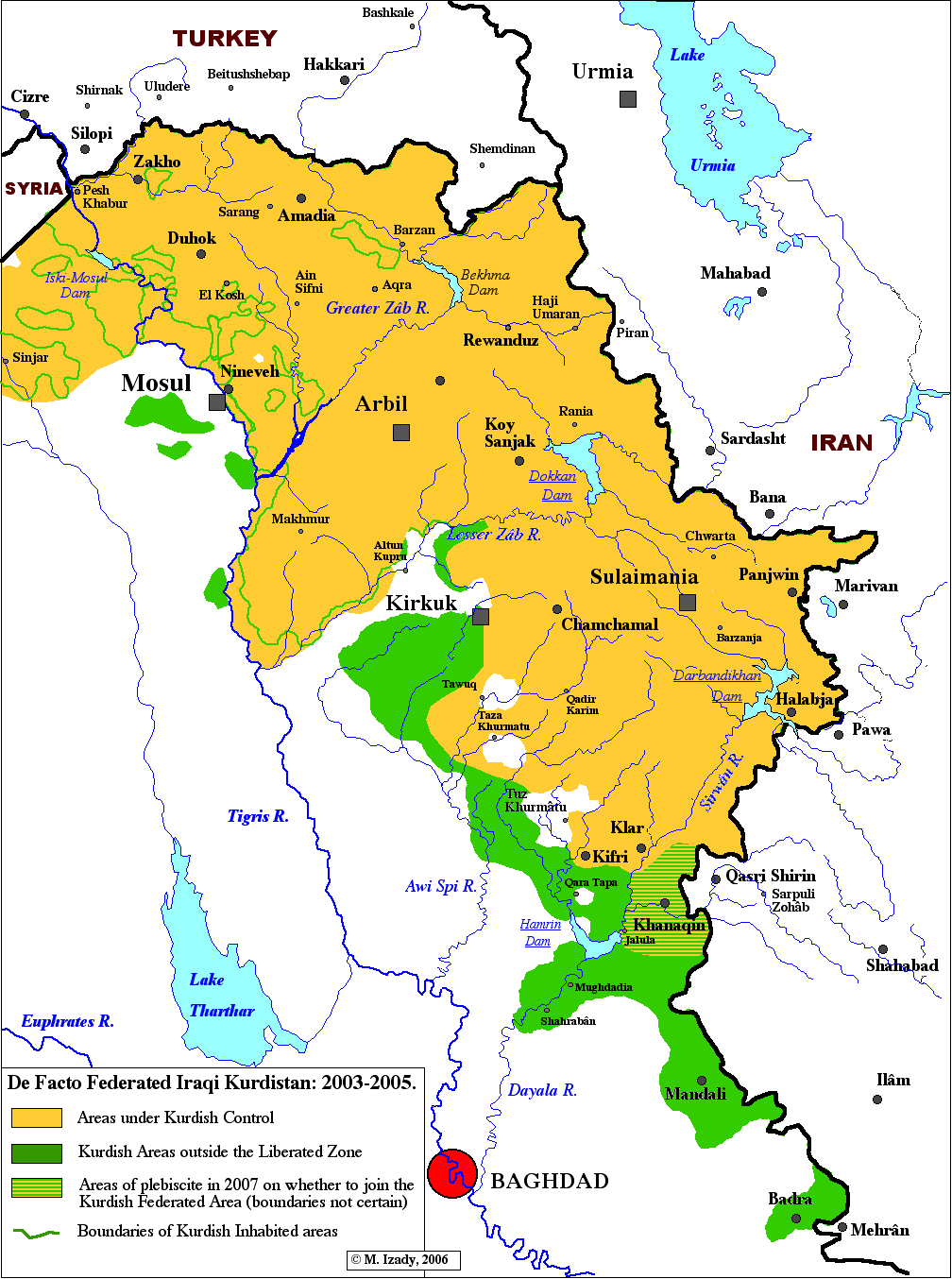
A senior Kurdish official visited Baghdad to discuss Iraqi Army (IA) deployments to the so-called disputed territories. Mohammed Ihsan, minister of “territories outside the region affairs” said he met the defense minister and other senior officers to discuss Iraqi Army movements in Makhmour.

According to Ihsan, an IA brigade was to be redeployed from Diyala province to Makhmour, southeast of Mosul. The Kurdish official described the planned deployment as “unnecessary because Makhmour is safe area. No terrorist activity, comparable to other regions, exists there”. He went on to say that there needs to be coordination between Baghdad and Irbil regarding military movements in disputed territories; otherwise “such movements would be seen as provocations”. Despite the obvious anxiety, the Kurdish official says an understanding was reached with Baghdad, “The minister of defense understood the situation and took steps to resolve the issue…we agreed on a mechanism for coordination among the main parties that exist in those regions”.
For more details on the confrontation in Makhmour, I recommend this article from the Washington Post.

PM Nouri al-Maliki has adopted a more belligerent stance in dealing with the issue of “disputed territories”. He seems to be emboldened by the growing sense of unity among Sunni and Shiite Arabs in the face of Kurdish ambitions in areas outside the three provinces; Irbil, Duhok and Sulaymaniah.

Both Arab and Kurdish keep saying that these problems must be solved by adhering to what the constitution says. Beautiful! If negotiations, compromises and the law are sufficient to avert catastrophe, that would be great. My only concern is that for more than eighty years, armed conflict has been the state of affairs between Baghdad and the Kurds. It was only constant U.S. intervention since 1991 that produced the current state of peace. It will be a huge challenge for Arab and Kurdish leaders to perpetuate this peace when the American peacemaker leaves.

*For an approximate map of Kurdistan and disputed territories click here.