Today Baghdad is witnessing a tragic disaster; hundreds have died and more were injured when huge crowds of pilgrims heading to the shrine of Imam Kadhom caused the fence of the A'imma bridge to collapse pushing people to fall into the Tigris river.
The news is still uncertain about the cause and casualty toll of this disaster but sources in the ministry of health say that around 640 people were killed in the incident.
The government is to blame for a large deal of the incident as they should have arranged sufficient safe pathways for the passage of the crowds especially that such ceremony had been practiced by Iraqis for so many years.
Our condolences to the families of the victims, may God give them patience.

New points of view about the future of Iraq and the Middle East.
Wednesday, August 31, 2005

Tuesday, August 30, 2005
Among 40 beautiful women competing for the Miss UK title, one carries Iraqi blood in her veins; that's Miss Nottingham Sara Mendili (23) who's got a degree in "organic medicine".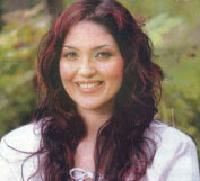
Sara who left Iraq when she was 12 said that her mother encouraged her to join these contests because "I didn't have the chance to win in beauty contests in Iraq where the awards were reserved for girls from the ruling family and their friends" said Sara.
According to the current results of voting for choosing the 12 finalists-which started in the beginning of August and will last till the 3rd of September-Sara is still ahead of the nearest contestant by over 500 points.
Dar Al-Hayat paper which reported the story mentioned that the Iraqi community in the UK is divided over Sara's participation; while moderate westernized Iraqis supported her and helped her with her campaign to get more votes, conservatives and Islamists are calling her names and making jokes about her.
I wish her good luck.
Don't forget to check out the latest episode of 'good news from Iraq' at Chrenkoff's. The best story (aside from politics, war and construction) was this one about music:
A lot more here.
In entertainment news, two thousand hopefuls sign up for the Iraqi Idol:
Many Iraqis already obsessively watch "American Idol", a version of the original British "Pop Idol" franchise, and a glitzy Lebanese copy called "Arab Superstar" on free-to-air Arabic satellite channels.
But "Iraq Star" is a brave indigenous effort to perk up the spirits of a depressed nation. The studio set is spartan and drab, and there is no studio audience, though viewers are being promised tinseltown touches when the finale is held in Beirut.
"We are trying to lighten the load and problems Iraqis are going through," said director Wadia Nader during recording of an episode this weekend in a Baghdad hotel.
"We had shows like this in the 1960s when people were discovered on television. But since then, with so many wars, Iraqis couldn't see this kind of thing," he added.
A lot more here.
-Bill Roggio over at the Fourth Rail sheds light on the the latest American air raids near Qaim and the apparently continuous tribal clashes between pro-Qaeda and anti-Qaeda Sunni tribes.
Monday, August 29, 2005
Sistani embarrasses the government.
The differences between the Sheat clergy and the parties that used its name during the elections are deepening and this appeared clearly after Sistani that he's not going to accept having his name or that of the clergy used for any future electoral campaign.
The clergy's negative attitude towards Sheat ruling parties increased after more seeing criticism coming from the people in the Sheat regions to the worsening situation in their cities which is attributed to the failure of the local administrations in running the affairs of the cities; the peak of the crisis came when Sheat-Shaet conflicts started in Najaf and a few other cities. I was even told by some Najafi friends that the conflict pushed Sistani to rufuse any meetings with government officials.
Today the differences reached the peak when Sistani dropped a bomb by rejecting federalism and thus rejecting the constitution of the Kurdish-Sheat alliance putting the current ruling parties in a difficult position.
Sistani in his statement said "The Sunnis are your family. Stay by their side this time so that they stay by your side in the coming times…"
This development reflects a critical turn in the relationship between the Sheat clergy and the government, and the ruling politicians will be faced again by the danger of having clerics interfering with politics but this time, the Sheat alliance which insisted onmentioning the clergy in the introduction of the constitution will certainly realize this danger and they will be left before a hard choice as they have put all their weight on the balance of the clergy and if the latter lets them down the consequences will be catastrophic for those politicians.
The persistence of some politicians to discuss all matters with the clergy in all topics gave the clerics more and more confidence in their role and in a country like Iraq, abolishing the influence of clerics is extremely difficult but still, depending on them is even more dangerous.
Will Sheat politicians absorb the lesson this time and what's their reaction going to be like? Will they try to appease the clergy and regain its support? Or are they going to act independently and count on their own decisions that are deigned to please the people not the clerics?
It is better to have these differences solved right now and prevent them from becoming time-bombs embedded in the constitution; of course this will make the situation a bit harder but our road wasn't easy at all in the last 35 years so why fear a few more difficulties!?
The clergy with all its power and influence hardly got 50% of the votes for its endorsed slate (when the Sunni didn't vote) so I think unity among liberal and secular power can grant them a good chunk of the votes in the coming elections and that will be sufficient to put the clerics and the clergy-dependent parties back in their actual size.
Sunday, August 28, 2005
Iraq's constitution: the final discussions...
Dr. Sallama Al-Khafaji (Assembly member from the SCIRI) announced 5 minutes ago on Al-Iraqia TV that many of the disputed points that were delaying the completion of the constitution have been solved and that the word "Party" (which the Sunni CDC members had objections on) was omitted from the clause that deals with deba'athification and now the clause refers to the Saddamist Ba'ath without calling it a "party"!
Dr. Khafaji said that further delays are not expected and voting will take place later today.
She said that everyone is awaiting Mr. Hachim Al-Hasani to decide the time for the voting session as he is the chairman of the National Assembly.
Update: (1:00 pm local time).
Montasir Al-Imara (Assembly member) confirmed that voting on the draft will take place in the coming few hours but also said "There are 153 clauses in the draft and naturally these clauses won't satisfy all Sunnis as Sunnis or all Kurds as Kurds but it's a project for a nation that looks at everyone's interests. The draft concentrated on equality among all Iraqis and there will be no 2nd degree citizens".
Update: (1:10 pm local time).
Baha Al-Araji (CDC member) said a few minutes ago that the latest modified version of the draft has been signed by the majority of the CDC members who are present today.
He pointed out that some federalism-related points will be shifted to the next National Assembly for discussion and approval.
Update: (2:10 pm local time).
Hussein Falluji (Sunni CDC member) told Al-Arabiya TV that the committee of the "marginalized" (in reference to the Sunni politicians) is holding a separate meeting right now for the purpose of preparing an announcemnet to clarify the "challenges and pressures" they were subjected to:
Update: (2:55 pm local time).
The National Assembly has just started its session.
Humam Hammodi made a short introductory speech where he pointed out that this constittution is "not a holy text" and that amendmendts can follow in the future.
A representatives of each political, ethnic, religious faction will be reading a part of the draft in front of the National Assembly.
Update: (3:35 pm local time).
While the draft is still being read, Salih Al-Mutlaq confirmed again that none of the 15 Sunni members of the CDC have signed the draft.
Al-Mutlaq also highlighted the American role in bridging the gap between the different parties involved in the process but he put the blame on the other parties (the Sheat and the Kurds) for focusing on "their narrow partisan and sectarian" interests.
Al-Mutlaq also explained that their objections are limited to a few points and that they agree with large parts of constitution and he stressed that they (the Sunni parties) will fully participate in the future phases of the political process.
He also called on the people who are not satidfied with the darft to avoid violence and keep practicing their normal daily activities and express thier opinion in peace.
It's worth mentioning that Hachim Al-Hasani (chairman of the Assembly) is not present at the current session.
Update (4:10 pm local time).
The whole draft has been read, now the session is over and tomorrow will be a special session dedicated to making an "elections law".
Dr. Khafaji said that further delays are not expected and voting will take place later today.
She said that everyone is awaiting Mr. Hachim Al-Hasani to decide the time for the voting session as he is the chairman of the National Assembly.
Update: (1:00 pm local time).
Montasir Al-Imara (Assembly member) confirmed that voting on the draft will take place in the coming few hours but also said "There are 153 clauses in the draft and naturally these clauses won't satisfy all Sunnis as Sunnis or all Kurds as Kurds but it's a project for a nation that looks at everyone's interests. The draft concentrated on equality among all Iraqis and there will be no 2nd degree citizens".
Update: (1:10 pm local time).
Baha Al-Araji (CDC member) said a few minutes ago that the latest modified version of the draft has been signed by the majority of the CDC members who are present today.
He pointed out that some federalism-related points will be shifted to the next National Assembly for discussion and approval.
Update: (2:10 pm local time).
Hussein Falluji (Sunni CDC member) told Al-Arabiya TV that the committee of the "marginalized" (in reference to the Sunni politicians) is holding a separate meeting right now for the purpose of preparing an announcemnet to clarify the "challenges and pressures" they were subjected to:
We did not have sectarian or partisan demands; all we care about is the unity of Iraq...we're arranging for a large campaign now to tell the people the truth about what happened. After all, it's all up to the people to decide since the people are the source of authority and sovereignty. All we asked for was to be given more time because we were expected to deal with all of Iraq's chronic problems in a matter of only two months!
We've got nothing to do now but to look forward to the next step; that is the referendum.
Update: (2:55 pm local time).
The National Assembly has just started its session.
Humam Hammodi made a short introductory speech where he pointed out that this constittution is "not a holy text" and that amendmendts can follow in the future.
A representatives of each political, ethnic, religious faction will be reading a part of the draft in front of the National Assembly.
Update: (3:35 pm local time).
While the draft is still being read, Salih Al-Mutlaq confirmed again that none of the 15 Sunni members of the CDC have signed the draft.
Al-Mutlaq also highlighted the American role in bridging the gap between the different parties involved in the process but he put the blame on the other parties (the Sheat and the Kurds) for focusing on "their narrow partisan and sectarian" interests.
Our only difference we had with the Americans was about setting a rigid timetable for completing the process.
[..]
We'll be calling all the powers that didn't participate in the last elections for a conference where we will be declaring our objections on the draft...
Al-Mutlaq also explained that their objections are limited to a few points and that they agree with large parts of constitution and he stressed that they (the Sunni parties) will fully participate in the future phases of the political process.
He also called on the people who are not satidfied with the darft to avoid violence and keep practicing their normal daily activities and express thier opinion in peace.
It's worth mentioning that Hachim Al-Hasani (chairman of the Assembly) is not present at the current session.
Update (4:10 pm local time).
The whole draft has been read, now the session is over and tomorrow will be a special session dedicated to making an "elections law".
Friday, August 26, 2005
Breaking News.
I was just about to go to bed when I saw the breaking news on Al-Iraqia TV announcing that an agreement has finally been reached on the draft of the constitution.
Update:
Humam Hammodi, the head of the CDC announced that the vote on the draft will take place tomorrow if the required number of Assembly members show up at the HQ of the Assembly (Saturday is not a usual day for parliamentary sessions) and if not, the vote will be postponed till Sunday.
Update:
Humam Hammodi, the head of the CDC announced that the vote on the draft will take place tomorrow if the required number of Assembly members show up at the HQ of the Assembly (Saturday is not a usual day for parliamentary sessions) and if not, the vote will be postponed till Sunday.
Iraq's constitution: How long is the tunnel?
This piece wasn't supposed to be published in the first place as I only wanted to put my thoughts on paper in order to help myself reach some answers but then I thought I could share it with you so that we can all think together:
It is not easy to forecast the future of this stage of the constitutional process in Iraq; several delays forced themselves after no agreements were reached between the Sheat and the Kurds on one side and the Sunni on the other.
One thing that we must realize here before making assumptions is that the Sunni are more stubborn that their Sheat and Kurds counterparts; the latter two parties managed to get over their differences and they reached accord over the once disputed issues between them and they gave up on some of their previous demands.
On the other hands the Sunni negotiators-till this moment-do not seem willing to change their minds and accept what the other tow parties have agreed upon.
The toughest obstacle delaying getting the Sunni agreement right now is federalism or more accurately it’s generalizing federalism; the Sunni negotiators would agree to granting the Kurds the right to establish a federal state (which already exists) but they don't want that state to include Kirkuk and they don't want other provinces to have the right to form other federal states.
However, that's not what all Sunnis think; there are the tribal chiefs of Al-Anbar who announced yesterday that they have no objection to the idea of generalizing federalism and there is also the governor of Mosul who seems to be in favor of federalism and in a statement he gave a few days ago he expressed his interest in turning Mosul into a federal state without the need to include other provinces in that state since Mosul alone was one of the four (or was that five?) counties from which modern Iraq was established after the fall of the Ottoman empire.
But the question is: where do the Sunni get their bargaining power from?
How did they get to exert this amount of pressure on the Kurds and the Sheat (the winners in the January elections) while the Sunni were the boycotters and they were invited to join the process only months after that?
Actually, this boycotting which is supposed to be a weakness point has become the source of strength for the Sunni.
The Sunni have absolutely nothing to lose, they didn't win the elections and they don't feel like they need to help the constitution succeed, simply because it's not their accomplishment.
It's the winners who worry about the constitution and care for the success of the process because that will be the parameter for measuring their success.
The Sheat and the Kurds know very well that they will not be able to score similar results in any future elections when the 3rd player joins the game especially when this 3rd player is so willing to join the game.
The Sunni are starting to realize their significance and what supports this idea is seeing very prominent political figures like Allawi and Talbani seeking alliance with the Sunnis so why would they (the Sunni) back the Sheat-Kurdish project and try to make the current process succeed when they can be a main player when the next stage comes and then they can design the game the way they like?
That's why the Kurds and the Sheat are so keen to win the support of the Sunni because they realize that the Sunni can fail the current draft if they wanted without losing anything.
Actually the Sunni politicians right now are concentrating on the claim that the latest delays in the process are illegal and are in violation of the TAL and probably they're thinking that the Sheat alliance is weakening after the latest conflict between the Sadrists and the SCIRI and that will probably encourage the Sunni to adhere more to their demands since they think that the position of Sadr men in the National Assembly (who also oppose federalism) could more or less double their influence on the process.
Moreover, the 21 members of advisory board of the CDC backed the Sunni's demands to drop the name of the Ba'ath from the constitution and they suggested rephrasing the clause to ban "all parties that adopt a chauvinistic, Nazi and racist ideology" instead of mentioning the Ba'ath party; actually many people think that the constitution must not sink into small details like this.
Bottom line, I think that even if the draft gets approved by the National Assembly tonight or tomorrow, we're still going to face more obstacles with this constitution that focused on unnecessary details; these details were introduced to please politicians and serve partisan ambitions while the interests of the people came only in the 2nd place and believe me, till this moment no one can know for sure if Iraqis are going to accept or reject the constitution, maybe the Kurdish people are most likely to vote with "yes" but the Shaet and Sunni people's position is not definite yet and that particularly applies to the Sunni whose current spokesmen do not necessarily represent the mainstream Sunni opinion.
Iraqis as a people are facing a very difficult choice this time; it's not like the January elections when they had 111 slates from all colors of the political spectrum to choose from but now they're left to choose between a constitution they don't agree with all its contents and a possible dangerous political vacuum in case they reject the constitution.
Wednesday, August 24, 2005
Muqtada's office in Najaf is on fire.
Right now there are bloody clashes in Najaf between the supporters of Muqtada Al-Sadr and the residents of the city.
The clashes started after Al-Sadr men tried to reopen their office which has been closed for months but the locals attacked the office, set fire in it and clashed with Sadr's men.
The police forces intervened and the casualties till now are 7 killed and tens wounded.
I have received news saying that a curfew has been imposed in the city.
It's worth mentioning here that the governor prohibited demonstrations arranged by people from outside the city "who wants to demonstrate can go and do that in his own city" said the governor in a statement yesterday.
I was told in a phone call from a friend who lives there that gunfire can be heard right now in najaf.
As a reaction, a number of Sadrists suspended their membership in the National Assembly and warned from "serious consequences" accusing the governor and his party (the SCIRI) of being responsible for the tension in the city.
Update:
Al-Hurra just reported that the Najaf police force is exchanging gunfire with the followers of Muqtada Al-Sadr.
The militia men are now hiding and returning fire from the shrine of Imam Ali.
At the same time, the Badr organization (military wing of the SCIRI) denied connection with the conflict.
Update:
There are news about clashes extending to reach parts of Baghdad and apparently followers of Muqtada have attacked some offices tht belong to the Badr organization of the SCIRI while the news are confirming that the first clashes originated between the Sadrists and civilian residents.
On the other hand, the ministers of transport and health (both Sadrists) have suspended their membership in the government.
I would like to bring the latest statements of Iraqi law makers to your attention, so I collected a number of these statements that surfaced after the submission of the draft of the constitution to the National Assembly two days ago:
Humam Hammodi, chief of the CDC said that the next parliament will decide the shape of the federal system in Iraq and that and that the possibility for future amendments on the constitution does exist.
He said that he and his Kurdish deputy D. Fouad Maasoum have signed the proposed draft but they're still waiting for Dr. Adnan Al-Janabi (senior Sunni MP) to sign it as well.
Hammodi announced in a press conference yesterday that the CDC has replaced the "constitutional board" that was supposed to monitor the application of the constitution by the "federal court" that is going to look into constitutional texts and solve any problems in interpreting them; this court shall include both, law experts and religious scholars.
One of the important issues is that of keeping balance in distributing governmental posts among the different components of the nation; the concept of quotas will remain valid for only another four years to be discarded after that.
The other key issue was the way of distributing the revenues of the natural resources like oil and gas which Hammodi confirmed that population counts in provinces and the state of development will influence the percentage that will go to each province so that poorer and the relatively underdeveloped cities will have a point of advantage in the distribution.
According to Al-Mada paper, the Sunni parties submitted their version of federalism (via non-Iraqi parties) to the CDC and their suggestion was to limit the formation of a federal state to the three Kurdish provinces while other federal states shall be formed (from one province only) only after the approval of the parliament.
Meanwhile, judge Wael Abdullatif (from Allawi's block) expressed his opposition to the decision of submitting the draft without the approval of all the concerned parties and said that "exceeding the deadline for writing the draft was illegal" while Jalal Addin Al-Saghir from the Sheat alliance block said that the three extra days that were requested were not an extension or a violation to the TAL but it's rather a chance for the Sunni to reach an agreement with the CDC and he criticized the way Hachim Al-Hasani (the chairman of the Assembly) announced the news and the way he ran the last session of the Assembly.
Ahmed Abdulwahhab from the Kurdish block said "we believe that we have satisfied the ambitions and hopes of the Kurdish people" adding that "federalism is the main point of disagreement with the Sunni".
Abdulwahhab added a worrisome comment about the issue of the personal affairs law; he said that we should be expecting a new wave of objections from Iraqi women since sharea still has a role in this part of the constitution.
Tariq AlHashimi, deputy secretary of the Islamic party announced that his party refuses the generalization of federalism but "if the Iraqi people say yes to this constitution then we will respect the will of the people".
Hameed Majeed Mousa, the secretary of the Communist Party said that the current draft "has many deficiencies and holes" but he also expressed his hope in reaching a better result by the end of the three-day period.
Sources, Al-Mada Al-Sabah papers and Al-Iraqia TV.
Tomorrow will apparently be exciting and decisive since it will bring the final word on the new constitution of Iraq and we at this blog will try to keep you updated on the developments of the process.
Monday, August 22, 2005
Breaking News! (updated)
National Assembly member Bahaa Al-Aaraji just told Al-Iraqia TV that an agreement has finally been reached among the leaders of political bodies on the final draft of the constitution and that disputes over issues like federalism, distribution of resources and the role of Islam have been solved.
"All we need now is a couple of hours to reprint the document and produce enough copies to submit them to all the members of the National Assembly to get theri approval later this evening…" Al-Aaraji explained.
Till now there has been no announcement from the head of the constitution drafting committee but Al-Iraqia reporter in the green zone is confirming the news.
Update (6:45 pm local time)The Sunni member of the constitution drafting committee Hasan Zaidan (1st image) said that he didn't get to see the new document till now and added:
"It seems that the Kurds and the Sheat want to pass this draft without considering our opinion...There are other unsolved points till now and I have no idea why no one notified us of the results of the latest negotiations".
Mean while, another CDC member Ali Al-Dabbagh (2nd image) confirmed the news of the agreements and he insisted that this outcome was reached with lots of dialogue among the concerned parties.
Update (7:10 pm local time):
In a press conference that just ended in Baghdad, Jawad Al-Maliki and Jalal Addin Al-Saghir (CDC members from the United Alliance) said that the Sunni politicians still have reservations on federalism but they expected that the draft will easily get the approval of 2rds of the Assembly members.
"Frankly speaking, we cannot wait for the Sunni forever; we have a deadline to respect and if they don't agree with what was written in the draft they can say that in the referendum but we're still having talks with the Sunni politicians" said Jalal Addin (3rd image).
Regarding Islam and the constitution: it was agreed upon that no laws that are against the widely agreed upon values of Islam can be issued and no laws that are against the values of democracy and human rights can be issued.
Natural resources according to the draft will be managed in cooperation between the central government and the local administrations of the federal states/provinces.
Update (10:45 pm local time):
Chairman of the National Assembly Hachim Al-Hasani announced that discussions are still underway among all involved parties in hope for reaching "accord" before disclosing the draft; this is expected to be done within an hour and then the Assembly shall start a session to approve the draft immediately after that.
This is of course in effort to convince the Sunnis to be part of the process, however if this last discussion fails the Sheat and Kurdish blocks are most likely to present the draft without the "OK" from the Sunni politicians.
Meanwhile there have been rallies of joy and celebrations in many Iraqi cities mainly in the south and people went to the streets in thousands although it's past 10 pm now.
The Iraqi TV has been playing patriotic songs all the evening and in between the incoming reports and updates; one song named "Good bye sadness" was played more than 20 times so far!!
Update (11:20 pm local time):
The Assembly has assembled! Voting will follow so stay tuned!
Update (11:30 pm local time):
PM Dr. Jafari and president Talbani join the session and the Assembly members are receiving their copies of the draft.
Update (11:55 pm local time):
"The Assembly has received the draft from the CDC but becaue there is a number of issues that still need further discussio and in accordance with clause 61-f of the TAL, voting will be postponed for another 3 days until the leaders of political blocks can reach accord on the few remaining disputed issues" said Hachim Al-Hasani chairman of the Assembly.
Apparently they think that it is in the best of the process to have accord among all the political blocks.
Session is over.
"All we need now is a couple of hours to reprint the document and produce enough copies to submit them to all the members of the National Assembly to get theri approval later this evening…" Al-Aaraji explained.
Till now there has been no announcement from the head of the constitution drafting committee but Al-Iraqia reporter in the green zone is confirming the news.
Update (6:45 pm local time)The Sunni member of the constitution drafting committee Hasan Zaidan (1st image) said that he didn't get to see the new document till now and added:

"It seems that the Kurds and the Sheat want to pass this draft without considering our opinion...There are other unsolved points till now and I have no idea why no one notified us of the results of the latest negotiations".
Mean while, another CDC member Ali Al-Dabbagh (2nd image) confirmed the news of the agreements and he insisted that this outcome was reached with lots of dialogue among the concerned parties.

Update (7:10 pm local time):
In a press conference that just ended in Baghdad, Jawad Al-Maliki and Jalal Addin Al-Saghir (CDC members from the United Alliance) said that the Sunni politicians still have reservations on federalism but they expected that the draft will easily get the approval of 2rds of the Assembly members.
"Frankly speaking, we cannot wait for the Sunni forever; we have a deadline to respect and if they don't agree with what was written in the draft they can say that in the referendum but we're still having talks with the Sunni politicians" said Jalal Addin (3rd image).

Regarding Islam and the constitution: it was agreed upon that no laws that are against the widely agreed upon values of Islam can be issued and no laws that are against the values of democracy and human rights can be issued.
Natural resources according to the draft will be managed in cooperation between the central government and the local administrations of the federal states/provinces.
Update (10:45 pm local time):
Chairman of the National Assembly Hachim Al-Hasani announced that discussions are still underway among all involved parties in hope for reaching "accord" before disclosing the draft; this is expected to be done within an hour and then the Assembly shall start a session to approve the draft immediately after that.
This is of course in effort to convince the Sunnis to be part of the process, however if this last discussion fails the Sheat and Kurdish blocks are most likely to present the draft without the "OK" from the Sunni politicians.
Meanwhile there have been rallies of joy and celebrations in many Iraqi cities mainly in the south and people went to the streets in thousands although it's past 10 pm now.

The Iraqi TV has been playing patriotic songs all the evening and in between the incoming reports and updates; one song named "Good bye sadness" was played more than 20 times so far!!
Update (11:20 pm local time):
The Assembly has assembled! Voting will follow so stay tuned!
Update (11:30 pm local time):

PM Dr. Jafari and president Talbani join the session and the Assembly members are receiving their copies of the draft.
Update (11:55 pm local time):
"The Assembly has received the draft from the CDC but becaue there is a number of issues that still need further discussio and in accordance with clause 61-f of the TAL, voting will be postponed for another 3 days until the leaders of political blocks can reach accord on the few remaining disputed issues" said Hachim Al-Hasani chairman of the Assembly.
Apparently they think that it is in the best of the process to have accord among all the political blocks.
Session is over.
Iraq's constitution: the second last chance...
The latest news coming from the National Assembly and the constitution drafting committee indicate that no agreement has been reached so far and probably the different blocks are now farther from reaching an agreement than they were a week ago.
The difference now is that they already asked for an extra week chance to get over their differences but they obviously failed in doing that and asking for further time will be unjustified and even if it's legal it won't be accepted by the people.
However there are some worrisome signs that surfaced this morning and were uncovered by members from the Sheat block; they're threatening that if they don't solve the differences with other blocks, mainly the Kurdish alliance they (the Sheat block) will submit their draft to the National Assembly for approval, ignoring the other components of the Assembly and I don't want to think of the consequences of such a move.
The major remaining obstacle right now is the issue of distributing the natural resources between the central government and the provinces/federal states; ironically this particular issue was said to have been solved at least three times before and we heard in the past few weeks that a deal was reached more than once and now they come and say that they still have differences regarding this issue!
I believe the national Assembly failed in accomplishing their mission because the people who shouldered the responsibility of writing the constitution have been giving partisan interests the priority instead of the nation's interests and since partisan interests are naturally in conflict with each other, I think that reaching a dead-end is inevitable.
Sunday, August 21, 2005
Today I came across this caricature by one of Iraq's best cartoonists, Khudair Al-Himyari:
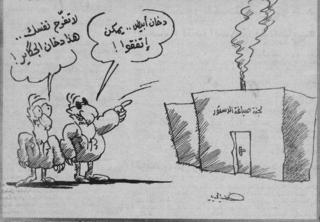
Guy with sunglasses: I see white smoke! Maybe they reached an agreement.
Guy to the left: Don't get excited pal, it's only cigarettes' smoke!
Notice that words on the building say "Constitution writing Committee"

Guy with sunglasses: I see white smoke! Maybe they reached an agreement.
Guy to the left: Don't get excited pal, it's only cigarettes' smoke!
Notice that words on the building say "Constitution writing Committee"
Yesterday in the afternoon I picked up some clothes to get them to the laundry; by the way, in Iraq we do most of our laundry at home except for suits, jackets or clothes that have a stubborn spot of oil or juice or…whatever! That's not what I should be talking about right now.
So, the place I was going to to do the laundry is very close to a mosque (a Sunni mosque to be more specific), now once I parked the car and made the first two steps to my destination I was attacked by a kid holding a parcel of flyers in one hand and handing out flyers to pedestrians and people in cars with the other hand.
The parcel was heavy for him that he barely kept balance while moving and it looked funny.
"Uncle, here, take these, read them and then go register your name in the office" said the kid while he snatched a couple of flyers from the parcel (which you can see in the image below) and handed them over to me.
The word "uncle" or "aunt" is used so often when talking to anyone relatively older in age…well, again that's not our topic today!
That kid was not alone there; there were other kids doing the same, all wearing the same kind of screen printed t-shirts and caps carrying the name and sign of the Islamic Party.
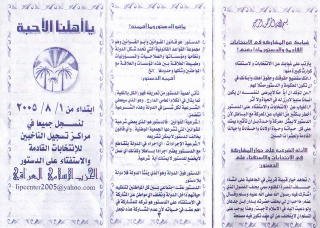
Those flyers are different from the ones that were distributed prior to the January elections by this party and other Sunni entities; this time they're encouraging their fellow Sunnis to take part in the referendum and the next elections describing the people's commitment to the constitutional process as a "must do" social and patriotic duty and describing the party's campaign to encourage joining the process as a "must do" religious duty.
It's interesting that this time they were digging for proofs in the Quran and Hadith (sayings of the prophet) to support and justify their calls for taking part in the referendum and elections. They even chose a Hadith where the prophet is supposed to have legalized having a social contract with "nonbelievers" if that contract is going to serve the interests of the community and that's in my opinion is a huge change.
It seems that everyone is getting ready to say their word the on constitution and all that is missing now is, er...the constitution!
So, the place I was going to to do the laundry is very close to a mosque (a Sunni mosque to be more specific), now once I parked the car and made the first two steps to my destination I was attacked by a kid holding a parcel of flyers in one hand and handing out flyers to pedestrians and people in cars with the other hand.
The parcel was heavy for him that he barely kept balance while moving and it looked funny.
"Uncle, here, take these, read them and then go register your name in the office" said the kid while he snatched a couple of flyers from the parcel (which you can see in the image below) and handed them over to me.
The word "uncle" or "aunt" is used so often when talking to anyone relatively older in age…well, again that's not our topic today!
That kid was not alone there; there were other kids doing the same, all wearing the same kind of screen printed t-shirts and caps carrying the name and sign of the Islamic Party.

Those flyers are different from the ones that were distributed prior to the January elections by this party and other Sunni entities; this time they're encouraging their fellow Sunnis to take part in the referendum and the next elections describing the people's commitment to the constitutional process as a "must do" social and patriotic duty and describing the party's campaign to encourage joining the process as a "must do" religious duty.
It's interesting that this time they were digging for proofs in the Quran and Hadith (sayings of the prophet) to support and justify their calls for taking part in the referendum and elections. They even chose a Hadith where the prophet is supposed to have legalized having a social contract with "nonbelievers" if that contract is going to serve the interests of the community and that's in my opinion is a huge change.
It seems that everyone is getting ready to say their word the on constitution and all that is missing now is, er...the constitution!
Saturday, August 20, 2005
From Al-Sabah:
Well, the way things change in Iraq can be really surprising sometimes; just try to compare between Fallujah 12 months ago and today's Fallujah!
The residents of Fallujah are asking the authorities to increase the number of voters' registration offices in the city as the existing ones are not enough to finish the registration process of all eligible voters before the day of the referendum planned for October 15….
Well, the way things change in Iraq can be really surprising sometimes; just try to compare between Fallujah 12 months ago and today's Fallujah!
Friday, August 19, 2005
Iraqi parties demand international monitoring for the next elections.
"The next elections need to be supervised by international committees and not by the Iraqi government because the government is not neutral" said Adnan Al-Pachachi the prominent Sunni politician and former Governing Council member in an interview with Al-Mada newspaper, he adds:
Many parties, especially those of the opposition or those who boycotted the January elections have increasing fears from manipulations or fraud in the next elections and that's why they think that having international supervision is essential to reassure both, the parties and the voters.
And I share their concerns.
We're going to press for having international monitoring over the elections and to have international protection for the fairness and transperancy of the elections.
The IECI has failed to prevent violations in several regions during the last elections.
Depending on the police forces to provide protection for the voting centers isn't a logical choice because we know how those forces were chosen and local security corps will not be neutral either…the government in general is going to be part of the electoral race so it will certainly be biased.
[..]
We need the international community to protect these elections; any doubts in its fairness could lead the nation to a disaster.
Many parties, especially those of the opposition or those who boycotted the January elections have increasing fears from manipulations or fraud in the next elections and that's why they think that having international supervision is essential to reassure both, the parties and the voters.
And I share their concerns.
Thursday, August 18, 2005
A group of 35 Iraqi sergeants graduated from a training course in the UK on Wednesday:
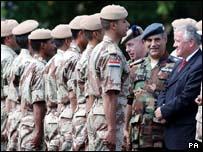
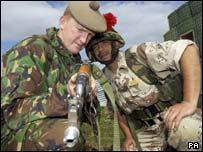
From the Arabic BBC news page.
The graduation ceremony was attended by UK's defense minister who talked to the graduates saying "I see brave men in you and there's a tough task awaiting you so be careful and take good care of your country".
Iraq's army deputy chief of staff General Naseer Al-Ibadi who was also there said "We're looking forward to seeing the day when two units from our countries can work side by side in far away places to fight for and defend peace" and added "training our soldiers in the UK is the start for introducing the right ethical values and the concepts of human rights into the Iraqi army".
This is the type of commanders I admire; the cruelty of the difficult situation in Iraq didn't stop him from looking forward to the future.

The 35 graduates who received intensive training for 3 months from British trainers showed their new learned military skills as they paraded in the Infantry training facility in Wales.
The new sergeants were trained according to the same curriculum that is adopted in the British army after introducing a few modifications to meet the special requirements for operating in Iraq; the main job of these men when they return to Iraq will be training new Iraqi soldiers.

From the Arabic BBC news page.
The graduation ceremony was attended by UK's defense minister who talked to the graduates saying "I see brave men in you and there's a tough task awaiting you so be careful and take good care of your country".
Iraq's army deputy chief of staff General Naseer Al-Ibadi who was also there said "We're looking forward to seeing the day when two units from our countries can work side by side in far away places to fight for and defend peace" and added "training our soldiers in the UK is the start for introducing the right ethical values and the concepts of human rights into the Iraqi army".
This is the type of commanders I admire; the cruelty of the difficult situation in Iraq didn't stop him from looking forward to the future.
More pressure from the people on the national Assembly for a secular constitution; this time Iraqi Christians raise their voice loud:
Around 30,000 Iraqis signed a memorandum that demands including the rights of Iraqi Christian communities in the permanent Iraqi constitution which is still being negotiated till now.From Al-Sharq Al-Awsat.
The signature-collecting campaign is organized by the "Ma'an" (equal for 'together') NGO.
Chief of the organization, Ibtisam Georges (woman) expressed her fear from having the new constitution ignoring the rights of the Christians who have been living in Iraq for two thousand years side by side with people of other religions, sects and ethnicities.
Mrs. Georges summed up the demands by a) The constitution must not discriminate between Iraqis on any basis. b) The constitution must be based on the concept of citizenship.
A Saudi youth tells his story of an unsuccessful trip for Jihad in Iraq.
A Saudi young man (name was not revealed) gave an interview to Al-Watan Saudi paper after he was recently released from prison where he spent some time for trying to sneak into Iraq to join the jihadists.
Here's a translated summary of what he said in the interview
The man denied the existence of specialized recruiting and smuggling network in Saudi Arabia and he said that Saudis who feel the urge to go to fight in Iraq usually travel to an intermediate country (any guesses?) using tourism as a cover for their real intentions and there they would be met by certain people who organize them into units, provide training and transportation in exchange for a certain amount of money.
The man described the procedures as "primitive and arbitrary" and usually depend on luck and coincidences; men willing to become jihadists travel to town near the Iraqi borders where they are identified (from their looks) and spoken to by the recruiting agents who ask them what they they're doing here and so a deal is made.
For example this guy paid 5,000 Saudi Riyal (~1,700 $) just to be taken 30 miles beyond the Iraqi borders but his journey failed.
Inspite of the high cost of the trip, the new jihadist had to share the transportation with other passengers; he was told by his agent that this is essential to "reduce the cost of the dangerous trip"!
He went on with his story explaining that people's positions and ranks within jihadi cells depends on their combat skills, so those with good skills are appointed leaders for cells working under bigger organizations while those with little or no experience would work under the leadership of a professional commander and he pointed out that cells are usually multinational with members from various countries joined by one goal.
I just want to add that according to an earlier report published by the same paper, 5 Saudis were killed in Iraq during the last week.
Here's the rest of the story but in Arabic.
Subscribe to:
Posts (Atom)