Nothing was more painfully clear than this message; they are killing our future by killing students and knowledge. They are killing the flowers who filled the world with laughter, energy and hope since the first school was built thousands of years ago somewhere on this very land.
65 families or maybe more mourn their sons and daughters today and I know their feeling very well…I've been through it when I lost my loved ones and I know what their obsessions are telling them; why did send them to school? Did I have to, was it the right thing to go on with our lives and defy terror? Oh God, they threatened and they did it but what future would we have if my son didn't go to school!?
Why did I let her go? Oh God help me answer my bleeding heart.
A policeman says: the cell phones didn’t stop ringing in their pockets and purses but there was no one to answer…they were gone.
The ringing will keep me awake tonight angels of Iraq…you were the bravest when you chose to go on in the face of danger. I will not close my eyes tonight; your phones and your voices echo in my head waking up the demons who want revenge in cruelty that splits heads from shoulders.
Isn't this sight enough for the world to stand with us? Doesn't it look clear now? Damn you if you watched this and saw only new numbers for your counts.
I bet my life on it; tomorrow students will go to their schools again carrying their books, wearing their best clothes. Even if one student remains I bet you these crimes will not stop life from going on.
Please, go light a candle for their souls and let the world hear your voice…let's expose the criminals and let's fight them with all the strength we can find so that our sons and brothers can walk to school every day.
Oh, angels of Iraq, I mourn you like I mourned no one else.

New points of view about the future of Iraq and the Middle East.
Wednesday, January 17, 2007

Sunday, January 14, 2007
What? Already running away!?
Insurgents and terrorists are already abandoning some of their positions in Baghdad and moving to Diyala, al-Sabah said:
Actually the people in Diyala have every reason to worry about such migration of terror cells because in fact even without reading what those eyewitnesses and officials had to say one would expect insurgents and terrorists to choose hiding in Diyala rather than other provinces until the security operations are through.
I can see some reasons for this choice; Sunni insurgents and al-Qaeda fighters would prefer Diyala over Anbar because:
-They have established many bases in the both, but;
-Anbar is expecting 4,000 additional troops. This along with increased pressure by the tribes in Anbar and the fact that reaching Diyala would be easier than Anbar make Diyala the alternative.
On the other hand and at the same time Sadr's militiamen seem to have chosen Diwaniya to be their destination in case they come under fire in Baghdad, the same al-Sabah report adds:
And the reasons to expect this movement here are clear as well; first of all Diwaniya is not far away from Baghdad, and the past few months had shown the level of the Sdarists strength in that city when order was restored only after reinforcements were summoned from neighboring provinces.
The Sadrists feel they are very strong in Diwaniya and what their man in the city said yesterday shows the level of extremism of the Sadr followers in this city. This is the same man who ordered the execution of unarmed Iraqi soldiers last summer and his threat this time shows a strange lust for violence that is likely to attract militiamen who want to keep fighting regardless of place.
Both cases indicate that the bad guys are adjusting their plans as the government and US military adjust theirs. The clear and hold tactic means militants will have little chance to maneuver within Baghdad like they used to do to work around previous crackdowns so now they are planning to make long-range maneuvers in provinces outside Baghdad.
Although the main objective of the new security plan is securing Baghdad, it would be a good idea for the military commanders to keep an eye on a few other provinces because we don't want to fight the same men twice, or thrice!
In Diyala, politicians, religious and tribal figures demanded that their province be included in the security plan of Baghdad. This came after dozens of foreign Arab militants ran away from Baghdad to areas across Diyala in order to avoid raids by the Iraqi and American forces during the incoming security plan to secure Baghdad.
Eyewitnesses told al-Sabah that areas such as New Baquba, Gatoon and al-Zour in Miqdadiya have become convenient bases for terrorists and foreign al-Qaeda members from Egypt, Syria, Yemen and Afghanistan.
This movement of terrorists forced most of the families in these areas to leave either to neighboring countries or to the southern provinces.
The people are asking the interior and defense ministries and the MNF to seal the entrances and exits in order to contain and capture those terrorists in order for Baghdad's plan to succeed. In the same regard a knowledgeable security source stressed that the success of Baghdad's plan depends on the stability of surrounding provinces, especially Diyala…
Actually the people in Diyala have every reason to worry about such migration of terror cells because in fact even without reading what those eyewitnesses and officials had to say one would expect insurgents and terrorists to choose hiding in Diyala rather than other provinces until the security operations are through.
I can see some reasons for this choice; Sunni insurgents and al-Qaeda fighters would prefer Diyala over Anbar because:
-They have established many bases in the both, but;
-Anbar is expecting 4,000 additional troops. This along with increased pressure by the tribes in Anbar and the fact that reaching Diyala would be easier than Anbar make Diyala the alternative.
On the other hand and at the same time Sadr's militiamen seem to have chosen Diwaniya to be their destination in case they come under fire in Baghdad, the same al-Sabah report adds:
The national security officer in Diwaniya Mehdi Abu-D'ayna stressed that his province that enjoys stability would possibly turn into a shelter for militants escaping areas of tension similar to what happened in the past.
But he also pointed out the security measures that are underway to stop militants from entering the city such as increasing the number of checkpoints and asking the locals for more cooperation in monitoring strangers.
And the reasons to expect this movement here are clear as well; first of all Diwaniya is not far away from Baghdad, and the past few months had shown the level of the Sdarists strength in that city when order was restored only after reinforcements were summoned from neighboring provinces.
The Sadrists feel they are very strong in Diwaniya and what their man in the city said yesterday shows the level of extremism of the Sadr followers in this city. This is the same man who ordered the execution of unarmed Iraqi soldiers last summer and his threat this time shows a strange lust for violence that is likely to attract militiamen who want to keep fighting regardless of place.
Both cases indicate that the bad guys are adjusting their plans as the government and US military adjust theirs. The clear and hold tactic means militants will have little chance to maneuver within Baghdad like they used to do to work around previous crackdowns so now they are planning to make long-range maneuvers in provinces outside Baghdad.
Although the main objective of the new security plan is securing Baghdad, it would be a good idea for the military commanders to keep an eye on a few other provinces because we don't want to fight the same men twice, or thrice!
Friday, January 12, 2007
Baghdad, between Maliki's plan and Bush's strategy...
In Baghdad, Iraqi and US forces are still targeting what seem to be pre-selected spots.
According to local TV, Iraqi troops made an airborne assault in al-Iskandariya area south of Baghdad in a quality operation where 6 al-Qaeda local commanders were arrested. In addition to that large weapons caches were discovered near Taji north of Baghdad and containers full of aircraft parts and an entire helicopter were unearthed in Mada'in southeast of Baghdad.
Last morning we woke up to rocking explosions that were perhaps caused by air strikes. The explosions echoed across Baghdad and they were many that I couldn't count them all; the state TV says these were American raids against insurgents strongholds in Dora but a friend of mine said there were also raids on Zafaraniya and specifically on Arab Jubour village which is also known for harboring insurgents.
I heard rumors that in Amiriya in western Baghdad militants put up posters calling the neighborhood "The Islamic Emirate of Amiriya", and I heard the same about Adhamiya and Raghiba Khatoun in the east. These are some of the most dangerous areas in Baghdad now that extremists dominate and almost totally isolated them from the rest of the city.
Walking into these areas has become scary even to Sunnis. In fact I see that the isolation is more geographic than sectarian; the insurgents suspect any stranger, for example most Sunnis from outside Adhamiya fear going into it or Amiriya and the same applies to Shia Baghdadis when it comes Sadr city or Hurriya…it's hard to convince militiamen or insurgents of your background when you're a stranger to the neighborhood.
The problem is that it’s the peaceful and terrified majority in such neighborhoods who suffer the most from this siege, for example the price of a kilo of any vegetable in the inner markets of those areas is twice as much as in the rest of the city. Let alone that cleaning workers and fuel distributors fear going into those areas.
Yesterday one of our relatives who decided to leave Haifa street permanently visited us. We had a long talk and she described to me what happened there, and said it all started when militiamen dressed as soldiers made an attack.
She couldn't explain how the locals could tell that the assailants were fake soldiers but I wasn't surprised because Sunni clerics have been warning that Shia militias had intended to attack Sunni neighborhoods and I think that's what made residents in Haifa street interpret any operation as an attack by militias.
She went on and described how the attackers set two homes on fire and how armed locals in the districts of Meshahda, Fahhama and Sheik Ali managed to repel the attacks later and captured some of the attackers.
She told me that the news about executions and hangings on electricity poles were true but that no one could tell the toll. When I asked whether the bodies had military uniforms on them she said "no, they were all in civilian clothes but were all young men"
I asked her if she thought that harboring insurgents and outlaws was the problem in the first place and she agreed "yes, but what are we supposed to do! We don't trust the government's forces either. The police and army say they are here to protect us from terrorists and the militants say they are here to protect us from militias; we're stuck between two fires here!"
When I asked my relative about the backgrounds of the insurgents in her neighborhood she said that most of them are originally bandits, thieves and notorious thugs but the interesting thing is that she told me that some of the worst one were killed in the latest clashes "Noori al-Aqra' [Noori the Bald] for example was the 6th in his family to be killed in clashes with government forces. The whole neighborhood knows he was the one who murdered the Kurdish reporter that worked for al-Iraqiya TV and robbed her jewelry and cell phone…"
The other news was that the area of Haifa street had seen an influx of militants from Amiriya sent by the infamous terrorist "Ibn Quoza" who's a former bandit and a wanted criminal.
The curfew in the area has been lifted but only through one passage at al-Talayi' Square and only women and children are allowed on the street so they can shop for food and other needs. She explained that men wouldn't go out because they are afraid the troops might get suspicious and arrest them…"most of the militants are now hiding in basements or in the nearby cemetery…there are many Afghan-Arabs, they are like ghosts; they come from nowhere and disappear just like that. Like I said before, those do not care to distinguish between Sunni and Shia and they'd kill anyone they suspect"
While Baghdad is preparing for the main plan to begin we're getting rumors that the government is considering terminating the curfew since it didn't help in limiting the violence, and occasionally restricts the movement of students, workers and ordinary people. However Baghdad's streets look less crowded than usual and many people avoid going out except for urgent matters, and although the curfew begins at 9 pm, most people return home before 7 after which you can hardly find cars on the streets.
The awaited security operation still occupies the headlines and the conversations of people as well as the statements of politicians. Yesterday PM Maliki's office confirmed that Baghdad now has a new commander and two assistants, neither was named.
On the other hand extremist parties like the Sadrists and the Muslim scholars are attacking the plan and telling the people that it would cause too much collateral damage and casualties to innocent people.
Perhaps the most important headline in the papers yesterday was of the statement Sistani made after meeting with the national security adviser al-Rubai'i where he said that weapons must be only in the hands of the official security forces. I think the government should make use of this statement to the maximum limit because it leaves no excuse for anyone who claims militias exist to protect the innocent or to compensate for the weakness of the government. This statement gave Maliki a green light to disarm Sadr's militias and he should use this chance.
Sistani had another meeting a few days earlier than that. It was with Sadr this time and it was the first in a year actually. Little was revealed about what was discussed during this meeting but al-Sabah paper said Sadr was trying to convince the Ayatollah that the plans to form a new political bloc were not in the interest of the UIA or Iraq and were motivated by personal ambitions of some politicians. Sistani's response to this was not revealed but his position from disbanding militias looks clear now.
Despite being concerned about security developments, the people were very interested in learning about the new strategy of president Bush but since the speech was aired at 5 am in Baghdad, the morning has seen a rush to radio and TV to find out what the president had said.
A few hours later a flood of comments from Iraqi politicians filled the media here and maybe the earliest and most interesting argument was the one that took place between Abdul Kareem Al-Inizi of the UIA (from a branch of the Dawa party that split from the original Dawa of Jafari and Maliki) and Mithal al-Alusi during yesterday's session of the parliament.
Al-Inizi said "Iraq is not an American state and Bush must consult with us before making such decisions about sending troops…" to which al-Alusi responded by saying "We have an elected prime minister and he was consulted…you and others like yourself wouldn't be sitting here had America not helped us. They are trying to protect this democracy and they possess what they can offer to help us with the security situation, but what do you have?? Cut the nonsense, ok? Do you think the parliament wants to vote about this? Fine, let's ask everybody if they want such voting…"
There was only silence in the hall after this and no one said another word about voting.
Another lawmaker from the UIA told the press that Bush was successful in identifying the problems and the ways to fix them.
The Accord Front on the other hand had their reservations and said they were concerned the new strategy might cause more harm than good.
The Kurdish bloc is totally satisfied with the plan to send in more troops.
Ayad al-Samerra'i, a senior Islamic party lawmaker said he supports the presence of American troops and said that terrorists and militias "are the two sides of the same coin" obviously reflects his hope that the new strategy would deal strictly with militias.
The association of Muslim scholars as expected said it was against the new strategy of Bush and warned that new security plans would cost Iraqis and Americans a heavy price.
From the above and from more that we heard we could see that there are different opinions even among members of a single bloc but I also see that a majority supports the new strategy while opposition is coming from extremists who realize that they will be the next target for the government and allied forces.
This was how Baghdad looked to me….
Wednesday, January 10, 2007
Did the operation actually begin?
The sounds of furious battles filled Baghdad's skies for the past two days. In the largest battle Haifa street and its surroundings were the field in which all sorts of guns were used.
Actually yesterday was the first time in months that I hear the familiar characteristic sound of the 30 mm cannon that is usually mounted on A-10's and Apache helicopters. This particular weapon is an indication of the seriousness of the battles even though was fired only a few times. Anyway, military aircrafts are still roaming the skies above us occasionally at low altitudes and making significant sounds.
The battles left more than 50 militants killed and more than a dozen captured, seven of whom are Syrians and this supports what we reported in our last post that eyewitnesses said. Meanwhile there have been more clashes in Al-Aamil district in western Baghdad yesterday and we learned that all roads and bridges leading to that area are now closed, with helicopters hovering above.
With all of this going on, the government still insists that the new security operation in Baghdad hasn't started yet according to the spokesman of the government Ali al-Dabbagh who, in a statement to Al-Mada has also denied the news about the Peshmerga or The Badr brigade being involved in the new security operation:
Al-Dabbagh also told l-Mada paper that this operation would be different:
Al-Dabbagh delivered more details to al-Sabah:
The debate among politicians here about the operation continues; some are for and others are against and perhaps among the major points of controversy is the participation of the Peshmerga. This one is already clarified after the participating units have been identified. It appears that some of the participating brigades in fact have a Kurdish majority but they are IA brigades though and they answer to the defense ministry, not the Peshmerga organization.
The Peshmerga Minister of Kurdistan made this explanation to Al-Mada (same link as above):
The other point of controversy, and the more important one indeed is the fear from having the operation turn into a selective operation that targets one sect and ignores the other. I think that although this might possibly be the case but those who are marketing this idea are the extremists in the first place; the ones who see a serious threat for them in this operation.
For example, the association of Muslim scholars which was yesterday calling the former army officers to lead a coup said the new operation would target Sunnis only. This sounds like a replay of a broken record that al-Qaeda always uses to deepen the sectarian tension, terrify, and win the sympathy of nonviolent Sunnis who still believe the political process has a chance. The statement came like this:
Most people here expect the major operations to begin by Friday or early next week at maximum and actually it looks like nothing is going to stop the government from doing it.
Actually yesterday was the first time in months that I hear the familiar characteristic sound of the 30 mm cannon that is usually mounted on A-10's and Apache helicopters. This particular weapon is an indication of the seriousness of the battles even though was fired only a few times. Anyway, military aircrafts are still roaming the skies above us occasionally at low altitudes and making significant sounds.
The battles left more than 50 militants killed and more than a dozen captured, seven of whom are Syrians and this supports what we reported in our last post that eyewitnesses said. Meanwhile there have been more clashes in Al-Aamil district in western Baghdad yesterday and we learned that all roads and bridges leading to that area are now closed, with helicopters hovering above.
With all of this going on, the government still insists that the new security operation in Baghdad hasn't started yet according to the spokesman of the government Ali al-Dabbagh who, in a statement to Al-Mada has also denied the news about the Peshmerga or The Badr brigade being involved in the new security operation:
The operation will be conducted by the troops of the Interior and defense ministries supported by the MNF…redeployment of units and relocating them from one area to another within the borders of the nation is a normal action
Al-Dabbagh also told l-Mada paper that this operation would be different:
This one will differ in terms of tactics, supervision, deployment plans and size of the participating troops who are well equipped and prepared… this plan is built on what we learned from the shortcomings of previous ones
Al-Dabbagh delivered more details to al-Sabah:
He denied the reports that the government had set a specific starting date or duration for the operation but he said that the operation would be decisive, focus on confiscating unlicensed arms, strike militants no matter what their backgrounds or affiliations were and would commit to enforcing peace and order by all possible means putting the issue of militias on the top of its priorities.
What al-Dabbagh said reflects that the government is determined on dealing firmly with any security breach "this time there will be raids on targets without putting in consideration that they represent this or that political or partisan front" and asserted that troops would reach their targets no matter what side effects
The debate among politicians here about the operation continues; some are for and others are against and perhaps among the major points of controversy is the participation of the Peshmerga. This one is already clarified after the participating units have been identified. It appears that some of the participating brigades in fact have a Kurdish majority but they are IA brigades though and they answer to the defense ministry, not the Peshmerga organization.
The Peshmerga Minister of Kurdistan made this explanation to Al-Mada (same link as above):
"The news reports show some confusion, the media considers all Kurdish troops as Peshmerga while in fact there are three brigades; one in each of Duhok, Sulaymaniya and Erbil that are part of the IA and they receive orders from the Iraqi defense ministry." Sheikh Mustafa denied there would be any role for the Peshmerga in Baghdad's operations.
The other point of controversy, and the more important one indeed is the fear from having the operation turn into a selective operation that targets one sect and ignores the other. I think that although this might possibly be the case but those who are marketing this idea are the extremists in the first place; the ones who see a serious threat for them in this operation.
For example, the association of Muslim scholars which was yesterday calling the former army officers to lead a coup said the new operation would target Sunnis only. This sounds like a replay of a broken record that al-Qaeda always uses to deepen the sectarian tension, terrify, and win the sympathy of nonviolent Sunnis who still believe the political process has a chance. The statement came like this:
Reuters reported that a website carried a call from the leader of al-Qaeda in Iraq to his followers to be prepared to confront the new American-backed security plan of Baghdad, calling the plan an Iranian conspiracy to strike the Sunni people.
Abu Omar al-Baghdadi, the leader of the so called the Islamic Emirate in Iraq sent an order to all armed groups to be ready to confront what he called Iranian gangs preparing to launch an offensive on Baghdad's Sunni neighborhoods using the cover of the security plan to "annihilate Sunni Muslims and destroy their mosques"
Most people here expect the major operations to begin by Friday or early next week at maximum and actually it looks like nothing is going to stop the government from doing it.
Sunday, January 07, 2007
A new crackdown is about to begin...
A new security plan has been made and action is on the way to Baghdad's streets.
Our experiences with the various previous plans weren't exactly good and results were almost always below expectations for several reasons including the bad guys working around plans, incompetence of the Iraqi security element and in the last case political orders and one of the most recent examples to such interference among many others was when Maliki ordered the removal of barricades from around Sadr city.
This time it looks like the plan will perhaps be somewhat different, at least in its political side because there's a need and an apparent will to avoid the mistakes that surrounded previous plans as can be told from Maliki's words yesterday. He sent, or resent, a few tough-worded messages including:
-Political factions will not interfere with the implementation of the plan
-ALL outlaw groups bearing arms will be dealt with in the same manner
-Protecting the populace is the job of the official armed forces and not the job of militias
I think the most important point is the first one which indicates that there had been interferences in the execution of previous plans and such interferences were not good for the results of the plans.
Actually we had seen some parties over the past few weeks offer their "advice" to Maliki regarding the shape of the plan but Maliki was firm in refusing these offers. I don't know whether that included Maliki's party as well; although the Dawa has no militia but they are close to Sadr who might put pressure on Maliki to prevent the crackdown from reaching his militia.
The operation in its expected mass isn't launched yet but the situation on the streets indicates it's imminent. There was heavy deployment of troops this early morning and there were joint patrols and checkpoint at all important streets and squares but many patrols withdrew later in the afternoon as if they were checking the pulse of the streets.
There were some limited yet significant operations yesterday. The news here says that 30 militants were killed by the army in Haifa Street, one of the strongholds of insurgents in Baghdad, in fact I heard from one of the families that chose to leave the area for a while that they saw what they thought to be "Afghanis" in the neighborhood from the way they dress and their hair which might mean they are preparing for a confrontation.
Baghdadis have nothing but hope that someday peace and stability be restored to their city. Their expectations may be low but they still hope to see some progress when this operation is completed.
This plan will be the real test that will decide the future of Maliki and his cabinet and failure will not only reflect on the security situation but also on the future of the current government which is losing public support.
This test will stand as a chance for the government to reverse the deterioration in Baghdad and offer something worth of appreciation and respect.
Thursday, January 04, 2007
Secret? What secret!?
Where's the secret in this!?
I mean really, with some good common sense and some humble analysis this would have never been a secret nor would it have taken years to figure out.
I think this stands as one example of the state information people in the west have about the geopolitics of the middle east. I can feel that ethnic and sectarian lines are perceived to be concrete lines that no one in the middle east would think of crossing to achieve goals.
Syria for example was on Iran's side during the eight year war with Iraq despite the fact that both Syria and Iraq were ruled by the Ba'ath party and both were bragging about being the beacons and defenders of the Arab nationalism.
The relationships between dictators and terror groups are complex and not the same as one can expect from normal states, take a look at Qaddafi who had also stood with Iran against Saddam, he is now building a statue to commemorate the dictator who used to call Qaddafi Qirdafi (means Monkey-Dafi)!
The same Ba'ath regime in Syria is now providing safe havens, financial and logistical support to the remnants of the same Iraqi Ba'thists they stood against during Iraq's war with Iran.
This is no secret and evidence of such support were visible since as early as summer of 2003.
The alliance between Iran and Syria is so deep that they will utilize anything they can get their hands on to dominate the middle east and defeating America in Iraq is the key to that.
Let's look at some of those "secrets"...
Iran is helping Shia militias = Direct strong support
Syria is helping Sunni militants and Ba'athists = Direct strong support
IRGC supports small and particular groups of Sunni extremists = Direct limited yet effective support
Iran is helping Syria and Hezbollah = Direct strong support
Syria is helping Hezbollah =Direct strong support
Hezbollah is helping the Mehdi Army = Direct limited yet effective support
Those two countries have focused their efforts on one mutual goal for now which is again defeating America in Iraq in order to go ahead with more future steps to dominate the region and they will support anyone and receive support from anyone in this quest, even some former or potential enemies.
What concerns me here is that if it continues to take us this long to identify our enemies and figure out their ways and the shape of their networks we will be always allowing them to be a few steps ahead of us.
While America is facing difficulties in gathering intelligence but what concerns me more is that even what's being gathered is not being processed, interpreted and utilized in the right manner or mace.
This war is different from conventional wars; networks of terror and their relationships with their supporting regimes and the manner in which they work are complex and different than those of conventional enemies and this situation necessitates that our ways evolve and adjust accordingly.
In a war like this, one must be prepared for anything…if the enemy used civilian aircrafts to carry out massacres, it should not be a surprise to see Shia and Sunni extremists join efforts. We must not let small details distract us from seeing the bigger image.
Monday, January 01, 2007
The United Alliance at a Crossroads.
For some time now we're seeing renewed speculations about the state of unity of the Shia alliance that we can almost see a possible radical change in its structure on the horizon.
It looks like the crack that resulted from ousting Jafari and choosing a replacement after the last elections is still haunting the alliance and its future. The question now is, is this likely to happen again and will the crack deepen after the failure of the government-with the UIA being its bigger component-in providing services and containing the political crisis?
To understand the nature of this bloc we must not forget the underlying historical and ideological factors from which the idea of a unified Shia alliance had arisen.
Centuries of injustice and fear from extinction that reach the level of paranoia affect the thoughts and attitude of its poles; this combined with constant attacks from Salafi/Wahabi extremists and threats posed by statements from regional Sunni powers who are concerned about a rising Shia power in Iraq backed from Iran, all of this keeps pushing the UIA to adhere more to its unity. A unity that is of existential value to the leaders of the alliance; it means much more than a mere political asset.
Reaching the top of the political pyramid in Iraq was a significant achievement for the UIA but the aftermath of this brought with it the real challenge. The UIA seemed weaker than it was before elections and found itself facing a reality that exceeds the Shiasm of the bloc; the UIA had to lead a country of various components and to deal with regional and international situations that impose their own variety of terms and demands.
This has made sticking to the unity of the bloc an impractical idea that can't be salvaged by historical or ideological pretexts. In other words, the big mass of the bloc turned into a burden because it's near impossible for all of its factions to agree on a common policy that satisfies their various goals.
If we look at the political blocs we can say that the UIA now is not as strong as the Kurdish bloc but also not as fragile as the Sunni component. The latter being the most susceptible to disintegration.
Some inside the UIA discovered this early and predicted its impact on the political future of the Shia bloc but still, walking away isn't easy at all especially when the hierarchy in Najaf stresses that, in order to preserve the Shia identity, the unity of the alliance is a redline that politicians must not cross—the UIA became a divine entity and not just a political body and this combination is critical.
When signals came that there are ideas to reshape the political map by forming a 'front of moderates' the members of the alliance who needed the bloc to be in the offices they occupy today felt the danger. They all know that alone they wouldn't get as much votes as if within the UIA, especially the Sadrists and the Dawa; neither can get the same number of seats if enters elections alone. And here the Dawa has another weakness that it has no significant armed wing and they are also less politically powerful than the SCIRI, their traditional rival.
They (the Dawa) realize they won't be the winners from forming the new front and they also know an alliance with the Sadrists won't be fruitful either should the latter get sidelined or struck.
The Dawa is now hesitant between joining the new front which they won't gain much from, and staying away which will mean a loss. That's why it was mostly Dawa members who panicked and rushed to Sistani to explain the nature of the threat which was described to him as a recipe for breaking up the UIA rather than a new phase in political building…once again, the politician seeks shelter in the religious symbol at times of distress.
Sistani didn't hesitate and stood once more on the side of history and faith rather than the present and the state. This is a signal that will be in my opinion of negative impact on the reputation of the Ayatollah who has so far been considered relatively impartial but this time he was very far from being impartial and this will make those who used to trust him as a 'safety valve' for Iraq change their mind—the Ayatollah is now a figure in the Shia equation, not a national symbol. He has simply declared himself a safety valve for the UIA.
The parties afraid from a change did not only warn the Ayatollah about the serious situation but even put in his mouth the "best way" to solve the problem which is convincing the Sadrists to abandon their destructive stance that's been threatening the unity of the alliance.
Although the Sadrists said they would think about it and that they would rejoin the political process (on conditions) the facts on the ground and the constant irresponsible atrocities committed by their gangs makes it very difficult to trust any words they give.
I think the targeting of Aadil Abdul Mahdi in Karrada, the stronghold of the SCIRI shows the level of Shia infighting. This along with the constant challenging to the authorities, mass kidnappings and the attempts to take over Shia cities in the south; this bloody conflict that reached the doorsteps of the UIA leaders is making the moderates in the UIA less interested in preserving the alliance in its old form.
Others will try everything to keep the alliance united and so will Sistani but they will be facing the realism of the others. Even Sistani himself knows that the change is supported by other senior clerics in Najaf which means his word will be faced by opposition from other Ayatollahs who don’t agree with him and who also endorse members and parties within the same alliance.
Meanwhile Maliki and his party have not chosen their way yet and Maliki is torn between two choices; he and his party would like the situation to remain unchanged and at the same time hope the Sadrists come back to reason, but I think every day that passes is making him more willing to consider joining the moving train rather than missing it. Sadr's stiffness will fix Maliki on this track.
It will take some time and lots of talks for the new formation to emerge, and overriding Sistani's interference won't be an easy task at all because who used his influence to win in the first place can't just abandon him like that. a strong and good excuse will be needed to get over it.
In any case I can only see a change coming, the present suggests this, not the past. And perhaps the biggest event that I expect to come after the new front is formed would be calling for holding early general elections towards the end of 2007, and then the political map of Iraq will be different.
Saturday, December 30, 2006
Celebrating Justice...
Saddam drew his path to hell long time ago…he chose this fate the day he chose cruelty and oppression as a way to deal with his people. He built his reign with blood and terror and vowed to make death the fate of anyone who dared say no to him.
Saddam lost his humanity the day he committed his first crime, so the one I saw walking to the rope this morning was no man to me.
It was him who rejected humanity to become the monster that the weak feared and prayed to see him dead for years to be safe from his crimes.
Outside Iraq people will divide over his hanging, just like they divided over his life and rule but here in Iraq most of us feel that today justice has been served. Those who mourn him are a few and are still living in the past that has no future in Iraq.
To those who didn’t like justice I say that his death means life to many.
Executing the dictator renews the hopes of not only Iraqis but also of other oppressed peoples in the world in having a better future where they enjoy freedom. It's time for other tyrants to learn from this lesson and realize that a similar fate is on the way if they refuse to change.
Yes, it was the people though their elected government who put Saddam on trial and who says otherwise should go back and learn about how Saddam humiliated, murdered and tortured Iraqis and plundered their fortunes in his stupid adventures.
He deserved to die—our people are still suffering from his crimes till this moment, maybe not in person anymore but through the murderous terrorist machine he built and expanded over years; his orphans are still murdering our people in cold blood trying to deny us the right to build a model of life away from the culture of death the dictator created.
Executing Saddam is an execution to a dark era in Iraq's history and it's a message to all those who followed his ways that there is no turning back; yes, the people will never kneel to a tyrant again and will never give up.
The future is in the hands of the people and they will choose their way no matter how big the sacrifice is.
We have suffered too much for too long and we deserve a better life and that we will keep pursuing.
On this day as we celebrate justice we shall not forget to pray for blessings for the souls of the dictator's victims and we shall not forget to thank our brothers in America and the rest of the coalition nations who helped us and are still helping us in our struggle to build the new free and democratic Iraq.
Friday, December 29, 2006
Year 2007 will definitely be without Saddam walking on the ground….
It's very imminent now and might become a fact at any minute.
The situation in Baghdad is tense now and US and Iraqi forces are heavily deployed on the streets.
We're hearing and reading more confirmations that US military has already turned Saddam in to the Iraqi authorities and I don't think the government is willing, or able, to keep him in custody for too long.
Rumors are spreading fast through phones and text messages in Baghdad, mostly saying that curfew will be imposed in the city tomorrow. No word about that from state TV though.
Friends and relatives are calling me asking me whether he's been already executed, some are claiming he already has.
Meanwhile lots of updates are coming through news TV here; al-Arabiya reporter said the noose is already set in a yard in the IZ. Al-Hurra reported that preparations for the execution are underway and no delay is expected.
It's going to be a long night but it looks like the morning will bring the news Iraqis have long waited for….
By the way, check out Pajamas Media for a good roundup of related news and updates.
Updates:
-Tariq Harb, Iraq's most famous judicial expert who's been following and commenting on the trial since the beginning said he expected the execution to take place in the next few hours.
-The Sadrist said they would return to the cabinet and parliament after Saddam is executed.
-Bahaa' al-Aaraji, a Sadrist and member of the parliament's legal commission told al-Iraqiya TV that two execution sites have been prepared; one in the IZ and one in another location he wouldn't disclose.
-Al-Aaraji told al-Iraqiya TV that the government is asking clerics whether it's allowed to carry out executions during religious holidays. He added that he expects Saddam to be executed no later than noon tomorrow.
Wednesday, December 27, 2006
It's in our interest to make them understand...
"Oh Iraqis, just listen to what your American enemies are saying these days and you'll know that victory is close…" this is a slogan among many others we hear everyday on one of the terrorists' mouthpieces.
They are talking about the anticipated change in America's policy in the region and this possible change has been interpreted by the terrorists and their supporting dictatorships as the prelude for the victory of the powers of darkness over the "losing" project of America and its friends.
That's the project that aims at getting rid of these extremist powers and allowing freedom to flourish in the region.
It's neither new nor unexpected from our region's leaders and politicians (with a reservation on the word politicians) to misread signals coming from American or western statements. We'd always lacked clear strategic vision in our region and most of our movements are reactions rather than genuine actions because it's rare to see intellectuals or reasonable thinkers given a real role in governance. In fact most of the leaders have either inherited the crown or are lucky guys who took over after successful coups.
That also applies to even our primitive parties which are often small family dictatorships.
Such misreading by unqualified leaderships had always led to moves from their end that brought catastrophes upon the region and history of the middle east is full of examples.
What made me want to write about this issue is the way in which the middle east has read America's announcement of an imminent change of policy. Apparently here, the leaders got it this way: that the change in strategy would be from one of victory to one of exit.
Perhaps the Iranian statement was the clearest (and I consider Nejad a symbol of the nature of middle eastern leaderships) when he said something that shows clearly the way they misunderstood America's position, he said "we are ready to help America walk out of its trouble in Iraq…" it's very obvious from these words that they misunderstood "a change" as a surrender.
Meanwhile other anti-American powers moved to escalate the confrontation on the Palestinian, Iraqi and Lebanese fronts in a way that reflects a renewed hope in a near triumph against the US and its project in the region. We again began to hear voices saying that it's only a matter of time before a chopper evacuates the American ambassador from the IZ to mark a logical end (from their point of view) for the struggle of the mighty extremist powers.
The ideology of the extremists believes in "either victory or martyrdom" and now they think they are closer to the former and this will be used to attract more of the reluctant to the camp that considers itself close to victory and we'll see intensified media efforts invested in this field.
What I want to say here is that now I believe more that I must disagree with those who claim that wrong American policy breeds extremism, and now I believe more than ever that wrong signals that might be interpreted as weakness are what can be exploited by the enemy to give more credit to extremism especially under the current circumstances.
To put it simply; saying that a policy that aims at ridding the world of regimes and criminals such as Saddam, al-Qaeda, Ahmadinejad or Assad is a wrong policy that breeds extremism is utterly stupid.
I personally do not think that America changed its policy from victory to exit but I see that it hasn't been good at expressing its intentions nor sending the right signals, and when I say right I mean clear even to those who have a problem understanding things.
What the free world needs to do, the US and UK in particular, is to make their messages clear and loud so that wrong interpretations by extremists do not cost us losses that can be otherwise avoided.
The message ought to be clear and loud that the change in strategy will be to renew and empower the strategy from one of victory to one of nothing but victory.
Here I see steps such as considering adding more troops in Iraq and imposing sanctions on Iran to have a positive impact; more strategic than tactical though as this will express beyond doubt that nothing short of victory would be the goal of the new strategy.
Sunday, December 24, 2006
When did wondering become analysis!?
A friend of mine asked me to comment on a story that was published on IraqSlogger yesterday.
The story is presented as "analysis" by the website's editors but I can't figure out how it could fit this description when it's filled with "harder to explain", "even more puzzling", "one has to wonder" and "how can we explain" instead of phrases that are usually used to introduce the author's analysis and conclusions to the readers about a given subject.
The so-called analysis tries to describe and analyze the situation of the local press in Iraq and its inability to provide reliable and timely coverage of topics and news that supposedly interest Iraqis.
Yet all I could read was bewildered and ostensible disappointment with the new press in Iraq, a disappointment that I can feel is hiding morbid satisfaction.
Before I proceed I must say that my aim is not to defend the Iraqi press but rather to inspect failed analysis written by a misinformed commentator.
So here are some of the questions that puzzled the Slogger's writer and here are also some answers that hopefully will ease his puzzlement, maybe:
First of all "Babil" was not the official paper of Saddam's regime. The official papers were basically al-Thawra, al-Jumhoriya and al-Qadisiya while Babil was founded only in the 90's and it was owned by Uday who presented the paper as an independent paper. Yes of course it was never independent but it was not official either.
The second thing is that al-Sabah al-Jadeed (New Sabah) is not based in Erbil. I happen to know its owner and editor in chief (Ismail Zayer) in person.
Mr. Zayer has indeed moved to Erbil but he did not take his paper all the way with him. Al-Sabah al-Jadeed is still based, edited and printed in Baghdad.
Perhaps our friend @ Slogger when he heard that al-Sabah al-Jadeed opened offices in Erbil and Amman assumed that the entire paper relocated. And by the way, I read the paper every day and I never got the feeling that it endorsed the views of the Kurdish parties; perhaps there are some shared opinions out there but that is not equal to "strictly follows the political line of the Kurdish parties".
Mr. Mohsen has obviously little knowledge about the situation in Iraq and the obstacles publishers face, and this lack of knowledge explains his analysis.
For example, trying to compare the coverage offered by local papers with that of news TV is absurd and for a simple reason; you can't expect to find today's news (nor last night's news) on today's papers, but you can wait for them to be in the papers the next day or even two days later in cases of weekends.
This is because of the daily nighttime curfew, occasional unexpected curfews and the weekly Friday morning curfew; journalists, editors and printing houses in Iraq do not have the time they need to publish in the way papers elsewhere do.
Another correction for Mr. Mohsen, he wrote:
As I understood, Mr. Mohsen saw neither of the editions (print edition) since I assume he's living outside Iraq and what he saw was exactly what I saw which is the web edition.
Now if you know Arabic and opened the website of Azzaman you will first find yourself in the homepage from which one can navigate to either the Iraqi or International version, and guess what? The top story at the top-middle portion of the page is occupied by the rape and murder story.
Now why Iraqi papers are not covering the Haditha investigation in a way that pleases Mr. Mohsen?
The reason is simple, it's that they know Iraqis do not view incidents of this sort-that happen like once a year) to be as important as the daily deaths of dozens at the hands of terrorists and gangsters.
Or take a look at this:
The stories do not contradict each other in any way; al-Ya'qubi controls only 15 or so of the 130 seats of the UIA and his opinions frequently conflict with those of other bigger factions of the UIA; in this particular case, al-Ya'qubi thinks no solution can be reached while other members are trying to show-or hope for-otherwise. The paper had done nothing wrong in putting both stories. I agree they can use some better coordination but give them a break! All Iraqi papers pay less attention to websites than to print editions.
And by the way, al-Ya'qubi's comments made it to the front page of the website of the Iraqi edition this morning, so like I said, it's only a matter of late publishing rather than policy.
Or this about the Haditha case story:
What's puzzling in that? As far as I know, the legal proceedings are conducted by American military courts so it's very natural to let a correspondent in America handle the coverage.
One more thing to assist Mr. Mohsen in better understanding the situation; a couple months ago the government, and as part of the attempts to create appropriate climate for reconciliation, asked (or rather ordered) the local media not to publish stories that might inflame the situation and create tensions. Technically that means the media will have to stop using terms such as "Sunni insurgents" or "Shia militiamen" if they want to keep publishing (Azzaman was just about to get closed if you remember) and so if you can't share the material you have as a journalist this will naturally make you less and less interested in reporting news about violence.
Last but not least I have one language tip for Mr. Mohsen and his colleagues; you cannot take "several" out of "4 or 5", right?
Poor Eason, he screwed up big time in his media career then he hired people to "slog" for him (what the heck does that mean anyway?) and that's what he gets!
If the Slogger team wants to offer analysis or become a better alternative for whatever other sources of Iraq news, they ought to try better than this. Because if they keep writing like this, their site will soon be regarded as just one new waste of bandwidth, the same way that flipping channels looking for the whole image can be a waste of time.
The story is presented as "analysis" by the website's editors but I can't figure out how it could fit this description when it's filled with "harder to explain", "even more puzzling", "one has to wonder" and "how can we explain" instead of phrases that are usually used to introduce the author's analysis and conclusions to the readers about a given subject.
The so-called analysis tries to describe and analyze the situation of the local press in Iraq and its inability to provide reliable and timely coverage of topics and news that supposedly interest Iraqis.
Yet all I could read was bewildered and ostensible disappointment with the new press in Iraq, a disappointment that I can feel is hiding morbid satisfaction.
Before I proceed I must say that my aim is not to defend the Iraqi press but rather to inspect failed analysis written by a misinformed commentator.
So here are some of the questions that puzzled the Slogger's writer and here are also some answers that hopefully will ease his puzzlement, maybe:
First of all "Babil" was not the official paper of Saddam's regime. The official papers were basically al-Thawra, al-Jumhoriya and al-Qadisiya while Babil was founded only in the 90's and it was owned by Uday who presented the paper as an independent paper. Yes of course it was never independent but it was not official either.
The second thing is that al-Sabah al-Jadeed (New Sabah) is not based in Erbil. I happen to know its owner and editor in chief (Ismail Zayer) in person.
Mr. Zayer has indeed moved to Erbil but he did not take his paper all the way with him. Al-Sabah al-Jadeed is still based, edited and printed in Baghdad.
Perhaps our friend @ Slogger when he heard that al-Sabah al-Jadeed opened offices in Erbil and Amman assumed that the entire paper relocated. And by the way, I read the paper every day and I never got the feeling that it endorsed the views of the Kurdish parties; perhaps there are some shared opinions out there but that is not equal to "strictly follows the political line of the Kurdish parties".
Mr. Mohsen has obviously little knowledge about the situation in Iraq and the obstacles publishers face, and this lack of knowledge explains his analysis.
For example, trying to compare the coverage offered by local papers with that of news TV is absurd and for a simple reason; you can't expect to find today's news (nor last night's news) on today's papers, but you can wait for them to be in the papers the next day or even two days later in cases of weekends.
This is because of the daily nighttime curfew, occasional unexpected curfews and the weekly Friday morning curfew; journalists, editors and printing houses in Iraq do not have the time they need to publish in the way papers elsewhere do.
Another correction for Mr. Mohsen, he wrote:
How can we explain the fact that the story of the killings in Baghdad's colleges was deemed to be important enough to occupy the most prominent space in a Pan-Arab publication, only to not appear in the local Iraqi version of the same daily? (Both editions share the same editorial board).
As I understood, Mr. Mohsen saw neither of the editions (print edition) since I assume he's living outside Iraq and what he saw was exactly what I saw which is the web edition.
Now if you know Arabic and opened the website of Azzaman you will first find yourself in the homepage from which one can navigate to either the Iraqi or International version, and guess what? The top story at the top-middle portion of the page is occupied by the rape and murder story.
Now why Iraqi papers are not covering the Haditha investigation in a way that pleases Mr. Mohsen?
The reason is simple, it's that they know Iraqis do not view incidents of this sort-that happen like once a year) to be as important as the daily deaths of dozens at the hands of terrorists and gangsters.
Or take a look at this:
Another title in Az-Zaman's International front page reads: "al-Ya`qubi: the Iraqi Coalition is disintegrating!" Compare with the headline of the Iraq edition: "The Coalition: we shall not abandon the Sadr Current".
The stories do not contradict each other in any way; al-Ya'qubi controls only 15 or so of the 130 seats of the UIA and his opinions frequently conflict with those of other bigger factions of the UIA; in this particular case, al-Ya'qubi thinks no solution can be reached while other members are trying to show-or hope for-otherwise. The paper had done nothing wrong in putting both stories. I agree they can use some better coordination but give them a break! All Iraqi papers pay less attention to websites than to print editions.
And by the way, al-Ya'qubi's comments made it to the front page of the website of the Iraqi edition this morning, so like I said, it's only a matter of late publishing rather than policy.
Or this about the Haditha case story:
Even more puzzling, Az-Zaman ‘covered' the story by their correspondent in Washington…
What's puzzling in that? As far as I know, the legal proceedings are conducted by American military courts so it's very natural to let a correspondent in America handle the coverage.
One more thing to assist Mr. Mohsen in better understanding the situation; a couple months ago the government, and as part of the attempts to create appropriate climate for reconciliation, asked (or rather ordered) the local media not to publish stories that might inflame the situation and create tensions. Technically that means the media will have to stop using terms such as "Sunni insurgents" or "Shia militiamen" if they want to keep publishing (Azzaman was just about to get closed if you remember) and so if you can't share the material you have as a journalist this will naturally make you less and less interested in reporting news about violence.
Last but not least I have one language tip for Mr. Mohsen and his colleagues; you cannot take "several" out of "4 or 5", right?
Poor Eason, he screwed up big time in his media career then he hired people to "slog" for him (what the heck does that mean anyway?) and that's what he gets!
If the Slogger team wants to offer analysis or become a better alternative for whatever other sources of Iraq news, they ought to try better than this. Because if they keep writing like this, their site will soon be regarded as just one new waste of bandwidth, the same way that flipping channels looking for the whole image can be a waste of time.
Wednesday, December 20, 2006
Understanding the question is half of the answer...
That's what we used to say back in school then when we became dentists and doctors we changed that to 'diagnosis is half the treatment', and it looks that's where we're standing right now.
Everyone now seems to agree that any plan to fix the situation in Iraq has to have a military component along with a political one. The latter, as I understood, is supposed to bring together or facilitate a set of compromises and mutual concessions among the political powers in Iraq in order to achieve an acceptable level of stability and allow for sustained progress…
But why has it been that difficult to advance this political path despite all the time and effort spent in this direction?
There's a problem we should address and do something about if we want a political solution to see the light and that is that some of the key political players in Iraq who are interested in finding a solution cannot move in that direction because they have their hands tied by former deals or affiliations with current-or former-extremist allies of the same sect as theirs and those extremist have taken the entire political process in Iraq hostage.
What I'm trying to say here is that the military component we need at this particular stage should be different from the routine military operations that US and Iraqi military had been conducting so far.
The new military component should be designed to create a friendly climate where politicians can strike deals and reach compromise without coercion from radical extremists.
And so if more boots are to be added on the ground then the mission will have to include freeing politicians and parties such as Maliki and al-Hashimi (the Dawa and the Islamic party respectively) from the ropes that bind them to Sadr and harmful elements in the Sunni political scene.
Right now is a good time, perhaps the best time we have to launch this effort since there's already a large front forming from the parties that are willing to talk against the extremists' camp.
If the way forward requires maintaining the basic course of the political process and empowering (and cleaning) the current government and its head then the only way to do this is to relief Maliki, his party and the rest of the Shia alliance from the dominance and influence of Sadr and there are two ways to accomplish this:
Either persuade Maliki and his team and promise them great support and protection from Sadr's reach.
Or,
Deal a lethal blow to Sadr and his militia in order to render him unable to inflict harm on Maliki and other members of the UIA.
Now really, it shouldn't be that difficult to figure out that the first way isn't working out right, what's needed now is to take the decision to try the second way and deal with the biggest threat to stability in Iraq in the way we should.
If claims that the militia is fragmented and not entirely under Sadr's control are true (and it's actually hard to believe that one man can control a militia of dozens of thousands spread over 11 provinces) then this must be an advantage for us because if that's the case there would be little reason to believe those renegade units would fight for Sadr since many have reached financial independence from the center leadership and let's not forget that money and fear are the main weapons militia leaders use to expand their power and maintain control over the militia members and the population.
The members were recruited by either fear or persuasion and these bonds that still keep some units highly loyal will fall apart once the head is taken…ideological fighters constitute a minority in my opinion and those, along with presumed IRGC and Hezbollah fighters who are assisting Sadr will represent the bulk of the remaining actual force that US and Iraqi troops would have to fight and eliminate. Those are highly organized but they are not invincible.
Together we succeeded in reducing the threat posed by al-Qaeda when it was identified as the biggest threat to Iraq's stability and security and now together we can do the same with Sadr and other thugs—we understand the question and we have a diagnosis that seems sound; it's time to proceed with the treatment.
Friday, December 15, 2006
The political process enters a new phase.
Instead of a 'national rescue front' led by the opposition some influential politicians here are considering forming a new political front made up of members of the government ostensibly to override sectarian and ethnic divides, and it seems there's support from Washington to form this bloc.
More about the shape and role should be clear when Tariq al-Hashimi returns from there as he represents one of the main candidate components of the proposed bloc (the Islamic party, the SCIRI and the two Kurdish parties) with reports about possible inclusion of the Iraqi bloc of Allawi, who already said he'd join the bloc if he gets invited to.
This new bloc, once formed, is expected to work jointly with Maliki to carry out a wide cabinet reshuffle as well as take measures to deal with Sadr and his militia.
Iraq Pundit has another theory in which he thinks Maliki could be replaced by Aadil Abdul Mahdil, the current VP from the SCIRI but I guess that's not among the primary goals of the new front, not now at least because I think the goal is to press and encourage Maliki to make some decisions rather than to replace him which might further destabilize the political process instead of advancing it.
Speculations for new names are already appearing in the media here and these names indicate that the direction of the new bloc will be towards including, and giving a bigger role to, elements who believe in continuing the political process and who reject extreme ideas and irrational suggestions for solutions. The latter represented by groups such as the Sadrists, the Ahl al-Iraq conference (the part of the accord front headed by Adnan al-Dulaimi) and Salih al-Mutlaq and his team, in other words the parties that call for fighting the MNF and deal irresponsibly with the sectarian situation whether by violent acts or provocative statements.
In fact both sides or both fronts are forming at the same time as the parties that are being excluded from the governing coalition are uniting themselves too and this is likely to heat up the struggle because the extremists will feel much more sidelined than they already are and they realize that the new, let's call it moderate, front will become a majority. This was clear when the radical parties tried two weeks ago to collect signatures of MPs to call for ending the presence of the MNF; they were able to collect 105 signatures which leaves a clear majority of 170 votes capable of passing its own new plans.
To me personally I don't think the new front will be able to eradicate violence but will focus on making some governance reforms which is a needed step to face extremism later; first you contain them politically and call things with their names so that later you can actually contain them.
The toughest part in the work of the new front will be gaining the trust of a hard-to-satisfy-population traumatized by rough times and frustrated by the performance it's seen so far.
Without winning enough support (from a public mostly standing idle or neutral in this partisan conflict) the front will not be able to easily contain the radical elements which will of course continue to play the role of destructive armed opposition with strong backing from the neighboring outside.
The other thing that bothers me is that the front although will include Sunni, Shia and Kurds it still retains an Islamic direction. My dissatisfaction changes nothing from reality which showed how Islamists won the last elections and this is sadly a phase we must bare with because of lack of organized alternatives that could've filled the vacuum left when the dictator was toppled. This applies not only to Iraq; after a long era of dictatorships in the middle east and the fading of the left, Islam which stood at times against former regimes had a better chance to become the new ruling power whether in Iraq, Palestine or Egypt.
The long and difficult transition to democracy enforces this phase and I feel I must accept it for one reason which is; if dictatorship remained in power, political Islam would've kept growing stronger but if I accept it as a transitional element in an inevitable stage and allow it to practice governance then performance will be the judge and the decision of the people through elections will then decide who deserves the next chance.
And from what can be seen now the performance of Islamists is not winning them new supporters as much as retaining dictatorships would be.
And this (Islamists being in power) will lead to one f two possibilities:
Either they insist on their obsolete doctrine and keep falling back in the face of liberal democracy which eventually leads to their defeat as a political power or, the moderate elements of political Islam, such as the two in the front in question, consider redesigning their policy and agenda in such a manner that avoids conflicts with other powers and accepts the concept of power-sharing and stop imposing their vision as the one and only right one to accept being a partner, not a sole leader.
The good thing in all of this however is that extremism will be the loser and will keep shrinking on the long term.
Thursday, December 14, 2006
Looking at the ISG report...
The ISG report was released more than a week ago but I didn't want to write immediately about it. The strange thing is that although the report is highly publicized and the recommendations touch on many critical topics few of ordinary Iraqis here seem interested in discussing it and the interest can be seen almost only among politicians.
It's actually not that strange; many people see this report and other political movements as an effort among politicians to make deals that can only by coincidence be in the interest of the people.
Anyway, that's not the way I feel—the report addresses both Iraq's and America's problems and needs and it did open a new dimension to the debate or at least, refreshed the debate.
Of course I'm not going to discuss or comment on every single one of the 79 recommendations but I'd like to share my general impressions about the document and will make that brief.
The External Approach; I basically do not think this can work especially when it comes to dealing with the main regional players; Syria and Iran and particularly Iran. I simply can't see a chance for the US to find common grounds with the current regime in Iran whose main goal is to extend its "Islamic revolution" throughout the middle east.
And I have no doubt that Iran, with the mullahs in power, is not willing to accept a compromise that offers the US even a marginal level of benefit. The goals and visions of the two countries are so at odds that they can't agree on anything, let alone work together.
Syria represents a rather different issue but still, what applies to Iran applies to Syria as well; the history of the middle east-one full of blood from coups-taught us not to trust clerics nor dictators.
Both never keep promises and they can come up with pretexts to feel good about their lies; clerics would say they had to do so to serve God and the community and dictators…well, they have no respect for their people in the first place, so why would we expect them to feel ashamed of not keeping promises!
But I digress…
All I want to say is that the political offensive described in the ISG report must evolve into an intensive political assault if it's to become a valid strategy.
Plus, there's big discrepancy between the internal and external approaches time-wise. While the internal approach sets deadlines sometimes as short as one month, the external approach is left with loose deadlines and the implementation of its recommendations depends largely on cooperation of states other than Iraq and America; states that are not so interested in helping us in the first place.
What I want to say is; if the external approach is really important to success then it has to go side by side with the internal one, and that I doubt would happen in the way it's presented in the report.
On the other hand and contrary to the external approach I think the Internal Approach has outlined several very thoughtful and astute recommendations for policy adjustments particularly in areas such as increasing the numbers of embedded US military advisers, the judicial system, fighting corruption, the oil sector (the meters and the way to deal with local tribes for example), putting police commandos and border guards under the defense ministry…These are good ideas that when implemented will make a difference.
I was disappointed by the reactions of some Iraqi leaders, yet not surprised I must admit; the recommendations include points where those leaders must accept making concessions; an example is the Kirkuk recommendations, the assertions on the unity of the country and Kurdish reactions to that. Honestly I also feel that Maliki has not made clear his position from the report as a whole and he has to make some clarifications soon. If he wants to show that he cares about finding solutions.
I understand that the milestones may be a little too tough on Iraqi leaders and politicians and that they might not be able to accomplish those milestones in time, but they must at least try and show their best once there's agreement on adopting some or all of the recommendations.
Bottom line, while the External Approach is of doubted feasibility and will need a lot of time to be polished and agreed upon and complex efforts to be implemented after that, the Internal Approach looks like a reasonable road-map that has good potentials for making tangible improvements.
Saturday, December 09, 2006
More money to the people.
According to a recent paper published last November by Dow Jones (don't have a link, read a summary on paper) after the world economic forum in the dead sea, Iraq's income from oil exports for this year was at 35 billion dollars with a 14.3% increase from last year's total.
And that if oil export levels retain the current level and under stable prices, the coming year will witness a record income that was never reached in the history of modern Iraq and revenues will jump up to 40 billion dollars; a huge figure given the humble plans of the government and a figure that will put the government in a position where it must come up with new and ambitious plans to match the new revenue figures.
In fact and from what can be read in papers and heard from official statements it seems most government departments failed to spend the funds allocated by the government for those departments to execute their projects.
That's not because of security challenges only since there are several regions in the country that are relatively stable and where work can be done but more because of bureaucracy and corruption that make it extremely difficult to implement plans and make sure the money is spent in the right direction.
I think this was what pushed the government to announce a number of new measures to cope with the condition, perhaps the easiest measure to come up with was to announce plans for massive raises for civil servants; according to al-Sabah the raise will be as high as 60% of current payments in some cases, especially to those with lower incomes.
Another announcement followed soon, yesterday al-Sabah brought the news that the parliament is discussing a suggestion to set aside 30% of oil sales income to distribute among the citizens of Iraq. The draft law sets 3 classes of payments according to age and subsequent needs and responsibilities; from one month to 6 years, from 6 to 18 years and the third one 19 years and older.
People who migrated from Iraq, those with salaries higher that 1 million dinars/month and convicted criminals will be excluded from the payment program, the report added.
The people here met the news with some delight, hope and some skepticism too although the announcement came through the government's paper.
If this plan comes to materialize I think it can reflect positively on the security situation to some extent. The economy is part of the problem and also part of the solution and the government should move forward with reforms that involve economy and infrastructure as well as, of course and above all, security.
I personally like the idea of distributing the money directly among the population because I believe the people are more capable of making good use of that money than the government and instead of having billions lost to corruption and mismanagement that money will be used to revive the market and reduce the government's control over the economy. Plus, it will give people the sense that they do have an actual and visible share of their country's riches.
The private sector in Iraq had witnessed giant leaps immediately after the fall of Saddam; that could be seen in the form of the thousands of private businesses that were established in the course of the past three years and that had a direct positive effect on the standards of living after long years of deprivation.
It's worth mentioning that between 1946 and the beginning of 2003 a total of 8374 businesses were registered while between April 2003 and the end of 2005 more than 20,000 have been registered. During last month alone 286 new businesses were added.
Such statistics seem quite extraordinary under the current security situation which sadly continues to overshadow and limits further improvement of this aspect of life in Iraq.
On the other hand, the exchange rate of the Iraqi dinar improved significantly in the past few weeks and is now at 1410/$1 instead of 1480/1$ in early November. I am no economy expert but this looks like a good sign; it improves the purchase ability of people who get paid in dinar, which is the vast majority of course and at the same time it serves to reassure the people of the value of the national currency.
Let's imagine if the government intensifies its efforts in this direction and takes some candid and well-studied steps to offer a convenient environment for business and investment particularly in Baghdad, the heart of the country's economy. A lot of progress can be made, especially that the foreign investment law has been instated and approved which by the way looks like a good paper. This economic activity can move Iraq forward in a matter of few years and the country can catch up with what it missed.
The potential is huge; a stable climate is the key to unleash that potential.
Thursday, December 07, 2006
Scores of Ansar Al-Sunna Emirs Captured!
Excellent news, about a dozen high-level leaders of Ansar al-Sunna terrorist group have been captured recently. From MNF Iraq:
Continue reading the report.
By the way, this is the same terror group that's been threatening to murder university students and teachers in Baghdad if the latter refuse to suspend study; perhaps the arrests and their locations explain why the threat was addressing students and teachers in Baghdad alone and not any other city.
BAGHDAD, Iraq – On Wednesday, the Government of Iraq released the names and photos of several suspected senior-level Ansar al Sunna emirs who were captured by Coalition Forces during a series of raids in mid-November.
The AAS network is responsible for improvised explosive device attacks and suicide attacks on Iraqi government, Coalition Forces and Iraqi civilians. The AAS network is also responsible for multiple kidnappings, small arms attacks and other crimes in the central and northern part of Iraq.
One terrorist emir, Abu Mohammed aka Ismail, AAS Emir of Yusifiyah was killed during a raid late November.
The suspected Ansar al Sunna emirs who were captured are:...
Continue reading the report.
By the way, this is the same terror group that's been threatening to murder university students and teachers in Baghdad if the latter refuse to suspend study; perhaps the arrests and their locations explain why the threat was addressing students and teachers in Baghdad alone and not any other city.
Wednesday, December 06, 2006
Kofi al-Tikriti!!
Kofi Anan is once again imagining that by mourning Saddam's days he'd be putting his feet in Iraqis' shoes and undestand their feelings. I can't figure out how he managed this fantasy but I'm more inclined to believe that he's put his feet in the shoes of his son and his partners in the oil for food. That way his grief would make sense.
Many try to speak on behalf of Iraqis—politicians, journalists…everyone! And I just don't understand why they don't let Iraqis speak for themselves.
What Kofi and the like are doing is unjustified and ignorant generalization of one group' s opinion upon the rest of Iraqis opinions.
He simply can't generalize the situation the way he did; did he consider Kurdish mothers and wives when he made that statement? Did Erbil, Basra or Kirkuk send a letter to Kofi blaming him for not stopping America from toppling Saddam?
Who said all Iraqis share the same vision! What Kofi missed is that Iraqi today is not the same place with 100% approval YES for Saddam. People have diverse opinions and have different problems and different dreams and someone like you Kofi cannot just come like this and say that Iraqis were better off under Saddam….you didn't live here.
I do agree though that there's some percentage of the population who would like to see Saddam back in power but that in no way reflects what the country as a whole wants.
Isn't it a shame that the secretary general of the UN is whining about he wasn't able to save a murderous dictator?
I'm not living in denial, I admit it that living here is so difficult and there's a lot of fear and pain, and a lot of patience and hard work is needed.
But that's the worst part about Kofi; he knows how things are in Iraq right now yet instead of trying to do anything to help us out, and instead of apologizing for the UN's failure to do something good for Iraq, he comes and says he's sorry he couldn't save the dictator!
Saddam is not coming back and history moves in one direction Kofi, and your term is about to end, so please shut up.
Tuesday, December 05, 2006
To the Iraqi teachers and students; with love!!!
And the terrorists' campaign to kill all aspects of humanity continues; this time with a direct threat addressing students in Baghdad.
This poster was seen in Baghdad lately, it has no ultimatum on it but the word on the streets says the ultimatum ends tomorrow morning.
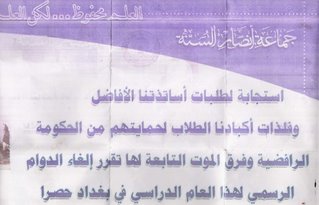
Here's what the poster says:
They did not say what the consequences would be for those who ignore the ultimatum but this at least constitutes a call for halting the very basic activities of a society with implicit threats for those who choose to do otherwise.
No one needs to read more to know the kind of punishment this terror group has designed for those who dare disobey the order. At least students didn't need to know more, the students I talked to today and yesterday were so scared. In fact they were terrified thinking about what the terrorists might do to them should they choose to continue going to school.
After all, we all know what those savages are like and how they look at education and particularly universities where male and female students exist and learn together.
Who asked for their protection in the first place?! The students and teachers? Of course not.
And if teachers and students want protection, they would want that protection to be able to continue their studies, not cancel it!
Update: December 6
Schools were open today, most students went to their schools and colleges as they normally do and gladly there are no reports of attacks gaainst schools or students.
However, a not so small percentage of students skipped schools today and that percentage varied from one place to another, but all in all, there were more students in schools than at homes.
Meanwhile, the Ansar al-Sunna terrorists have released another poster, in which they announce (long story short) that the ultimatum was meant to address only university students and not high schools.
The new poster clarified the punishment part that wasn't explicitly described in the first one.
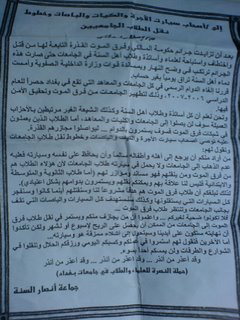
The message clearly says that students, teachers and even bus drivers who drive them to colleges, who choose to challenge the warning will be considered "members of the death squads...we will kill them anywhere they go and we will blow them up in their cars and buses".
This poster was seen in Baghdad lately, it has no ultimatum on it but the word on the streets says the ultimatum ends tomorrow morning.

Here's what the poster says:
In response to demands from the honorable teachers and beloved students and to protect them from the Rafidhi [Shia] government and the death squads it endorses, it has been decided to cancel all studies for this school year in Baghdad exclusively
Ansar Al-Sunna
They did not say what the consequences would be for those who ignore the ultimatum but this at least constitutes a call for halting the very basic activities of a society with implicit threats for those who choose to do otherwise.
No one needs to read more to know the kind of punishment this terror group has designed for those who dare disobey the order. At least students didn't need to know more, the students I talked to today and yesterday were so scared. In fact they were terrified thinking about what the terrorists might do to them should they choose to continue going to school.
After all, we all know what those savages are like and how they look at education and particularly universities where male and female students exist and learn together.
Who asked for their protection in the first place?! The students and teachers? Of course not.
And if teachers and students want protection, they would want that protection to be able to continue their studies, not cancel it!
Update: December 6
Schools were open today, most students went to their schools and colleges as they normally do and gladly there are no reports of attacks gaainst schools or students.
However, a not so small percentage of students skipped schools today and that percentage varied from one place to another, but all in all, there were more students in schools than at homes.
Meanwhile, the Ansar al-Sunna terrorists have released another poster, in which they announce (long story short) that the ultimatum was meant to address only university students and not high schools.
The new poster clarified the punishment part that wasn't explicitly described in the first one.

The message clearly says that students, teachers and even bus drivers who drive them to colleges, who choose to challenge the warning will be considered "members of the death squads...we will kill them anywhere they go and we will blow them up in their cars and buses".
Monday, December 04, 2006
New plan for security in Sadr City, Sheiks pledge support.
I read this on Radio Sawa yesterday; the headline says:
Audio report (available from the same link above for those who know the langauge) explains:
Al-Hurra had this tiny bit to add to the news:
Obviously an ambitious plan and I can tell that Maliki is trying to exert more pressure on Sadr. But at the same time, if he wants to go ahead this plan-which will inevitably lead to confrontations between the militias and the government's armed forces-he must be prepared to rely exclusively on his own efforts and assets and not give much credit to what ever help or cooperation sheiks pledge to offer.
They said very encouraging things and made some promising gestures but I still wouldn't bet on their support, I hope I'm wrong in my judgment this time though!
The thing is that that's how most sheiks are, they sound friendly, reassuring and try to please you when they are your guests and in your territories only to do the exact same thing and make the same exact promises to your enemy when they return home.
Anyway, we'll see how it goes.
And by the way, I've been hearing rumors that Sadr is dead, and many emails are asking me to verify the rumor.
All I can say for now is that I can neither confirm nor deny the rumor, and I must add that the website on which the rumor first appeared is not a credible source.
The Iraqi government within the next few days will launch a new security plan to extend order and tranquility in Sadr city.
Audio report (available from the same link above for those who know the langauge) explains:
Sources that attended a meeting between PM Maliki and tribal chiefs of Sadr city told Radio Sawa that the two partis agreed to cooperate to launch a campaign to improve security and basic services in the city.
The campaign would include controlling the possession of weapons and limiting that to the official security forces.
The sheiks had also demanded that Malki orders aborting plans for future MNF raids on the city.
Al-Hurra had this tiny bit to add to the news:
PM Maliki met with tribal leaders of Sadr city to discuss the security situation…the sheiks hailed the PM's meeting with President Bush because they said "it was an effort in the interest of Iraq"
Obviously an ambitious plan and I can tell that Maliki is trying to exert more pressure on Sadr. But at the same time, if he wants to go ahead this plan-which will inevitably lead to confrontations between the militias and the government's armed forces-he must be prepared to rely exclusively on his own efforts and assets and not give much credit to what ever help or cooperation sheiks pledge to offer.
They said very encouraging things and made some promising gestures but I still wouldn't bet on their support, I hope I'm wrong in my judgment this time though!
The thing is that that's how most sheiks are, they sound friendly, reassuring and try to please you when they are your guests and in your territories only to do the exact same thing and make the same exact promises to your enemy when they return home.
Anyway, we'll see how it goes.
And by the way, I've been hearing rumors that Sadr is dead, and many emails are asking me to verify the rumor.
All I can say for now is that I can neither confirm nor deny the rumor, and I must add that the website on which the rumor first appeared is not a credible source.
Friday, December 01, 2006
Renouncing a myth, or ignoring a fact?
It's really odd that the arrest of "Baghdad Sniper" didn't get any mention in the news. Of course except for here on Pajamas Media when we reported it two days ago.
And two days ago it was understandable since the only source available back then had been a short report aired on Radio Sawa Wednesday afternoon.
Next day, that's yesterday morning, the two major newspapers in Iraq had the news on their first pages, yet the story didn't spread to the MSM!
The government owned al-Sabah had this to tell:
Al-Sabah's rival, Azzaman had also reported the arrest, only leaving aside some details:
And yesterday we got the news here that 30 more militants have been arrested using intelligence that became available after arresting al-Jubori…
Where's the MSM from all of this?
If he was a myth, then why were the media running stories about him and his operations in the first place?
And if he was for real, then why are they ignoring his arrest?
Whatever! All I care about is that a notorious bad guy has been arrested and is no longer able to harm anyone, and I like that!
Meanwhile, the silence of the MSM makes me, well...giggle but with a splash of disgust.
And two days ago it was understandable since the only source available back then had been a short report aired on Radio Sawa Wednesday afternoon.
Next day, that's yesterday morning, the two major newspapers in Iraq had the news on their first pages, yet the story didn't spread to the MSM!
The government owned al-Sabah had this to tell:
"Spokesman of the interior ministry brigadier general Abdul Kareem Khalaf told al-Sabah that a security force that belongs to the ministry, backed by a force from the rescue police conducted a dawn-time raid yesterday and arrested terrorist Ali Nazar al-Jubori also known as Baghdad Sniper and two of his aides; Isam Fadhil and Ali Basil…intelligence led to their whereabouts in three different locations in Hay al-Neel of the Palestine Street district…"
Al-Sabah's rival, Azzaman had also reported the arrest, only leaving aside some details:
"…on the other hand, official spokesman of the interior ministry, brigadier Abdul Kareem Khalaf confirmed to Azzaman that "three snipers were arrested yesterday" but offered no further details"
And yesterday we got the news here that 30 more militants have been arrested using intelligence that became available after arresting al-Jubori…
Where's the MSM from all of this?
If he was a myth, then why were the media running stories about him and his operations in the first place?
And if he was for real, then why are they ignoring his arrest?
Whatever! All I care about is that a notorious bad guy has been arrested and is no longer able to harm anyone, and I like that!
Meanwhile, the silence of the MSM makes me, well...giggle but with a splash of disgust.
Subscribe to:
Posts (Atom)