The liberal opposition party of Egypt, al-Ghad has apparently lost in the 1st stage of the parliamentary elections.
Big Pharaoh reports that Muslim Brotherhood has won a good deal of the votes too.
Obviously this is not going to serve the reform movement in Egypt.
Check out Sandmonkey too for news, comments and updates.

New points of view about the future of Iraq and the Middle East.
Thursday, November 10, 2005

With the number of blogs coming out of Iraq increasing day by day, it becomes increasingly difficult to keep track of all of them (don’t look at the sidebar, there are over 300 hundred more blogs out there!) but today I came across this blog by a 13 year old girl from Mosul that really impressed me with her writing style and spirt. She wrote this in the ‘about me’ section:
And in a post about referendum day, she wrote:
Yet her mother (a fellow blogger and fellow dentist) can’t feel the hope and optimism within her own household…I don’t know why is that so but I hope the mother could learn a little from the daughter.
I’ve blogrolled both of them; don’t forget to check their posts.
And by the way, Kurdo is back to blogging after a very long hiatus and so is Liana after a not so long vacation.
… My school is far away from my home & the way to it is dangerous , so every day considered as a challenge. I have many dreams & ambitions, I wish that one day they become true . I want to be an engineer in the future , my mom always support me to accomplish my ambitions … optimism is my strategy always… Computer & internet are my life & what I do in my spare time , But if we don’t have electricity, I spend my spare time reading , writing, listening to music ,& doing some handmade work … I found that Blogging is a great way to express my thoughts , opinions, & feelings to the world ,to get friends & to share them my happy & sad moments….
And in a post about referendum day, she wrote:
But every one has different opinion even in my family , some agreed with the new constitution & some disagreed , today I knew what the democracy mean.
I saw Nineveh TV , all the programs were about the constitution & the referendum. The people opinions were also dissimilar , I thought in the beginning that few people only will contribute in the referendum . but I didn't anticipate that huge number of contributors .
Although I can't vote , but I have my OWN opinion , I can share it with my family ..
Yet her mother (a fellow blogger and fellow dentist) can’t feel the hope and optimism within her own household…I don’t know why is that so but I hope the mother could learn a little from the daughter.
I’ve blogrolled both of them; don’t forget to check their posts.
And by the way, Kurdo is back to blogging after a very long hiatus and so is Liana after a not so long vacation.
Wednesday, November 09, 2005
Terror attacks in Jordan!
The people pay for their governments' and media's denial and delusions...as simple and as sad as that.
I couldn’t help but ROTFL when I read this report about the Paris riots:
Here I was expecting shotguns, rifles or pistols to complete the sentence but then thought No, this is Europe and there must be laws against carrying firearms in public so I thought baseball bats would be the weapon of choice but again No I told myself; this is France they’re talking about and they don’t play baseball in France, so what did the community group carry to defend their property?
"pepper spray and heavy flashlights" was the answer!! I don’t know how you see this but to me it feels like telling the rioters ‘come here and bring that piece of pizza, I have a pepper spray in my hand’ or ‘come and pose for a photo, I brought this excellent flashlight with me!’.
Sarcasm off…
I feel sorry for what’s going on in France and in particular for Paris which is a city I adore but I don’t feel sorry for French administrations that brought this upon themselves and their country with their poor immigration policies over the last decades. Unfortunately this applies to several other European countries as well.
It is okay to accept refugees and immigrants and provide them with shelter and jobs but these people must follow the laws of their new place and respect its culture just like they want to have their own cultures respected and they must not be allowed to change the shape of the host country.
I’m not sure I can write this and make sense but I believe that European governments and large parts of the natives there failed to distinguish between oppressed people and wanted fascist extremists who fled their native countries; the first group fled their original countries looking for a better place where they can live a real life and grant their children a chance for a better future and they do deserve to be given the opportunity to do this in a place other than their dictators-ruled countries while the latter; well, they want to take over in any place they happen to exist in and they want to impose their vision on others without the least respect for their hosts.
If things continue to move the way they’re doing now, I’m afraid Europe will wake up some day to find itself infested with extremism to a degree that could possibly surpass what we see in many of today’s Muslim countries.
Faced with widespread lawlessness, some people in France have started defending their property. In Seine-Saint-Denis, a suburb of Paris rocked by several nights of unrest, a community group has started patrolling local properties armed with….
Here I was expecting shotguns, rifles or pistols to complete the sentence but then thought No, this is Europe and there must be laws against carrying firearms in public so I thought baseball bats would be the weapon of choice but again No I told myself; this is France they’re talking about and they don’t play baseball in France, so what did the community group carry to defend their property?
"pepper spray and heavy flashlights" was the answer!! I don’t know how you see this but to me it feels like telling the rioters ‘come here and bring that piece of pizza, I have a pepper spray in my hand’ or ‘come and pose for a photo, I brought this excellent flashlight with me!’.
Sarcasm off…
I feel sorry for what’s going on in France and in particular for Paris which is a city I adore but I don’t feel sorry for French administrations that brought this upon themselves and their country with their poor immigration policies over the last decades. Unfortunately this applies to several other European countries as well.
It is okay to accept refugees and immigrants and provide them with shelter and jobs but these people must follow the laws of their new place and respect its culture just like they want to have their own cultures respected and they must not be allowed to change the shape of the host country.
I’m not sure I can write this and make sense but I believe that European governments and large parts of the natives there failed to distinguish between oppressed people and wanted fascist extremists who fled their native countries; the first group fled their original countries looking for a better place where they can live a real life and grant their children a chance for a better future and they do deserve to be given the opportunity to do this in a place other than their dictators-ruled countries while the latter; well, they want to take over in any place they happen to exist in and they want to impose their vision on others without the least respect for their hosts.
If things continue to move the way they’re doing now, I’m afraid Europe will wake up some day to find itself infested with extremism to a degree that could possibly surpass what we see in many of today’s Muslim countries.
If you haven’t read this interview yet, I encourage you to do so; it marks at least one key change in the way war in western Iraq against terrorists is being fought:
This is something we needed to hear for a long time now and I believe that maintaining permanent presence along the routes used by terrorists to get to major cities will make it much easier in the future to restrict the movement of foreign suicide bombers and prevent many of them from reaching the cities.
It is obvious that securing a big town or a city from within the city itself is a very difficult task but securing a number of villages and smaller towns many kilometers apart one at a time can be a lot more practical and will eventually cut the routes used to move men and weapons to the rest of the country.
Col Davis: Husaybah has been cleared and secured. Coalition forces are now conducting combat patrols. Construction is underway for basing of Iraqi and U.S. troops to maintain a permanent presence in the city, and provide security. We had a real good plan, but the execution was even better. I am pleased with the results of Operation Steel Curtain.
This is something we needed to hear for a long time now and I believe that maintaining permanent presence along the routes used by terrorists to get to major cities will make it much easier in the future to restrict the movement of foreign suicide bombers and prevent many of them from reaching the cities.
It is obvious that securing a big town or a city from within the city itself is a very difficult task but securing a number of villages and smaller towns many kilometers apart one at a time can be a lot more practical and will eventually cut the routes used to move men and weapons to the rest of the country.
Monday, November 07, 2005
With less than 40 days to the next elections...
Political parties and alliances launched their campaigns to prepare themselves for the December elections; they’re marketing their programs and policies in a way that is considerably different from what we experienced a year ago and entirely different from what we had for decades under the Ba’ath despotic rule.
Now we have more than a few platforms to choose from and not the one and only “central report of the national conference of the Ba’ath party” which used to poetically illustrate the Party’s totalitarian vision for the Arab nation and we had the right to choose then too but it was more like "take this or have your head taken"! While now we see politicians seeking voters’ acceptance, each one of them building his strategy on what he believes appeals to the mainstream opinion.
A few days ago, the united alliance (the religious Sheat slate) revealed its platform which has the formation of the federal south as its core theme. The idea and the expected benefits were emphasized by Abdul Aziz al-Hakeem during a press conference last week.
This shows a will on the part of the SCIRI and allies to form an Iran-like state in the southern provinces of Iraq. This, even if not publicly stated but shows clear from the exclusively religious composition of this alliance after moderate/liberal elements like Chalabi, Bahril Iloom (the oil minster) and Ali al-Dabbagh departed the alliance and are now going to enter the election in separate slates.
At the same time, the Sadr trend-which is now the 2nd biggest component of the Sheat alliance after the SCIRI-based their campaign on the issue of ending the presence of “occupation forces”, reactivating the deba’athification process and halting any attempt to build peace with the “Zionist entity” without a word about the federal state idea endorsed by the SCIRI.
Moreover, some Sadr spokesmen occasionally continue to criticize the new constitution and its writers, perhaps they forgot that it was their allies in the SCIRI and Dawa who had the biggest role in writing the draft!
So, apparently the united alliance is not in its best shape nowadays and this is evident from the lack of harmony between the major elements and the widely differing declared policies and goals, actually there’s one incident that became a joke in the streets; the spokesman of Fadheela party said when he announced that the party joined the alliance “We were planning to enter in a separate list but since the deadline was yesterday, we decided-with reservations-to go back to the united alliance”!! The joke here goes like “is this an invitation to elect them with reservations??”.
The reputation of the alliance is being further damaged by reports of campaign posters of secular parties like Mithal’s Allawi’s and Chalabi’s being torn off the walls in cities like Najaf and Kerbala where followers of Sadr and the SCIRI predominate. This of course is against the regulations of the IECI and it won’t be a surprise if we hear soon about charges raised against the alliance.
On the other hand, the Iraqi Nation Party of Mithal al-Alusi which has been gaining more interest from the people here has announced their campaign which focuses mainly on improving the food rations system and eradicating terrorism and corruption; words that are not uncommon but the determined character of the man who said them makes one inclined to believe he means what he said and while I don’t think the food rations system is a good way of improving the life of Iraqis, I think if this man and his party reach offices they will most likely change the balance in Iraq’s war against terror and corruption.
Allawi’s team has also outlined their intended policy for the next four years which can be found in Arabic on New Sabah in a quite lengthy piece that included Allawi’s plans for so many issues but security and rebuilding the armed forces took nearly half of the document, anyway I’ll try to discuss this further in another post.
What I wanted to say is that, according to the current findings and observations, I think that next government will be formed from two blocs at least and maybe three or even four but there will be also a more pronounced and active opposition inside the parliament unlike what we have now because this time I expect to see a wider variety of trends and opinions with more small-to-mid-sized blocs winning several seats in the parliament and this will prevent the monopoly of decision making and eventually people will no longer feel they're being unjustly silenced or marginalized.
Sunday, November 06, 2005
Egyptian, Libyan and Iranian bloggers are spending time in jail as a punishment for words they have written on their blogs. Committee to protect bloggers has more details as well as links to petitions you can sign.
Meanwhile, I have found contact information for Egyptian embassies in some countries, you can do your part and call or (at least e mail) them and demand they free the imprisoned blogger.
United States:
Phone (202) 895 5400
Email: embassy@egyptembdc.org
Canada:
Tel. (613) 234 4931
Email: egyptemb@sympatico.ca
Ambassador: egypt4931@rogers.com
United Kingdom:
Tel: 020 7499 3304
Australia:
Tel: (61 2) 273 4437, 6273 4438
info@egypt.org.au
Saturday, November 05, 2005
I’ve been facing continuous problems with my internet connection in the past few days and I expect this to last for another couple of days, so excuse the light blogging.
The good thing is that such blackouts are temporary while the service is usually reliable and steady most of the time, unlike what Michael Totten experienced in his Middle East journey so far! Anyway, I’m seeking alternative methods to connect to the internet in case my default connection dies and I found one method that sounds good; one of Iraq’s three cell phone operators Asia Cell has introduced a GPRS service through which anyone can get on the web either directly through a cell phone or through a PCMCI modem plugged into a laptop. I have purchased their sim card and all I need now is to order the modem and then I’ll be able to get a connection anywhere in four provinces (so far) these are Baghdad, Kirkuk, Mosul and Sulaymaniya. This service is costly though, 1 $ per each 1 MB of data transfer but still it makes a good backup plan for emergencies!
Until later I leave you with two things to check out; first, I did a profile interview for Norman Geras which you can find here and the second (which you shouldn’t miss) is Sooni’s photoblogging of the Eid in Baghdad. Here are two of the photos he posted and you can see many more if you click the link above.
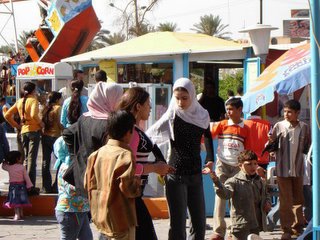
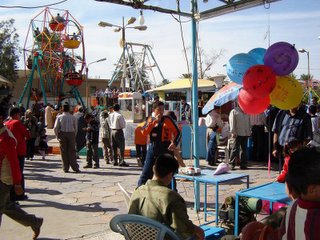
HAPPY EID EVERYONE!
Update: More beautiful Eid photos from Iraq, this time brought to us by al-Dhafer blog from Samawa city.
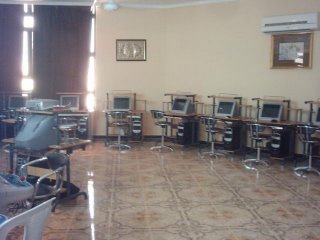
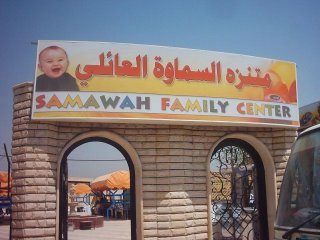
When coalition forces raid a house used by terrorists it becomes the big news of the day and is consistently used to show Iraq as a hole of hell but when coalition forces help Iraqis build an amusement park that serves a city with population of over 500,000 so that families can spend a good time, no one talks about it…thanks to blogs!
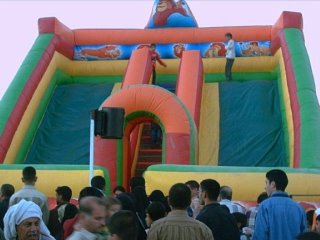
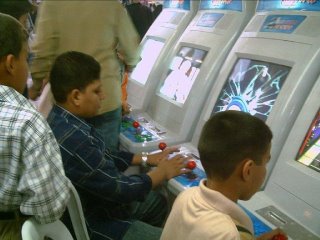
More here.
I’ve been following the progress of building this park for some time. Gladly it opened before the Eid so that people could enjoy it!
Here are some photos from August:
And more here.
The good thing is that such blackouts are temporary while the service is usually reliable and steady most of the time, unlike what Michael Totten experienced in his Middle East journey so far! Anyway, I’m seeking alternative methods to connect to the internet in case my default connection dies and I found one method that sounds good; one of Iraq’s three cell phone operators Asia Cell has introduced a GPRS service through which anyone can get on the web either directly through a cell phone or through a PCMCI modem plugged into a laptop. I have purchased their sim card and all I need now is to order the modem and then I’ll be able to get a connection anywhere in four provinces (so far) these are Baghdad, Kirkuk, Mosul and Sulaymaniya. This service is costly though, 1 $ per each 1 MB of data transfer but still it makes a good backup plan for emergencies!
Until later I leave you with two things to check out; first, I did a profile interview for Norman Geras which you can find here and the second (which you shouldn’t miss) is Sooni’s photoblogging of the Eid in Baghdad. Here are two of the photos he posted and you can see many more if you click the link above.


HAPPY EID EVERYONE!
Update: More beautiful Eid photos from Iraq, this time brought to us by al-Dhafer blog from Samawa city.
When coalition forces raid a house used by terrorists it becomes the big news of the day and is consistently used to show Iraq as a hole of hell but when coalition forces help Iraqis build an amusement park that serves a city with population of over 500,000 so that families can spend a good time, no one talks about it…thanks to blogs!


More here.
I’ve been following the progress of building this park for some time. Gladly it opened before the Eid so that people could enjoy it!
Here are some photos from August:


And more here.
Wednesday, November 02, 2005
In a press conference this morning, Ahmed Chalabi revealed the components of his new bloc with which he’s entering the upcoming election in December after he left the National Alliance.
He also seized the chance to announce his slate’s platform which of course included many not unexpected ideas like promises to fighting terrorism, creating more jobs and rebuilding the infrastructure which are common findings in almost all recent speeches of politicians but the most interesting plans he talked about was introducing an oil revenue distribution plan similar to that currently used in Alaska with one difference that is money is to be distributed monthly instead of annually.
I have doubts about the feasibility of such a system in Iraq, I think it can be a good alternative for subsidizing fuel and food rations, maybe in a few years from now but not at the moment (I will probably write in detail about this in a separate post).
The other significant statement he made came when he described his bloc as “a choice for Iraqi voters who do not want Iraq to become a theocracy…”
This makes one think that his separation from the National Alliance was not a political tactical maneuver like some observers suggested but more likely the result of a conflict of interests.
A positive change is noticeable even from the early days of the campaigns of competing parties and politicians (religious and secular) and it shows clearly in the speeches they’re making on TV; there’s more talking about plans and strategies than about sentiments and emotion-targeting slogans which dominated their campaigns before the January elections.
It is true their ways of presenting their platforms are still superficial and underdeveloped but it marks a change in the way politicians speak to voters.
This interesting post from Lebanese Political Journal was e mailed to me this morning and I’m damn glad I received it because it spared me the effort and time of composing a post about several ideas I had in my mind for some time, yet didn’t have the time, couldn’t find a way to organize or forgot for one reason or another to write about.
I might disagree with the author on a few little things but the post in general is certainly worth reading.
I might disagree with the author on a few little things but the post in general is certainly worth reading.
I received a grate e mail from an American soldier who has been serving in Iraq for nearly a year and is now preparing to go home after finishing his tour.
He sent me a copy of the latest edition of a weekly newsletter he writes from Iraq with lots of stories about reconstruction, humanitarian aid and friendship.
I really wish I could know about this rich source of information earlier, anyway, you can find the latest letter as well as the archived ones in this blog.
I’d like to introduce to you a new and interesting blog about Iraq; Pearls of Iraq. Actually it’s not that new; it’s about two months old now.
It is written by an American-Kurdish-Muslim who carries a Master’s degree in International service (Islamic approach to dialogue and peace- building and Kurdish studies).
In her latest post she brings suggestions about what to do with the unfinished mosque I mentioned a couple of days ago.
It is written by an American-Kurdish-Muslim who carries a Master’s degree in International service (Islamic approach to dialogue and peace- building and Kurdish studies).
In her latest post she brings suggestions about what to do with the unfinished mosque I mentioned a couple of days ago.
Monday, October 31, 2005
Do you know where you are heading Bashar?
The international community represented by the UN Security Council voted 15-0 for a resolution that applies more pressure on the Syrian regime to cooperate with the international investigation commission led by Mehlis.
I refuse to call it a resolution against Syria because I’m not unfamiliar with similar moments when resolutions were being made against Saddam’s regime and it hurt when we would hear the words “against Iraq”. Neither Saddam nor Assad represented their peoples and even if the UN failed to recognize this fact, this doesn’t change the fact that that such regimes are totally illegitimate and they don’t deserve the seats they occupy in the UN’s halls because they merely represent their families or the murderous cults they call political parties.
If we take a look at the statements and responses coming from the Syrian officials through Arab media we see that they all talk about legitimacy using this word and the seat they have in the UN to claim they represent the Syrian street.
The funny thing is that the Syrian regime and its supporters are still placing their bets on support from the Arab and Syrian public forgetting how Iraqi people abandoned Saddam when his end came near. Even if some Iraqis disagree with the US and the coalition it doesn’t deny the fact that they did not fight for Saddam. If we go back in time to spring 2003 we can notice that the provinces that surrendered without fighting were Mosul and Anbar.
Reality and history prove that tyrants have always failed to earn the trust or loyalty of their peoples or at least the largest parts of their peoples.
Anyway, what matters for us here as Iraqis is that this resolution and its aftermath is obviously going to have a significant impact on the situation in Iraq. It is well know that terrorism or insurgency in Iraq receives substantial material and logistic support from certain parties in Syria, so any pressure on the Syrian regime and its allies in this magnitude will most likely undermine the support these parties can provide the terrorists in Iraq and this can greatly accelerate the end of violence in Iraq.
Here in Iraq we remember how the Kurdish revolt collapsed in 1975 months after the Ba’athists made a deal with the Shah in Iran in which the central government gave away Iraqi lands to Iran in exchange for cutting Iran’s support to the Kurds.
Please do not think I am comparing the Kurds with the terrorists we are fighting now, I am only trying to point out one technical point that applies to this type of warfare.
Finally, if the regime in Syria complied with International legitimacy and gave up on supporting gangs operating against the peoples of Lebanon and Iraq, this will consequently have a positive effect on Iraq’s security but…if the Ba’ath regime of Syria decided to move on with their flawed plan and ignored the world then I think they will meet the same fate of Saddam’s.
I personally think they will commit one mistake after another.
Sunday, October 30, 2005
A new liberal lobby emerges in Baghdad...
Today, Mohammed and I had the privilege to be invited to attend a conference organized by a group of civil society organizations to announce the launch of a new community under the name “Ahd Al-Iraq” or (the oath of Iraq).
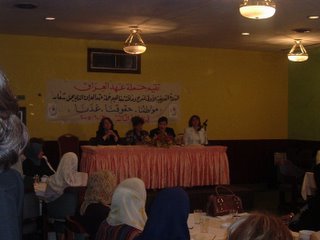
The basic theme of the community is to take a promise from politicians, civil society activists and MPs (current or running for office) to preserve and protect the rights and freedoms every Iraqi citizen is supposed to enjoy under the new constitution and under the internationally recognized conventions and laws and to work to introduce amendments in the constitution whenever believed necessary for the protection of these rights and freedoms.
The founders of the community named five main points in the constitution that require urgent reconsideration:
1-Several articles in the constitution mention “public order and ethics” as limits to freedoms granted to the population.
The suggestion: These concepts must be defined by the judiciary and must not be left loose for whomever (clerics, executive authority, etc) to interpret as they like.
2-The personal affairs law:
The suggestion: to return back to the civil law legislated back in 1959 and to prevent Shareat laws from replacing that law.
3-The supreme/higher federal court in the constitution has to be formed from law experts and Shareat experts, number and nominations are to be decided by 2 thirds of the parliament members.
The suggestions:
a)All court members have to carry high degrees in law and first line judges.
b)Shareat experts must not outnumber law experts.
c)Women must be represented inside the court with no less than 25%.
4 & 5- Both related to the role of the higher human rights committee:
Suggestions:
Several but the most important one is to allow the committee to a) review legislations and laws to ensure they do not violate the universal declaration of human rights b)verify the constitutionality of legislations.
This committee is founded by a group of well known Iraqi women activists including some who occupy important positions in the government namely, Dr. Azhar Al-Sheikhly the minister of women affairs, Iraq’s ambassador to Egypt Saiyah Al-Suhail Dr. Pascal Eisho, the minister of immigrants and displaced, Dr. Narmeen Othman the minister of environment and social affairs and Dr. Rand Raheem Iraq’s envoy to the US and founder of the ‘Iraqi Institute’ and others. However, these women didn’t participate as ministers but rather as individual Iraqi women working together to gather support for the cause of the community.
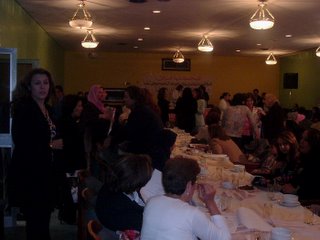
The event was attended by more than a few female Assembly members as well as several tribal sheiks and representatives of other political entities and organizations…one can fairly say that a wide range of social and political the spectrum of Iraq population was well represented in the event.
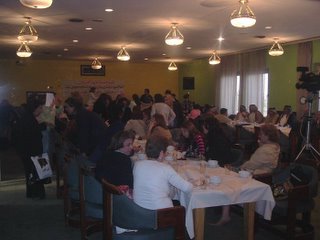
The general sense was that the constitution had to be supported to be passed but now, hard work and serious steps have to be taken to introduce the needed amendments to build the civil society where each and every citizen can enjoy his rights and his freedom like anyone else in the civilized free world.
The entire crowd welcomed the notes of one tribal Sheik from Sadr city who raised an objection to one clause in the punishment law which states that teachers and husbands should not be persecuted if they use disciplinary beating against their students or wives respectively. in his unexpected note, the sheik asked the committee to include correcting this clause in its agenda.
I learned that next week there will be a bigger conference with press coverage in the convention center and then participating politicians, activists and organizations will be asked to give their signatures and declare commitment to supporting the community’s efforts.
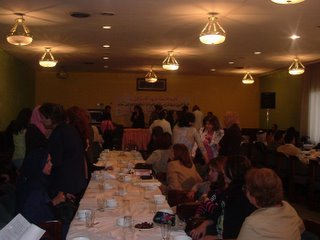
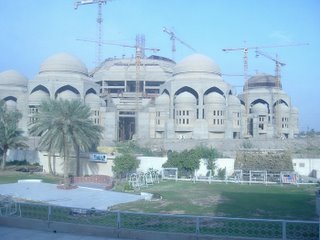
Through the window I could see one of Saddam’s ways of wasting Iraq’s money; work in this needless gigantic mosque started in 1990s during the sanctions but Saddam didn’t last long enough to finish it. (Any ideas for investment?)
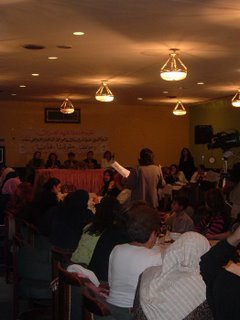
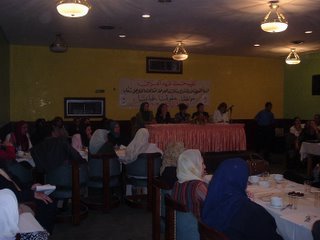
The interesting thing about this meeting and similar ones is that civil society organizations began to modify their methods of applying pressure on the government and politicians, so instead of waiting for politicians and parties to present their platforms, now we have emerging organizations that decided to jump a couple of steps ahead and start telling politicians and parties what the people want to see in electoral platforms and what kind of a government people are willing support.
I wish them success in this campaign.

The basic theme of the community is to take a promise from politicians, civil society activists and MPs (current or running for office) to preserve and protect the rights and freedoms every Iraqi citizen is supposed to enjoy under the new constitution and under the internationally recognized conventions and laws and to work to introduce amendments in the constitution whenever believed necessary for the protection of these rights and freedoms.
The founders of the community named five main points in the constitution that require urgent reconsideration:
1-Several articles in the constitution mention “public order and ethics” as limits to freedoms granted to the population.
The suggestion: These concepts must be defined by the judiciary and must not be left loose for whomever (clerics, executive authority, etc) to interpret as they like.
2-The personal affairs law:
The suggestion: to return back to the civil law legislated back in 1959 and to prevent Shareat laws from replacing that law.
3-The supreme/higher federal court in the constitution has to be formed from law experts and Shareat experts, number and nominations are to be decided by 2 thirds of the parliament members.
The suggestions:
a)All court members have to carry high degrees in law and first line judges.
b)Shareat experts must not outnumber law experts.
c)Women must be represented inside the court with no less than 25%.
4 & 5- Both related to the role of the higher human rights committee:
Suggestions:
Several but the most important one is to allow the committee to a) review legislations and laws to ensure they do not violate the universal declaration of human rights b)verify the constitutionality of legislations.
This committee is founded by a group of well known Iraqi women activists including some who occupy important positions in the government namely, Dr. Azhar Al-Sheikhly the minister of women affairs, Iraq’s ambassador to Egypt Saiyah Al-Suhail Dr. Pascal Eisho, the minister of immigrants and displaced, Dr. Narmeen Othman the minister of environment and social affairs and Dr. Rand Raheem Iraq’s envoy to the US and founder of the ‘Iraqi Institute’ and others. However, these women didn’t participate as ministers but rather as individual Iraqi women working together to gather support for the cause of the community.

The event was attended by more than a few female Assembly members as well as several tribal sheiks and representatives of other political entities and organizations…one can fairly say that a wide range of social and political the spectrum of Iraq population was well represented in the event.

The general sense was that the constitution had to be supported to be passed but now, hard work and serious steps have to be taken to introduce the needed amendments to build the civil society where each and every citizen can enjoy his rights and his freedom like anyone else in the civilized free world.
The entire crowd welcomed the notes of one tribal Sheik from Sadr city who raised an objection to one clause in the punishment law which states that teachers and husbands should not be persecuted if they use disciplinary beating against their students or wives respectively. in his unexpected note, the sheik asked the committee to include correcting this clause in its agenda.
I learned that next week there will be a bigger conference with press coverage in the convention center and then participating politicians, activists and organizations will be asked to give their signatures and declare commitment to supporting the community’s efforts.


Through the window I could see one of Saddam’s ways of wasting Iraq’s money; work in this needless gigantic mosque started in 1990s during the sanctions but Saddam didn’t last long enough to finish it. (Any ideas for investment?)


The interesting thing about this meeting and similar ones is that civil society organizations began to modify their methods of applying pressure on the government and politicians, so instead of waiting for politicians and parties to present their platforms, now we have emerging organizations that decided to jump a couple of steps ahead and start telling politicians and parties what the people want to see in electoral platforms and what kind of a government people are willing support.
I wish them success in this campaign.
Saturday, October 29, 2005
Today was the day for the official launch of electoral campaigns for the December 15 election when Iraq is going to elect its first 4 year term parliament and government since the fall of the dictator. The launch was marked by the two major blocs (I mean the united alliance and the Iraqi slate of Allawi) submitting their lists of candidates to the public after the lists were delivered to the IECI yesterday.
The media has extensively covered the press conferences of the big slates and it was easy to see the divisions that happened inside the united alliance because their spokesman today was Abdulaziz Al-Hakim instead of Ali Al-Dabbagh or Ahmed Al-Chalabi who were the usual spokesmen in front of the press but not anymore since they departed the alliance and formed their own separate slates.
Dabbagh announced the formation of a group of independent technocrats and emphasized that religion and politics have to be separated and that religion must take the role described in the constitution but that would be all and “policies and development plans should stay far from religious beliefs”.
At the same time the founder of the united alliance Chalabi and his INC pulled from the alliance too and I think Chalabi is expecting the alliance to lose its leading position after the government it led showed a lot of weaknesses in running the country’s affairs in the past several months, add to that, Ayatollah Sistani so far refrained from endorsing the alliance.
Chalabi is obviously dissatisfied with the places his INC was offered within the alliance (only 3 places) and that is certainly not equal to their influence and position. Anyway, I don’t expect Chalabi would get a lot more than the 3 seats he was promised by the alliance.
The parties that remained in the alliance’s slate are the SCIRI, the Da’wa (two branches), the Sadrists, Fadheela party, Iraqi Hizbollah and some other smaller parties like the Islamic Turkmen union. This shows that this slate has assumed a pure sectarian identity after the few relatively liberal elements that used to be part of it decided to leave.
Al-Hakim promised his supporters a majority in the parliament but I actually doubt; things are much different now and no one slate can form a majority by itself.
This religious trend is facing stronger competition from the growing secular that absorbed the lesson from last time and are uniting themselves in one broad front announced to the public this morning by Allawi. This launch was prepared for by numerous press releases and conferences and the slate succeeded in adding more parties to the original one that entered the January elections, most important of these news members are the bloc of former president Al-Yawir, the communists led by Hameed Mousa, the Independent democrats led by Pachachi (both are former GC members) as well as many other smaller parties and independent figures.
The competition will be strongest between these main slates; that’s the two mentioned above and the Kurdish one that only lost its Islamic element (the Kurdistan Islamic Party) and the Sunni Concord front formed by the Islamic party and the national dialogue council.
The results in the Kurdish provinces are predictable but elsewhere in Iraq things are different and not easy to forecast; the Sunni parties think they can win most of the seats in the 4 provinces with Sunni majority and so do the Sheat parties when it comes to provinces with Sheat majority but the question that remains is how many votes Allawi can steal from sectarian based alliances in their expected areas of influence.
On the other hand, Baghdad will be the main battleground for the competing slates and everyone will try hard to win as many votes as possible to win a bigger chunk from the 59 seats allocated to the mosaic population capital.
I hope these parties will rise to the level of responsibility and present to us an example of fair competition through offering their views and platforms and leaving the choice to the people without any pressure or intimidation.
As a matter of fact, it has to be acknowledged that the political experiment in Iraq has matured by far during these two and a half years and the political language slowly began to take more realistic dimensions and we can sense a growing faith in the ways of democracy giving some sort of special divinity to the ballot box which shall remain the only base for building a new Iraq.
The more Iraqis believe in elections and in voting as a way to express themselves, the weaker violence becomes and the more isolated the terrorists will be.
Iraqis will prove that they do believe in democracy and they do want liberty and justice and the will show the region an example of how partners can work out their differences in spite of all the hardships.
Thursday, October 27, 2005
Fuel prices in Iraq to be increased by January:
The government made a decision to cut back on subsidizing fuel for the domestic consumption. According to the announced plan, super gasoline price will rise from 50 to 150 dinars/liter, regular gasoline will rise from 20 to 50/liter also and kerosene will rise from 5 to 10 dinars/liter while the cost of refilling a propane canister usually used at homes for cooking and heating will increase from 250 to 500 dinars.
Although the prices will be at least doubled, this will not be enough to discourage smuggling activities that cost the economy billions of dollars a year.
The price of one liter of gasoline in neighboring countries will still be twice-five times as much as in Iraq and this will still encourage smugglers to continue their activities unless further decisions to increase the prices are made in future steps.
It is expected that people will start complaining from the sudden increase of prices but I don’t think it would take long before they get used to the new rates and here the government should start a campaign to educate the consumers about the actual reasons behind the increase and should explain its new economic policy to a peoples who are very skeptical about a free market.
Most Iraqis right now think about the immediate effects of such moves which are obviously more pressure on their households’ budgets and they do not see the catastrophic impact of continuing to subsidize fuel and other services.
Some time ago I got to read a little about the state’s budget for 2005 and I found out that more than 75% of Iraqi’s income goes to paying salaries (mostly for idle employees), subsidizing fuel and food rations leaving less that 25% (a little less than 7 billion $) of the income to provide funding for all other items. And with over 30 ministries in Iraq, most ministries get less than 1% of the allocations and this includes the ministries of education, higher education and health. This renders these ministries unable to implement their projects and execute their plans.
It is easy to conclude from this that Iraq cannot be rebuilt and developed without a comprehensive plan for privatization and endorsing the ways of the free market and it seems that the government and economic institutes are trying to put such a sequence of plans but the question is: why isn’t this being explained to the public? And how are the people expected to back decisions made according to undisclosed plans?
The longer the government waits to get their message to the people, the more credibility they lose, and that’s the thing that can be afforded the least right now.
Wednesday, October 26, 2005
Following Saddam's steps...
Ahmadinejad warns Israel and the Muslim and Arab countries from the fire of the Islamic nation:
Yeah right and Saddam said once that he was going to burn half of Israel, only some idiots do not seem to learn from history!
I don’t know exactly what he was referring to when he spoke about attacks on Israel, maybe he was talking about the recent rocket attack launched by Hamas and Jihad.
If that’s so, Nejad should hear Abu Mazin when mentioned today that out of 25 rockets that targeted Israeli lands, 23 hit Palestinian homes in Bayt Hanoon.
No second reading is needed to find out that the threat was addressing anybody who recognizes Israel and that as you know includes many Arab and Muslim brother countries, I wonder if it includes the Palestinian authority too.
Anyway, this could be good news too because the more enemies the mullahs create for themselves, the closer their end is.
By the way, it is clearer now than ever that Iran’s nuclear program is designed to disperse raw nuclear energy burning nations rather than to collect more electricity.
President Ahmadinejad declared Wednesday that Israel is a “disgraceful blot” that should be “wiped off the map…”
[...]
Ahmadinejad also condemned Iran’s neighbors which seek to break new grounds in their relations with Israel “"Anybody who recognizes Israel will burn in the fire of the Islamic nation's fury…”
Yeah right and Saddam said once that he was going to burn half of Israel, only some idiots do not seem to learn from history!
I don’t know exactly what he was referring to when he spoke about attacks on Israel, maybe he was talking about the recent rocket attack launched by Hamas and Jihad.
If that’s so, Nejad should hear Abu Mazin when mentioned today that out of 25 rockets that targeted Israeli lands, 23 hit Palestinian homes in Bayt Hanoon.
No second reading is needed to find out that the threat was addressing anybody who recognizes Israel and that as you know includes many Arab and Muslim brother countries, I wonder if it includes the Palestinian authority too.
Anyway, this could be good news too because the more enemies the mullahs create for themselves, the closer their end is.
By the way, it is clearer now than ever that Iran’s nuclear program is designed to disperse raw nuclear energy burning nations rather than to collect more electricity.
The constitutions passed, more elections soon...
As most of you have probably seen in the news yesterday, the constitution has been ratified after 78% of votes were found to be ‘yes’ and no three provinces turned it down by two 3rds of the votes.
I know I was supposed to comment on this sooner than now but honestly I didn’t feel like it because the news didn’t make me feel in any special way and I assume many Iraqis felt the same since the public didn’t show a significant reaction. To be more accurate, there were a few celebratory gatherings in the south but nothing major and especially no riots or anti-constitution rallies in the usual hot spots.
After all, we've written a ton about this subject in the past several months so my conscience isn't going to torture me if was a day late this time!
On the other hand, politicians are more excited who. Of course Kurdish and Sheat politicians praised the approval of the constitution while some Sunni ones expressed doubts about fraud in counting the ballots in provinces with Sunni majority but even politicians cannot afford to waste much time to either lament or celebrate since there’s another decisive electoral race coming and they are more interested in spending the next 50 days campaigning and getting publicity for their slates.
Actually the Sunni parties have already started working on that; today spokesmen of three Sunni parties announced that they intend to enter the December elections as one body.
The three parties are the Islamic Party, the Ahl Al-Iraq Council and the National Dialogue Council. This came only two weeks after the Islamic Party made a deal with the Kurdish and Sheat parties to back the constitution. This deal was strongly criticized by the other two Sunni parties mentioned above and this indicates that they want to put their differences behind their backs for a while and watch for the coming elections.
Watching this, one can predict that the new parliament will have at least 4 major blocs instead of 3 and this will certainly reduce the possibility of having the decision making power monopolized by one bloc, which is good in general.
I have explained before that I’m personally not so excited about the document itself and therefore I view the approval as a step that allows us to introduce amendments.
Anyway, it was a positive step that brought a sense of relief to the majority of our people.
Monday, October 24, 2005
Okay pals, go take a look at our profile over at Pajamas Media website.
Once you are there, you will also find many interesting profiles of many fine bloggers.
Once you are there, you will also find many interesting profiles of many fine bloggers.
Polls: can we rely on them?
Through Gateway Pundit, I learned this morning about some poll results that were published by the Daily Telegraph. I still have mixed feelings about this poll and the way its results were reported and these feelings drove me to the conclusion that we should neither believe nor entirely discredit the report. Here are my thoughts and observation:
First let’s take a look at the way of presenting the results; it begins with “Millions of Iraqis believe that suicide attacks against British troops are justified, a secret military poll commissioned by senior officers has revealed.”
Now one of the basic principles of reporting poll results is that they’re reported in terms of percentage of interviewed sample and not by turning these percentages into counts of the entire population.
Then there’s the “suicide attacks against British troops” well, as far as I know, there have been many against American troops but none against British ones and even the link provided in the report leads to a report about a roadside bomb attack and NOT a suicide attack. This makes one think that the results are being used to promote a wrong idea, i.e. we have a twist of bias here.
We also have this secret poll thing; I can understand that the poll was conducted by an Iraqi institute secretly in Iraq for security reasons but there’s no mention of the source through which the results have leaked to the paper, not even a vague note.
The other thing that makes such results unreliable is that the methodology of the poll was not revealed so was the wording of question as well as the scores of other choices of the answers, for example saying that “82 per cent are "strongly opposed" to the presence of coalition troops” is a pretty much tricky sentence because while I do think that maybe even 90% of the people in any country do not want foreign troops on their land, it remains important to state whether a time interval was included in the question or not. If not, then the question was designed to give a misleading result and if there was one, then it should have appeared along with the results.
I mean it could be true or close to the truth that 82% of Iraqis do not want the troops to stay indefinitely but if it was meant to say that 82% want the troops to leave now then I assure you that the results have been forged.
Moreover, there are some contradictions among the results, look at this one closely “43 per cent of Iraqis believe conditions for peace and stability have worsened” this means that 57% of the answers either indicated that stability and peace have improved or they have not changed and this contradicts the other statement that says “less than one per cent of the population believes coalition forces are responsible for any improvement in security” especially that everyone inside and outside Iraq knows that coalition forces are involved directly in all the training and equipping processes of the Iraqi security forces. Mohammed objected to my latter sentence as he thinks that the population is unaware of that role of the coalition forces but wait a minute! At least Iraqi police and soldiers know that and some of their families and even this small fraction is greater than 1%.
After all, I think this 43% is rather an optimistic estimate but it also gives an impression that the bulk of the poll was conducted in relatively safer places like the southern provinces rather than nationwide as the report mentioned.
Now let’s take a look at this statement:
“Forty-five per cent of Iraqis believe attacks against British and American troops are justified - rising to 65 per cent in the British-controlled Maysan province”
Ironically, Maysan has one of the lowest levels of violence in the middle and southern parts of the country and practically speaking if we put aside the clashes with Sadr’s militia’s last year there have been very few attacks against British troops during 30 months of their presence in the province and that certainly doesn’t go along with the results shown by the poll or we would have seen daily attacks and violence like we do in Baghdad, Anbar or Mosul, well maybe the results of some provinces got mixed up!
Some might object to my last sentence with something like “Just because it is believed to be justified doesn’t mean that translates into actual attacks themselves”
Well, if it doesn’t mean that this translates into actual attacks then what are we supposed to get from this poll? That Iraqis do not like the British and they want to see them bombed yet they wouldn’t do it? It doesn’t make any sense to me.
And by the way, I almost forgot to tell you this; when Iraqis are performing a poll they tend to do so while trying to keep as low a profile as possible for concerns about being misidentified as spies or intelligence gatherers for the coalition, the terrorists or even the government so they try to interview the first person they meet and think is safe to interview forgetting about all the known standards and requirements of correct sample choosing. This alone is enough to weaken the validity of the poll results.
Bottom line, I will personally ignore the results as a whole as I think it cannot add anything of value to a view of the situation here in Iraq, which is a shame, as it might have done so, had they framed the questions in a more scientific manner. I tend to recommend that you not take it seriously as well for these reasons.
Subscribe to:
Posts (Atom)